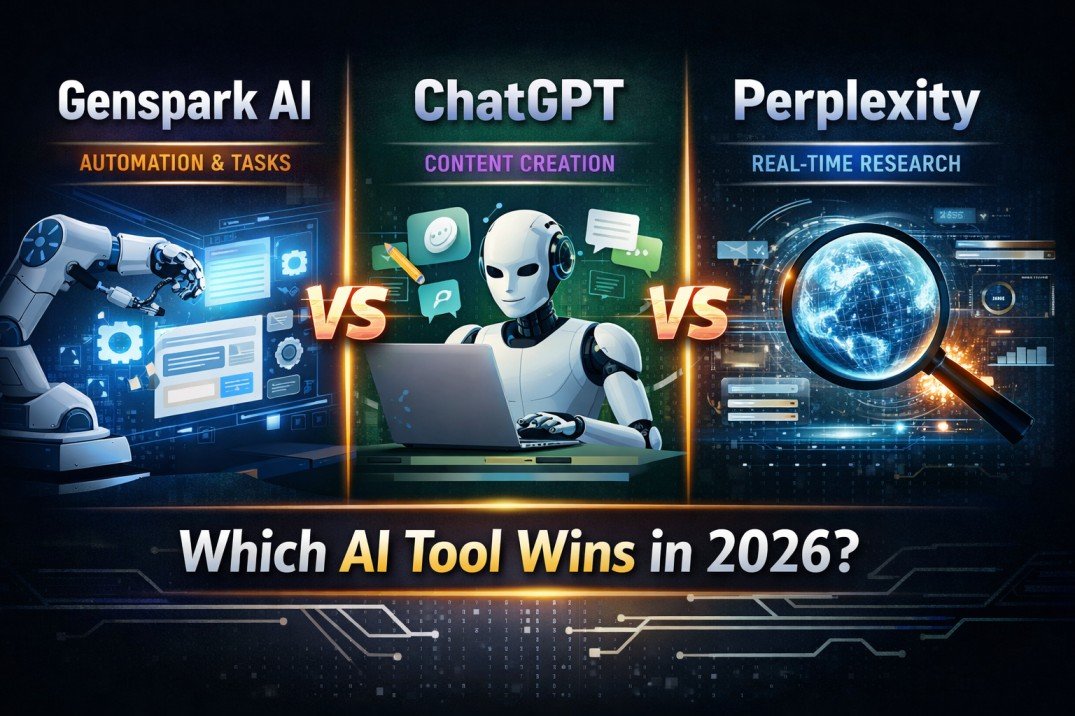
Artificial intelligence tools have evolved rapidly, and by 2026, the competition is no longer just about who gives the best answer. It’s about who can think, act, research, and execute tasks most effectively. Three major players dominate this space today: Genspark AI, ChatGPT, and Perplexity AI.
Each of these tools represents a different philosophy of AI:
- Genspark → Agent-first AI (does tasks)
- ChatGPT → Generation-first AI (creates content)
- Perplexity → Search-first AI (finds truth)
This article explores their features, strengths, weaknesses, real-world performance, and ultimately answers the big question: Which AI tool wins in 2026?
Table of Contents
Toggle1. The Evolution of AI Tools in 2026
The AI landscape has shifted dramatically. Earlier, users asked questions and received answers. Now, they expect end-to-end solutions.
According to recent analysis, the competition has moved from accuracy to task completion and automation .
This shift explains why these three tools are so different:
| Tool | Core Philosophy |
|---|---|
| Genspark | AI agents that complete tasks |
| ChatGPT | Conversational AI for creation |
| Perplexity | Real-time AI search engine |
Let’s break them down one by one.
2. Genspark AI: The Rise of Autonomous AI Agents
What is Genspark?
Genspark is not just another chatbot—it’s an AI agent engine designed to do things for you, not just talk about them.
It uses multiple AI systems simultaneously, selecting the best tools for each task and even cross-checking results for accuracy .
Key Strengths
1. Task Execution (Biggest Advantage)
Genspark can:
- Build websites
- Create presentations
- Generate reports
- Automate workflows
- Even simulate phone calls
Unlike ChatGPT, which often requires multiple prompts, Genspark completes workflows autonomously .
2. Multi-AI Collaboration
Instead of relying on a single model, Genspark:
- Uses multiple AI systems
- Cross-verifies outputs
- Produces more structured results
This leads to higher reliability in research-heavy tasks.
3. Deep Research Capabilities
Genspark generates comprehensive “Spark Pages”:
- Multi-source summaries
- Structured insights
- Organized outputs
It often outperforms traditional AI tools in complex research scenarios .
Weaknesses
- Less polished interface
- Credit-based pricing can be limiting
- Not ideal for casual conversations
- Learning curve is higher
Best Use Cases
- Business automation
- Deep research projects
- Startup founders / solopreneurs
- Workflow-heavy tasks
3. ChatGPT: The All-Rounder AI King
What is ChatGPT?
ChatGPT remains the most versatile AI assistant in 2026, widely used across writing, coding, productivity, and brainstorming.
It is considered a general-purpose AI tool for everyday tasks .
Key Strengths
1. Best for Content Creation
ChatGPT dominates in:
- Blog writing
- Storytelling
- Social media content
- Marketing copy
It is widely regarded as the best creative AI tool .
2. Conversational Intelligence
ChatGPT excels in:
- Natural conversations
- Context retention
- Multi-turn dialogue
This makes it ideal for:
- Brainstorming
- Coaching
- Learning
3. Coding & Problem Solving
ChatGPT is strong in:
- Debugging
- Writing code
- Explaining concepts
It remains a top choice for developers.
4. Versatility
ChatGPT can handle:
- Writing
- Coding
- Planning
- Explaining
- Translating
That’s why it’s often called the “AI Swiss Army knife.”
Weaknesses
- Can hallucinate facts
- Not always up-to-date
- Requires prompting skill
- Less strong in real-time research
Best Use Cases
- Content creators
- Students
- Developers
- General users
4. Perplexity AI: The Research Powerhouse
What is Perplexity?
Perplexity is an AI-powered search engine focused on delivering:
- Accurate answers
- Real-time information
- Verified sources
It is fundamentally retrieval-first, unlike ChatGPT’s generative approach .
Key Strengths
1. Real-Time Research with Citations
Perplexity:
- Pulls live web data
- Shows sources
- Minimizes hallucinations
This makes it ideal for:
- Journalists
- Researchers
- Students
2. Speed & Clarity
Perplexity provides:
- Short, direct answers
- Clean summaries
- Quick insights
It reduces the need to browse multiple websites.
3. Accuracy
Because it relies on real sources:
- Answers are more reliable
- Easier to verify
In many tests, it outperforms ChatGPT in research tasks .
Weaknesses
- Limited creativity
- Not ideal for long-form writing
- Less conversational depth
- Shorter responses
Best Use Cases
- Academic research
- Fact-checking
- News updates
- Data-driven decisions
5. Head-to-Head Comparison
Core Differences
| Feature | Genspark | ChatGPT | Perplexity |
|---|---|---|---|
| Core Type | AI Agent | Conversational AI | AI Search Engine |
| Strength | Task execution | Content creation | Research accuracy |
| Data Source | Multi-model + web | Trained models + tools | Real-time web |
| Creativity | Medium | High | Low |
| Accuracy | High | Medium | Very High |
| Automation | Excellent | Limited | Low |
| Ease of Use | Medium | Very Easy | Easy |
Performance Insights
- ChatGPT wins in versatility and creativity
- Perplexity wins in factual research
- Genspark wins in automation and execution
In real-world testing, ChatGPT often outperforms in creativity and usability, while Perplexity dominates real-time accuracy .
6. Use Case Breakdown: Which One Should You Use?
For Students
- Research → Perplexity
- Writing essays → ChatGPT
- Projects → Genspark
For Content Creators
- Blog writing → ChatGPT
- Research → Perplexity
- Automation → Genspark
For Businesses
- Automation → Genspark
- Communication → ChatGPT
- Market research → Perplexity
For Developers
- Coding → ChatGPT
- Documentation → Perplexity
- Workflow automation → Genspark
7. The Future: AI Agents vs AI Assistants vs AI Search
The biggest shift in 2026 is clear:
AI is moving from answers → actions
- Perplexity = “Here’s the answer”
- ChatGPT = “Here’s a detailed explanation”
- Genspark = “I’ve completed the task for you”
Genspark represents the future of agentic AI, where tools don’t just assist but execute entire workflows .
8. Final Verdict: Which AI Tool Wins?
Winner Depends on Your Use Case
There is no single “best” AI tool—only the best tool for your needs.
Best Overall: ChatGPT
- Most versatile
- Best for everyday use
- Strong across multiple domains
Best for Research: Perplexity
- Most accurate
- Real-time information
- Source-backed answers
Best for Automation: Genspark
- Executes tasks
- Saves time
- Ideal for power users
9. The Smart Strategy (Pro Tip)
The real winner in 2026 is not choosing one tool—but combining them:
- Use Perplexity for research
- Use ChatGPT for creation
- Use Genspark for execution
This combination gives you a complete AI workflow:
Find → Think → Create → Execute
Conclusion
The AI race in 2026 isn’t about replacing one tool with another—it’s about understanding their roles.
- ChatGPT remains the king of creativity and versatility
- Perplexity dominates in truth and research
- Genspark leads the future with automation and AI agents
Instead of asking “Which AI wins?”, the better question is:
“Which AI should I use for this task?”
Because in 2026, the smartest users aren’t loyal to one AI—they leverage all three strategically.
FAQ
What is the main difference between Genspark AI, ChatGPT, and Perplexity?
The biggest difference lies in their core purpose:
- Genspark AI focuses on executing tasks using AI agents
- ChatGPT specializes in content creation and conversation
- Perplexity is designed for real-time research with cited sources
Which AI tool is best for content writing in 2026?
ChatGPT is the best choice for content writing. It excels at:
- Blog posts
- Copywriting
- Storytelling
- Social media content
It produces more natural, engaging, and creative text compared to the others.
Is Perplexity better than ChatGPT for research?
Yes, in many cases. Perplexity is better for research because:
- It provides real-time information
- It includes citations and sources
- It reduces hallucinations
However, ChatGPT is better for explaining and expanding on topics.
What makes Genspark AI different from other AI tools?
Genspark stands out because it acts as an AI agent, meaning it can:
- Complete tasks automatically
- Build workflows
- Generate full outputs (like reports or presentations)
It focuses on doing, not just answering.
Which AI is best for students?
- Research → Perplexity
- Assignments & writing → ChatGPT
- Projects & automation → Genspark
Students benefit most by combining all three tools.
Is Genspark AI better than ChatGPT?
Not necessarily—it depends on your needs:
- Choose Genspark for automation and task execution
- Choose ChatGPT for writing, learning, and conversation
They serve different purposes rather than competing directly.
Which AI tool is best for business use?
For businesses:
- Genspark → automation and workflows
- ChatGPT → communication and content
- Perplexity → research and insights
Companies often use all three together for maximum efficiency.