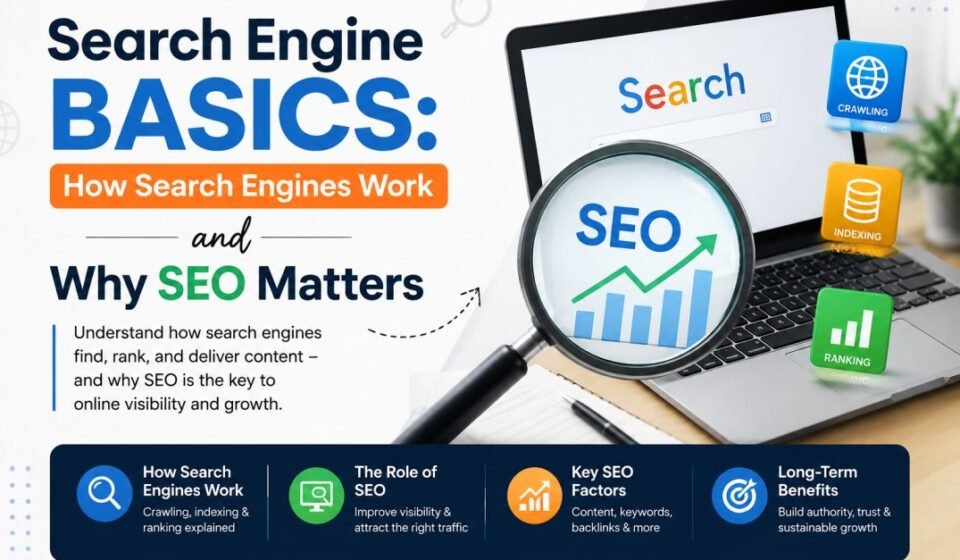
Search Engine Basics: How Search Engines Work and Why SEO Matters
Search engines have become one of the most important tools on the internet. Whether people want to find information, compare products, discover local businesses, read news, learn something new, or solve a problem, they usually begin with a search query. Understanding search engine basics is therefore essential for website owners, bloggers, marketers, students, and businesses that want to build a strong online presence.
Search engines such as Google, Bing, DuckDuckGo, and Yahoo process enormous amounts of information every day. They discover web pages, analyze their content, store useful information in an index, and then rank relevant pages when someone performs a search.
For website owners, understanding this process is the foundation of search engine optimization (SEO). SEO helps websites become easier for search engines to discover, understand, and rank while also providing a better experience for users.
In this guide, we will explain the fundamentals of search engines, including crawling, indexing, ranking, search intent, keywords, SEO, technical optimization, backlinks, and user experience.
What Is a Search Engine?
A search engine is an online system that helps users find information available on the internet. Instead of manually visiting thousands of websites, users can enter a query and receive a list of relevant results.
Google is the most widely recognized search engine, but it is not the only one. Other search platforms include Bing, DuckDuckGo, Yahoo, and several specialized search systems.
A search engine generally performs three major functions:
- Discovering web pages
- Storing and understanding information
- Ranking relevant pages for search queries
These processes are commonly described as crawling, indexing, and ranking.
Understanding these three concepts is one of the most important parts of search engine basics.
How Do Search Engines Work?
Search engines use automated systems and algorithms to process billions of web pages. When a new page is published, search engines need to discover it before it can potentially appear in search results.
The basic process can be divided into three stages:
- Crawling
- Indexing
- Ranking
Each stage has a different purpose.
Crawling
Crawling is the process through which search engine bots discover web pages.
Search engines use automated programs called crawlers, spiders, or bots. For example, Google uses Googlebot to discover and crawl content across the web.
A crawler can discover pages through:
- Internal links
- External links
- XML sitemaps
- Previously known URLs
- Submitted URLs
Once a crawler discovers a page, it can examine the page content and follow links to discover additional URLs.
This means website structure is important. A page that is difficult to reach through internal links may be harder for search engines to discover efficiently.
Indexing
After crawling a page, a search engine may analyze and store information about that page in its index.
The search index can be thought of as a massive organized database containing information about web pages.
During indexing, search engines may analyze elements such as:
- Page content
- Text
- Headings
- Images
- Links
- Metadata
- Structured information
- Page relationships
However, crawling does not automatically guarantee indexing. Search engines decide whether and how content should be included in their index.
For SEO, it is therefore important to make important pages accessible, technically sound, and useful.
Ranking
Ranking is the process of determining which indexed pages should appear for a particular search query and in what order.
When someone enters a query, the search engine evaluates relevant indexed pages and uses numerous signals and systems to determine which results are most useful.
Factors can include relevance, content quality, authority, links, technical performance, usability, and how well the page satisfies the searcher’s intent.
The goal is not simply to place pages containing a keyword at the top. Modern search systems attempt to understand the meaning behind a query and identify content that best answers the user’s needs.
What Is Search Engine Optimization?
Search Engine Optimization (SEO) is the practice of improving a website and its content to increase its visibility in organic search results.
SEO involves much more than adding keywords to an article.
A complete SEO strategy can include:
- Keyword research
- Search intent analysis
- Content optimization
- Technical SEO
- Internal linking
- Website architecture
- Mobile optimization
- Page speed improvements
- Image optimization
- Structured data
- Digital PR and link earning
- Content updates
- User experience improvements
The purpose of SEO is to help search engines understand a website while making the website more useful to visitors.
Why Are Keywords Important in SEO?
Keywords are words or phrases people use when searching for information.
For example, someone interested in learning SEO might search for:
- search engine basics
- how search engines work
- what is SEO
- search engine crawling
- search engine indexing
- Google ranking factors
- SEO basics for beginners
- how to improve search rankings
Keyword research helps website owners understand what their target audience is looking for.
However, successful SEO is not about repeating a keyword dozens of times. Excessive keyword repetition can make content unnatural and reduce readability.
A better approach is to understand the main topic and cover related concepts naturally.
For example, an article targeting search engine basics can naturally discuss crawling, indexing, ranking, search algorithms, search intent, SEO, keywords, backlinks, and technical SEO.
This creates topical depth without relying on keyword stuffing.
What Is Search Intent?
Search intent refers to the reason behind a user’s search query.
Understanding search intent is an important part of modern SEO.
There are several common types of search intent.
Informational Intent
The user wants to learn something.
Examples include:
- What is search engine optimization?
- How do search engines work?
- What is crawling?
- What is indexing?
For informational searches, detailed educational content is usually appropriate.
Commercial Investigation
The user is researching options before making a decision.
Examples include:
- Best SEO tools
- SEO agency comparison
- Best keyword research software
These searches often require comparison pages, reviews, guides, and detailed evaluations.
Transactional Intent
The user is ready to take an action, such as purchasing a product or hiring a service.
Examples include:
- Buy SEO software
- Hire an SEO consultant
- SEO services near me
Navigational Intent
The user wants to reach a specific website, brand, or page.
Examples include searches for a company name or website name.
Understanding intent helps content creators produce pages that actually satisfy users rather than simply targeting keywords.
What Are Search Engine Ranking Factors?
Search engines use many signals and systems when determining search results. No single factor guarantees a top position.
Some important areas of SEO include content relevance, quality, website authority, technical accessibility, links, and user experience.
Content Quality
High-quality content should provide genuine value to the reader.
Useful content should generally be:
- Accurate
- Relevant
- Original
- Clearly organized
- Easy to understand
- Comprehensive enough for the topic
- Written for people rather than search engines
Simply producing a long article does not automatically make it high quality. A 1,500-word article that answers the user’s question effectively can be more useful than a 4,000-word page filled with unnecessary information.
Website Authority
Authority can develop through strong content, reputation, mentions, links, expertise, and consistent publishing.
A new website may take time to establish credibility, while established websites can have stronger signals and broader topical coverage.
This is why SEO should be viewed as a long-term process rather than a quick ranking trick.
Backlinks
A backlink is a link from another website to your website.
Quality backlinks can help search engines discover content and can contribute to a site’s authority.
However, the quality and relevance of links matter. Building large numbers of low-quality or manipulative links is not a sustainable SEO strategy.
A better approach is to earn relevant links through:
- Original research
- Useful resources
- Expert contributions
- Digital PR
- High-quality content
- Industry relationships
Mobile Friendliness
A website should work properly on smartphones, tablets, and desktop devices.
Mobile users expect pages to load properly and content to be easy to read without excessive scrolling or zooming.
Responsive design is therefore an important part of modern website optimization.
Page Experience and Performance
Website performance affects how easily users can interact with a page.
Important considerations include:
- Loading performance
- Visual stability
- Interactivity
- Mobile usability
- HTTPS security
- Easy navigation
Improving performance can create a better experience for visitors and can also support overall SEO efforts.
What Is Technical SEO?
Technical SEO focuses on the technical aspects of a website that help search engines crawl, understand, and index its pages.
Important technical SEO areas include:
XML Sitemap
An XML sitemap provides search engines with information about important URLs on a website.
It can help search engines discover pages more efficiently, especially on large or frequently updated websites.
Robots.txt
The robots.txt file provides instructions to crawlers about which areas of a website they may or may not access.
It should be configured carefully because incorrect directives can unintentionally prevent important pages from being crawled.
Canonical URLs
Canonical tags can help indicate the preferred version of a page when multiple URLs contain similar or duplicate content.
This can be particularly useful for websites with filtering, sorting, tracking parameters, or other URL variations.
Internal Linking
Internal links connect pages within the same website.
A strong internal linking strategy can help:
- Users discover related content
- Search engines discover pages
- Distribute internal authority
- Establish topic relationships
- Improve website navigation
For a website focused on search engine education, articles about crawling, indexing, ranking, algorithms, and SEO can be connected through relevant internal links.
What Is a Search Engine Algorithm?
A search engine algorithm is a collection of systems and processes used to analyze information and provide relevant search results.
Search engines continuously improve their systems because the internet changes constantly and users expect increasingly useful results.
Modern search systems can interpret language, context, relationships between concepts, and the likely intent behind queries.
This means SEO has evolved beyond simple keyword matching.
Instead of asking only, “Does this page contain the keyword?”, search systems can consider whether the page provides a useful answer and whether it is relevant to the overall query.
Search Engine Results Pages Explained
A Search Engine Results Page, commonly called a SERP, is the page displayed after a user performs a search.
A modern SERP can contain different types of results, including:
- Organic listings
- Paid advertisements
- Featured snippets
- Local results
- Images
- Videos
- News results
- Related questions
- Other specialized search features
The appearance of a SERP depends on the query.
For example, a search for a restaurant may produce local business information, while a question may trigger an informational result or featured answer.
Understanding SERPs helps SEO professionals identify opportunities beyond traditional blue links.
Organic Search vs Paid Search
Organic search results are unpaid listings that appear because search engines consider them relevant to a user’s query.
Paid search results are advertisements purchased through advertising platforms.
SEO focuses primarily on organic visibility, while paid search focuses on advertising.
Both approaches can be useful for businesses.
SEO can provide long-term organic visibility, while paid advertising can provide immediate exposure for targeted queries.
How to Improve Search Engine Rankings
There is no guaranteed shortcut to the top of search results, but several fundamental practices can improve a website’s SEO foundation.
Create Helpful Content
Start by understanding what your audience wants to know.
Instead of writing content simply because a keyword has search volume, identify the problem behind the query and provide a useful solution.
Optimize Page Titles and Headings
Use clear page titles and headings that accurately describe the content.
A logical heading structure also improves readability.
Use one primary H1 and organize supporting sections with H2, H3, and H4 headings where appropriate.
Improve Internal Linking
Connect related articles using descriptive and relevant anchor text.
This helps users move between related topics and gives search engines additional context about the relationship between pages.
Improve Website Speed
Compress unnecessary resources, optimize images, use efficient hosting, and reduce technical elements that unnecessarily slow down pages.
Make Content Easy to Read
Use short paragraphs, descriptive headings, lists, examples, and clear explanations.
Good readability benefits both users and content discoverability.
Keep Important Content Updated
Information can become outdated, especially in areas such as SEO, technology, digital marketing, and search engine algorithms.
Review important articles periodically and update outdated information when necessary.
Common Search Engine Optimization Mistakes
Many websites struggle with SEO because they focus on shortcuts instead of fundamentals.
Common mistakes include:
Keyword Stuffing
Repeating the same keyword unnaturally can make content difficult to read.
Use keywords naturally and focus on covering the topic comprehensively.
Duplicate Content
Publishing substantially duplicated pages can create confusion and reduce the uniqueness of a website’s content.
Ignoring Technical SEO
Even excellent content can struggle if important pages cannot be crawled or indexed properly.
Building Low-Quality Backlinks
A large number of irrelevant links does not necessarily create a strong website.
Focus on relevance, quality, and genuine authority.
Writing Only for Search Engines
Content should ultimately serve people.
A page that is optimized for algorithms but frustrating for readers is unlikely to create sustainable success.
Why Search Engine Basics Matter for Beginners
Learning search engine basics gives beginners a foundation for understanding SEO.
Instead of memorizing isolated SEO techniques, beginners can understand how different parts of search work together.
For example:
Crawling → Indexing → Ranking → Organic Visibility → Traffic
If search engines cannot discover a page, indexing can become difficult. If a page is not indexed, it generally cannot appear in ordinary organic search results. If it is indexed, ranking systems determine when and where it may appear.
This simple framework helps beginners understand why technical SEO, content, keywords, internal links, and authority all matter.
Search Engine Basics for Businesses
Businesses increasingly depend on search visibility to reach potential customers.
A well-optimized website can help businesses attract people who are actively searching for their products, services, solutions, or information.
For example, a local business may optimize pages around service-related searches, while an online store may create product and category pages.
Businesses should focus on building a complete search presence rather than chasing individual keywords.
That means developing useful content, optimizing important landing pages, improving technical performance, earning relevant authority, and understanding the needs of their target audience.
Final Thoughts
Understanding search engine basics is the starting point for anyone interested in SEO and online visibility.
Search engines discover websites through crawling, organize information through indexing, and determine the order of search results through ranking systems. SEO helps website owners make their content, structure, and technical setup easier to understand while improving the experience for visitors.
The most sustainable approach is to focus on useful content, relevant keywords, search intent, technical SEO, internal linking, website performance, authority, and trust.
Search engines will continue to evolve, but the fundamental objective remains simple: help users find useful and relevant information as efficiently as possible.
If you understand crawling, indexing, ranking, search intent, keywords, and SEO fundamentals, you have a strong foundation for learning more advanced search engine optimization strategies.