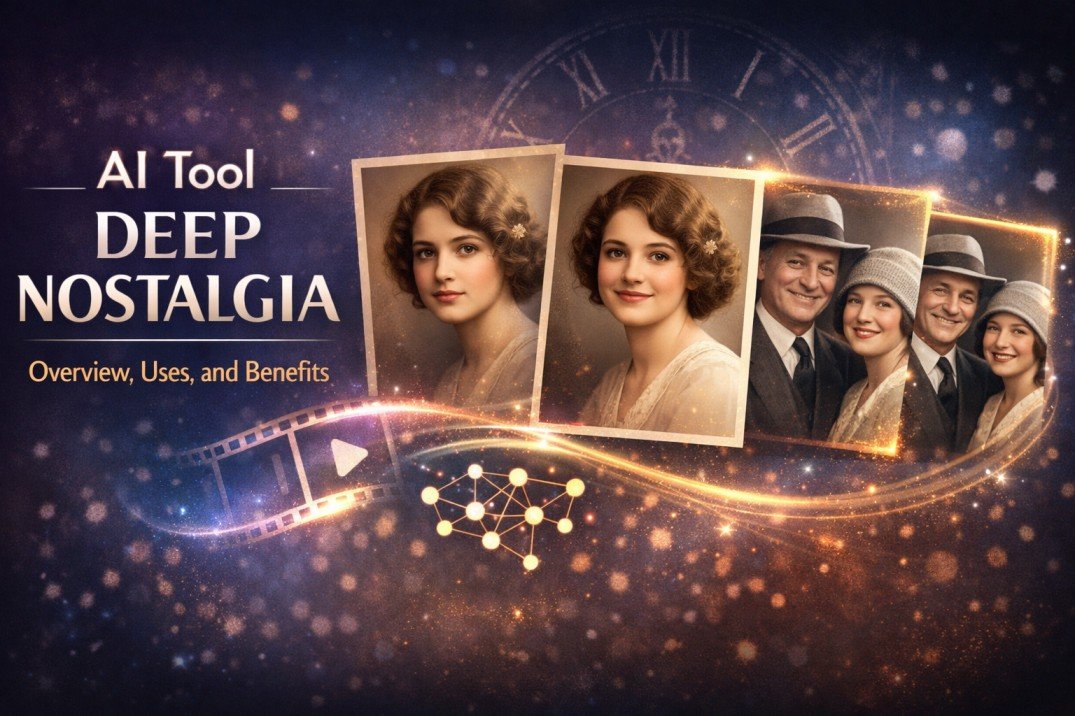
AI Tool Deep Nostalgia – Overview, Uses, and Benefits
The digital preservation of history underwent a paradigm shift with the release of Deep Nostalgia™. Developed by MyHeritage in collaboration with D-ID, this AI-powered tool allows users to animate the faces in still photographs, creating high-quality, realistic video clips of ancestors and historical figures.
In 2026, the tool remains a cornerstone of “algorithmic nostalgia,” evolving from a viral sensation into a sophisticated suite for genealogical storytelling.
1. Overview of Deep Nostalgia
Deep Nostalgia is an AI-based feature integrated into the MyHeritage genealogy platform. It uses deep learning algorithms to apply pre-recorded “driver” videos—sequences of human facial movements like blinking, smiling, and head-tilting—onto static portraits.
How the Technology Works
The core of Deep Nostalgia is Video Re-enactment Technology. When a user uploads a photo, the AI performs three primary steps:
-
Facial Detection: It identifies one or more faces within the image.
-
Enhancement: Using the MyHeritage Photo Enhancer, the AI upscales the resolution and sharpens the facial features to ensure the animation is crisp.
-
Mapping and Animation: The system selects a “driver” (a master video of a real person moving) that best matches the orientation of the face in the photo. It then “stitches” these movements onto the static image, creating a seamless 15-second loop.
2. Key Features and Capabilities in 2026
While the original version focused on simple blinks and smiles, the 2026 version of Deep Nostalgia and its successor features (like LiveMemory™) have expanded significantly.
A. Diverse Animation Drivers
Users are no longer limited to a single “blink and nod” sequence. The tool now offers over 20 different animation styles, including:
-
Compassion: A gentle, empathetic look.
-
Joy: A broad, toothy smile.
-
The Kiss: A subtle blowing of a kiss.
-
The Look: A thoughtful side-glance.
B. Automated Image Restoration
Deep Nostalgia doesn’t just animate; it heals. Before the video is generated, the AI automatically repairs scratches, removes “noise” from old film grain, and colorizes black-and-white photos if the user chooses.
C. Multi-Face Support
Early versions required users to animate one face at a time. The current platform allows for the detection of multiple individuals in a single family portrait, letting users toggle between different ancestors to bring an entire family tree to life.
3. Primary Uses of Deep Nostalgia
The tool serves various purposes ranging from personal emotional connection to professional historical preservation.
Genealogy and Family History
For many, genealogy can feel like a dry collection of names and dates. Deep Nostalgia transforms these records into a living history. It is used to:
-
Enrich Family Trees: Making digital family trees interactive and engaging for younger generations.
-
Memorials: Creating moving tributes for funerals or anniversary celebrations.
-
Storytelling: Providing a visual “anchor” for family stories passed down through oral tradition.
Educational and Museum Exhibits
Museums and educators use the tool to make history tangible. By animating historical figures—such as Abraham Lincoln or Marie Curie—students can feel a more direct human connection to the past, making lessons more memorable.
Social Media and Content Creation
The “creepy but cool” factor of Deep Nostalgia makes it a staple for viral content. Users share animated versions of famous paintings (like the Mona Lisa) or long-lost celebrities, sparking discussions about AI and the nature of memory.
4. The Benefits: Why It Matters
Beyond the novelty of a moving image, Deep Nostalgia provides several tangible benefits:
-
Emotional Resonance: Seeing a deceased loved one “move” can provide a powerful sense of closure or connection that a static photo cannot replicate.
-
Accessibility of Tech: The tool is designed for non-technical users. There is no need for video editing skills or expensive hardware; the heavy lifting is done in the cloud.
-
Preservation of Legacy: By converting fragile physical photos into high-definition animated videos, the tool ensures that family legacies are preserved in modern digital formats.
5. Ethical Considerations and the “Uncanny Valley”
Despite its popularity, Deep Nostalgia is a frequent subject of ethical debate.
The “Uncanny Valley” Effect
Some users find the animations “creepy” because they fall into the Uncanny Valley—a point where an AI-generated human looks almost real, but just “off” enough to cause a sense of unease. Because the AI is guessing how a person moved based on a template, the movements may not accurately reflect the actual personality of the subject.
Ethical Use of the Deceased
There is an ongoing conversation regarding post-mortem privacy. Is it ethical to animate someone who cannot give consent? MyHeritage has addressed this by:
-
Restricting Audio: The tool does not automatically generate speech (to avoid “deepfake” scams).
-
Focusing on Heritage: The platform encourages the use of the tool for historical and familial purposes rather than parody.
6. Comparison: Deep Nostalgia vs. Alternatives (2026)
| Feature | Deep Nostalgia (MyHeritage) | D-ID (Creative Reality) | Dreamina (TikTok/CapCut) |
| Best For | Genealogy & Ancestors | Business & Avatars | Creative Storytelling |
| Animation Quality | Highly Realistic/Subtle | High (Lip-Sync focused) | Cinematic/Stylized |
| Ease of Use | 1-Click | Moderate | 1-Click |
| Audio Support | Limited (No Speech) | Full (Text-to-Speech) | Full (AI Voice Cloning) |
Conclusion
Deep Nostalgia has redefined our relationship with the past. It serves as a bridge between the static world of the 19th and 20th centuries and the dynamic, AI-driven world of today. Whether viewed as a touching tribute or a technological curiosity, it remains the most accessible way to “meet” the people who came before us.