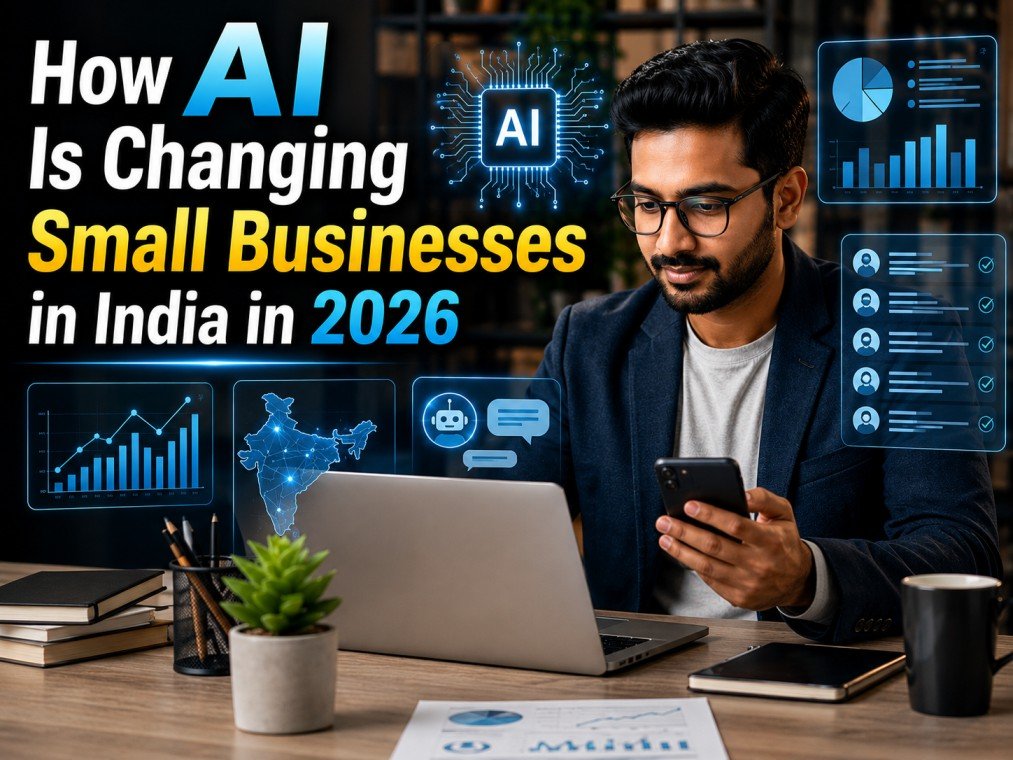
Artificial intelligence is quickly becoming part of everyday business operations.
Large companies have been investing in AI for years, but the technology is becoming increasingly accessible to small businesses, freelancers, retailers, service providers and entrepreneurs.
Today, a small business can use AI to generate content ideas, answer common customer questions, analyze information, create marketing material and automate repetitive tasks.
The biggest opportunity is not simply replacing human work.
It is using AI to help business owners save time and focus more attention on customers, strategy and growth.
Table of Contents
ToggleWhat Does AI Mean for a Small Business?
For a small business, AI can be viewed as a productivity technology.
Instead of thinking about AI only as advanced machine learning, business owners can start with practical applications such as:
- Content creation
- Customer support
- Market research
- Email writing
- Social media planning
- Data analysis
- Lead management
- Document processing
- Translation
- Business research
The right use case depends on the type of business.
Why Small Businesses Are Adopting AI
Small businesses often operate with limited time, staff and resources.
An owner may have to handle several responsibilities at the same time.
One person might be responsible for:
- Marketing
- Customer communication
- Sales
- Administration
- Research
- Content
- Operations
AI can assist with some repetitive tasks, allowing the business owner to spend more time on activities that require human judgment.
AI for Business Marketing
Marketing is one of the easiest areas for a small business to experiment with AI.
Content Ideas
AI can help generate ideas for:
- Blog posts
- Social media posts
- Videos
- Email campaigns
- FAQs
- Product explanations
The business should still review and personalize the content before publishing.
Social Media Planning
AI can help organize content calendars and suggest post variations.
For example, a local restaurant could create content around:
- New menu items
- Customer questions
- Seasonal offers
- Behind-the-scenes content
- Local events
The final content should reflect the restaurant’s real products and experiences.
Search Marketing
AI can help businesses research search topics and organize content ideas.
However, businesses should avoid publishing large quantities of generic AI-generated pages simply to target search engines.
Useful content should provide genuine information and value.
AI for Customer Service
Customer service is another practical application.
AI-powered chat systems can help answer common questions about:
- Opening hours
- Products
- Services
- Delivery
- Booking
- Pricing
- Basic policies
Human Support Still Matters
AI should not necessarily handle every customer conversation.
Complex complaints, sensitive situations and important business decisions often require a human representative.
A good system can use AI for routine questions while allowing customers to reach a person when necessary.
AI for Sales
Sales teams can use AI to organize information and improve productivity.
Potential applications include:
- Lead summaries
- Follow-up reminders
- Email drafting
- Customer research
- Sales note organization
- Proposal assistance
AI can help prepare information, but sales decisions should remain under human control.
AI for Small Business Content Creation
Content production can consume significant amounts of time.
AI can assist with:
- First drafts
- Headlines
- Product descriptions
- Social captions
- Video scripts
- FAQ ideas
- Content outlines
Why Human Editing Matters
AI-generated content can contain errors, outdated information or generic statements.
Businesses should review important facts and add their own expertise, examples and experience.
This is particularly important for financial, legal, medical or technical information.
AI for Business Research
Small businesses can use AI to organize research more quickly.
For example, an entrepreneur researching a new market may use AI to help structure questions around:
- Competitors
- Customer needs
- Pricing
- Market trends
- Product features
- Business models
AI should be treated as a research assistant rather than the final source of truth.
Important facts should be verified using reliable sources.
AI for Data Analysis
Businesses often have useful data but limited time to analyze it.
AI-assisted analysis can help identify patterns in:
- Sales
- Website traffic
- Customer inquiries
- Marketing campaigns
- Inventory
- Expenses
For example, a retailer could examine which products sell more frequently during particular periods.
The quality of the analysis depends heavily on the quality and completeness of the underlying data.
AI for Email and Communication
Business owners spend considerable time writing emails and messages.
AI can help draft:
- Customer replies
- Meeting summaries
- Follow-up emails
- Sales messages
- Internal communications
- Business proposals
A human should review important communications before sending them.
AI for Small Business Administration
Administrative work can include many repetitive tasks.
AI and automation tools can potentially assist with:
- Document organization
- Meeting notes
- Summaries
- Scheduling assistance
- Data entry workflows
- Standard responses
Automation should be introduced carefully, particularly when personal or confidential information is involved.
AI for Local Businesses
AI can be particularly useful for local businesses.
A local business can use AI to support:
- Local content ideas
- Review-response drafts
- FAQ creation
- Service-page planning
- Social media content
- Customer communication
For example, a local salon could use AI to organize common customer questions into a useful FAQ section.
The actual business information should always come from the business itself.
AI for Retail Businesses
Retailers can explore AI for:
- Product descriptions
- Customer questions
- Inventory analysis
- Sales reports
- Promotional content
- Product recommendations
AI can become more useful when it is connected to accurate business data.
AI for Freelancers
Freelancers can use AI as a productivity assistant.
Common applications include:
- Proposal drafts
- Research
- Content outlines
- Meeting summaries
- Project planning
- Client communication
- First drafts
The freelancer’s expertise remains the main source of value.
AI can accelerate the process without replacing professional judgment.
AI for Startups
Startups can use AI during different stages of development.
Idea Research
AI can help organize market questions and competitor research.
Product Development
AI can support brainstorming, documentation and certain development tasks.
Marketing
AI can assist with content and campaign planning.
Customer Support
AI can handle some repetitive questions.
However, startups should avoid adopting AI simply because it is fashionable.
The technology should solve a measurable business problem.
AI and Business Productivity
One of the biggest benefits of AI may be time savings.
A business owner could use AI to turn a long meeting transcript into a concise list of:
- Decisions
- Tasks
- Deadlines
- Questions
This can reduce administrative effort.
The output should still be reviewed because AI systems can misunderstand context.
AI Automation for Small Businesses
AI becomes particularly powerful when combined with automation.
For example:
A customer submits an inquiry → the system records it → AI categorizes the request → a standard response is prepared → a team member reviews it → the customer receives a reply.
This type of workflow can reduce repetitive manual work.
Automation should include human review wherever errors could have meaningful consequences.
Risks of Using AI in Business
AI can provide significant benefits, but businesses should also understand the risks.
Incorrect Information
AI can produce inaccurate information.
Privacy
Sensitive business or customer information should not be entered into an AI service without understanding its data policies and the organization’s requirements.
Security
AI tools can introduce new security considerations.
Brand Voice
Generic AI content may make a business sound similar to competitors.
Over-Automation
Automating everything can reduce the human interaction customers value.
How Small Businesses Should Start Using AI
Businesses do not need to adopt dozens of tools immediately.
A simple approach is better.
Step 1: Identify Repetitive Tasks
Find tasks that consume time every week.
Step 2: Choose One Use Case
Start with a specific problem such as content planning or customer FAQs.
Step 3: Test the Workflow
Measure whether AI actually saves time or improves quality.
Step 4: Add Human Review
Create a review process before important information reaches customers.
Step 5: Measure Results
Track:
- Time saved
- Cost
- Customer response
- Output quality
- Productivity
If the tool does not create meaningful value, change the workflow.
Will AI Replace Small Business Employees?
AI is more likely to change many tasks than eliminate every role.
Some repetitive activities may become automated, while employees may spend more time on:
- Customer relationships
- Problem solving
- Creativity
- Strategy
- Sales
- Decision-making
Businesses that use AI effectively may give employees better tools rather than simply reducing staff.
AI Skills Small Business Owners Should Learn
Business owners do not necessarily need advanced programming skills to start using AI.
Useful skills include:
- Writing clear prompts
- Fact-checking AI outputs
- Evaluating AI tools
- Understanding privacy
- Creating simple workflows
- Reviewing generated content
- Using data responsibly
These skills can become increasingly valuable as AI becomes part of everyday business software.
Future of AI for Small Businesses in India
AI adoption among small businesses is likely to continue as tools become easier to use and more affordable.
Future business applications may include more personalized customer communication, automated reporting, AI-powered search, intelligent inventory management and integrated business assistants.
The most successful businesses may not be those that use the most AI.
They may be the businesses that use AI in the right places while maintaining strong human oversight.
Final Thoughts
AI is becoming a practical business tool rather than something limited to large technology companies.
Small businesses in India can use AI for marketing, customer support, research, communication, data analysis, content creation and repetitive administrative work.
The key is to begin with a real business problem.
Choose one task, test an AI-assisted workflow, verify the results and measure the outcome.
AI should support business expertise rather than replace it.
For small businesses, the biggest advantage may ultimately be simple: doing useful work faster while giving more time to customers and growth.
Frequently Asked Questions
How can small businesses use AI?
Small businesses can use AI for marketing, content creation, customer support, research, data analysis, communication, sales assistance and administrative tasks.
Is AI useful for small businesses in India?
Yes. AI can help Indian small businesses improve productivity and support activities such as digital marketing, customer communication, research and content creation.
Can AI replace small business employees?
AI can automate some repetitive tasks, but many roles still require human judgment, creativity, communication and decision-making.
What is the easiest way to start using AI?
Start with one repetitive task, such as creating content ideas, summarizing meetings or drafting routine customer responses.
Is AI-generated business content safe to publish?
AI content should be reviewed for accuracy, originality, relevance and brand quality before publication.
Can AI help with small business marketing?
Yes. AI can assist with content ideas, social media planning, customer research, email drafts and other marketing activities.
Should businesses put customer data into AI tools?
Businesses should understand the AI service’s privacy and data-handling policies before entering confidential or personal information.
Will AI become more important for MSMEs?
AI is likely to become increasingly integrated into business software and workflows, making practical AI skills increasingly useful for MSMEs.