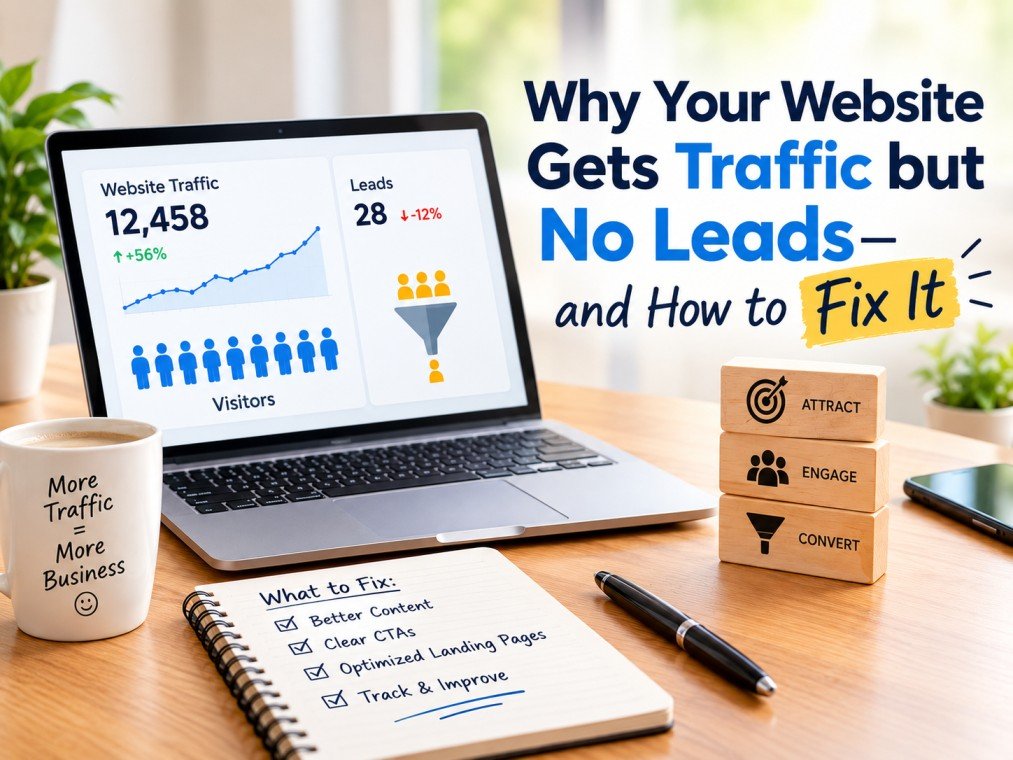
You checked Google Analytics this morning and felt a flicker of pride. Sessions are up. Organic traffic is climbing. Your latest campaign drove a solid spike in visitors.
And yet your inbox is quiet. The contact form sits untouched. Your sales team is asking where the leads went.
This is one of the most common—and most frustrating—problems in digital marketing: traffic without conversions. The good news is that it’s rarely a mystery. It usually comes down to a handful of fixable gaps between what brings people to your site and what makes them act once they’re there. Let’s walk through the most common culprits, and exactly what to do about each one.
Table of Contents
Toggle1. You’re Attracting the Wrong Visitors
Traffic is not the same as qualified traffic. If your content ranks for broad, top-of-funnel keywords, or if your ads target audiences based on vague interest signals, you’ll pull in people who are curious but not close to buying.
Here’s a concrete example: if you sell CRM software and most of your traffic comes from searches like “what is a CRM,” those visitors are still in the learning phase, not the buying phase. They’ll read your blog post, get their answer, and leave. Compare that to someone searching “best CRM for small teams”—that person has already decided they need a solution and is actively comparing options. The intent behind the search matters far more than the volume behind it.
This mismatch often happens because SEO and paid media teams are incentivized to chase traffic numbers rather than pipeline numbers. A blog post that ranks for a high-volume keyword looks like a win on a traffic dashboard, even if it never sends a single qualified lead your way.
How to fix it:
- Audit your top traffic sources in analytics and ask: would this person plausibly want what I sell, right now?
- Shift SEO efforts toward intent-driven, buyer-stage keywords rather than broad, informational ones
- Refine ad targeting to focus on audiences showing purchase intent, not just general interest
- Segment your content strategy by funnel stage, and be honest with your team about which pieces exist to convert versus which exist purely to build awareness
- Track conversion rate by traffic source, not just traffic volume—a smaller, more qualified source often outperforms a larger, generic one
2. There’s No Clear Next Step
Visitors often leave not because they’re uninterested, but because they don’t know what to do next. A page full of information with no clear call to action is a dead end, no matter how good the content is.
Picture this: a visitor reads your entire product page, comes away impressed, and scrolls to the bottom—only to find no obvious way to act. Should they book a demo? Fill out a form? Call someone? Without a clear signpost, most people simply close the tab rather than hunt for the next step themselves.
How to fix it:
- Every page should have one obvious next step—not five competing options fighting for attention
- Make your CTA visually distinct and specific (“Get a Free Quote” beats a generic “Submit”)
- Place CTAs above the fold, and repeat them at natural decision points as the visitor scrolls further down the page
- Avoid CTA fatigue: too many buttons create decision paralysis rather than action
- Match the CTA to the visitor’s likely stage—someone reading an introductory blog post isn’t ready for “Buy Now,” but might respond well to “Download the Guide”
3. Your Value Proposition Isn’t Clear in Seconds
You have roughly 5–8 seconds to answer three questions for a new visitor: What is this? Is it for me? Why should I care? If your homepage or landing page makes people work to figure that out, they’ll bounce before they ever consider converting.
This mistake often happens when companies get too clever with their messaging. “We reshape your future” sounds nice, but it tells a visitor nothing about what you actually do. Contrast that with a headline like “Accounting software built for freelancers”—instantly clear, instantly relevant to the right audience, and instantly disqualifying to the wrong one (which is actually a good thing).
How to fix it:
- Put a clear, benefit-driven headline above the fold—not a clever tagline that requires context to understand
- Support it with one sentence that explains who it’s for and what problem it solves
- Cut jargon. If a smart friend outside your industry wouldn’t understand it in one read, rewrite it
- Test your headline against the “5-second test”: show it to someone unfamiliar with your business and see if they can explain what you do afterward
4. Trust Signals Are Missing
People don’t hand over their email or their money to a website that feels uncertain. If you’re missing the markers that signal legitimacy, visitors will hesitate—and hesitation kills conversions.
This is especially true for B2B and high-ticket purchases, where buyers actively look for social proof before committing to any kind of engagement. If your site has no testimonials, no case studies, no client logos, and no reviews, a visitor’s brain naturally asks: “Is this company even real? Can I trust them?”
How to fix it:
- Add testimonials, case studies, or client logos near your CTAs—not just buried on a separate “About Us” page
- Display real reviews, star ratings, or third-party validation wherever decisions are being made
- Make your contact information, team page, and policies easy to find; hiding this information reads as evasive
- Use secure checkout badges and clear, plain-language privacy statements if you’re collecting sensitive information
- Where possible, quantify your credibility: “Trusted by 4,000+ businesses” carries more weight than a vague claim of expertise
5. Your Forms Are Asking Too Much
Every additional form field is a small tax on conversion. Asking for a phone number, company size, and job title when all you actually need right now is an email address is a common, self-inflicted wound.
Research consistently shows that reducing form fields meaningfully improves conversion rates. Every field you remove reduces friction—and friction is the enemy of action. People are busy, often browsing on mobile, and a long form signals a level of commitment they may not be ready to make yet.
How to fix it:
- Strip forms down to the bare minimum needed for the first step of your funnel
- Use progressive profiling—collect additional information over time as the relationship develops, not all upfront
- Test single-field forms (just email) against your current, longer version and measure the difference
- Make sure forms work flawlessly on mobile, where a growing share of your traffic likely originates
- Avoid unnecessary friction like CAPTCHA overuse, confusing validation errors, or multi-step forms when a single step would do
6. Page Speed and Mobile Experience Are Working Against You
If your page takes more than a few seconds to load, or if it’s clunky on a phone, you’re losing people before your messaging ever has a chance to land. This is especially costly given how much of today’s web traffic comes from mobile devices.
A slow website isn’t just irritating—it also erodes trust. When a page stutters or a button doesn’t respond, visitors subconsciously assume the rest of the business might be just as disorganized. Speed is, in a very real sense, part of your brand impression.
How to fix it:
- Run your site through a page speed testing tool and address the biggest bottlenecks—usually unoptimized images and unnecessary scripts
- Test every conversion path, not just the homepage, on an actual mobile device rather than just a desktop browser resized smaller
- Simplify navigation and increase tap target sizes appropriately for smaller screens
- Compress and lazy-load images so pages render key content quickly, even if secondary visuals load a moment later
- Regularly re-test speed after adding new plugins, scripts, or tracking pixels—these accumulate over time and quietly degrade performance
7. You’re Not Following Up With the Leads You Do Get
Sometimes the leak isn’t on the website at all—it’s in what happens after someone converts. A slow or nonexistent follow-up process can waste the leads you’ve already earned, which is often more painful than never capturing them in the first place.
Imagine someone fills out your form, receives no confirmation email, and three days later gets a call from a sales rep. By then, they may have already moved on to a competitor who responded faster. Speed of follow-up is frequently the difference between winning and losing a deal that was otherwise yours to lose.
How to fix it:
- Set up immediate, automated acknowledgment—at minimum, a confirmation email that sets expectations for next steps
- Aim for a real human response within 24 hours wherever possible; faster is always better
- Use a CRM to track and nurture leads systematically instead of letting them sit in a shared inbox or spreadsheet
- Build a simple lead-scoring system so your team prioritizes the hottest leads first, rather than working strictly by order received
8. Your Messaging Doesn’t Match Your Traffic Source
Another commonly overlooked issue is a mismatch between where traffic comes from and what the landing page actually says. If your ad promises “50% off” but the landing page makes no mention of a discount, visitors immediately lose trust and leave.
Similarly, if your social media post has a casual, conversational tone but the landing page it links to is stiff and overly corporate, that inconsistency creates subtle doubt in the visitor’s mind. Consistency across the entire journey—from the ad or post, to the landing page, to the confirmation message—reinforces trust rather than undermining it.
How to fix it:
- Build dedicated landing pages for each campaign that match the specific promise made in the ad
- Adjust tone and language to match the originating channel rather than using one generic page for all traffic
- Regularly audit whether your ads, emails, and social posts actually align with the landing experience they lead to
- Where budget allows, create separate variants for each major traffic source rather than funneling everyone to the same generic page
Putting It Together: Diagnose Before You Redesign
The instinct when leads dry up is often to redesign the entire website. Resist that urge until you’ve actually diagnosed the problem—a full redesign is expensive, time-consuming, and often addresses symptoms rather than the actual cause. Look at your analytics with these questions in mind:
- Where are visitors landing, and does that match where they should be landing based on your funnel design?
- Where exactly are they dropping off—the homepage, a specific product page, the checkout, or the form itself?
- Are they even seeing a clear call to action, or is it buried below content they never scroll to?
- How long are they staying, and does that duration suggest genuine engagement or confusion?
- Are there specific devices, browsers, or traffic sources where conversion rates are noticeably worse?
Beyond diagnosis, make A/B testing part of your regular process rather than a one-time event. Instead of making one large change and hoping for the best, make smaller, testable changes and let the data guide you—headlines, CTA text, form length, image choices, and even color contrast can all be tested individually to isolate what actually moves the needle.
The Long Game: Conversion Optimization Isn’t a One-Time Project
One final point worth emphasizing: conversion rate optimization (CRO) is not a project you complete once and forget about. As your audience, competitors, and market shift, so do the needs of your website.
The headline that performs well today may lose effectiveness in six months as your market matures or your competitors sharpen their own messaging. The form length that feels right today might be too long for a new, more impatient audience segment you’re trying to reach next quarter. That’s why treating your website’s performance as something to monitor, test, and refine on an ongoing basis—rather than a project with a defined end date—pays off far more over time.
Build a habit of quarterly reviews: revisit your funnel data, retest key pages, and stay alert to shifts in visitor behavior. Small, consistent improvements compound. A website that improves its conversion rate by even a percentage point or two every quarter will, over a year, dramatically outperform one that’s redesigned once and then left untouched.
Conclusion
Traffic is the top of the funnel, not the goal. A website optimized for visits but not for conversions is like a store with a packed parking lot and no employee to greet the customers walking in the door. The fix isn’t more traffic—it’s a clearer, more trustworthy, more frictionless path from arrival to action.
If you work through the eight issues covered here—wrong-audience traffic, unclear next steps, a fuzzy value proposition, missing trust signals, overly demanding forms, poor site speed, weak follow-up, and mismatched messaging—you’ll likely find that the traffic you’re already generating starts showing up exactly where it should: in your pipeline.
Get that path right, and you won’t need to spend another rupee, dollar, or hour chasing more visitors just to stand still. The audience you already have will start doing the work for you.
Need Help Turning Your Traffic Into Leads?
Diagnosing these issues is one thing—fixing them across your website, forms, and marketing funnel is another. If you’d rather not do it alone, Glimmers Point specializes in exactly this problem: turning existing traffic into real, qualified leads.
Glimmers Point builds conversion-focused websites (not templated ones), runs AI-ready SEO and paid campaigns aimed at the right audience, and audits landing pages and funnels for the exact gaps covered in this article—weak CTAs, unclear value propositions, slow load times, and mismatched ad-to-landing-page messaging. Their team has worked with 200+ businesses across India, the US, Canada, Australia, the UAE, the UK, and MENA.
If your website is getting visitors but not leads, it might be worth a second pair of eyes. You can get in touch with Glimmers Point or schedule a free strategy call to find out exactly where your funnel is leaking—and how to fix it.