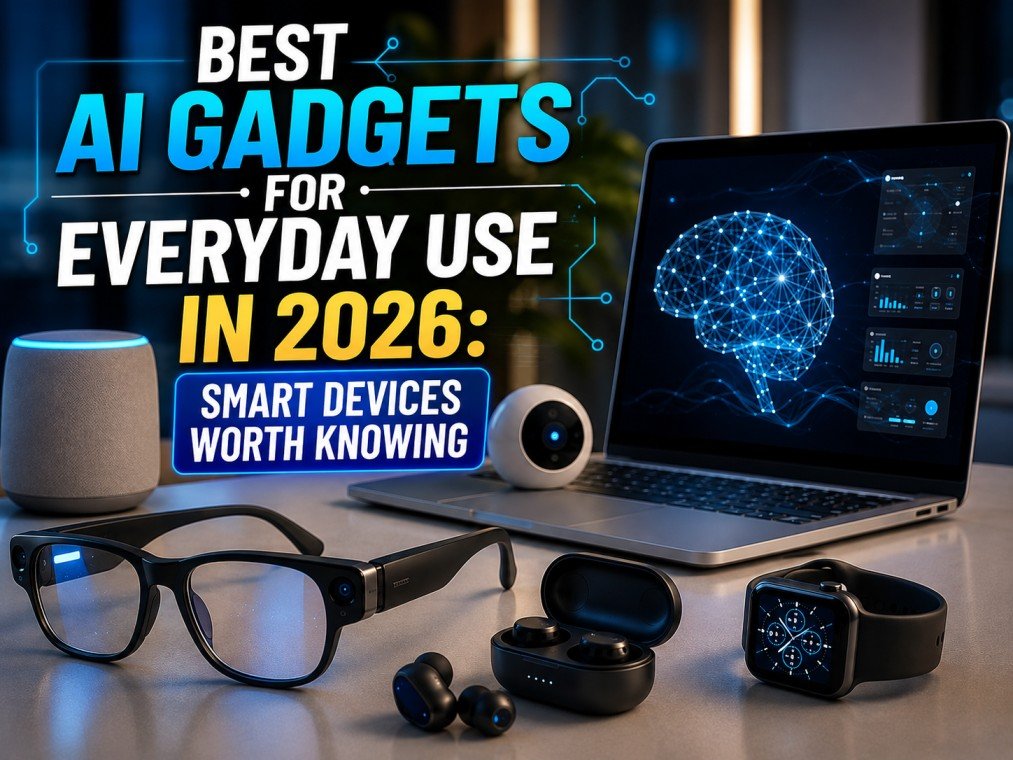
Artificial intelligence is no longer limited to chatbots and software applications.
AI is increasingly becoming part of physical devices that people use at home, at work and while travelling.
From smart glasses and AI-enabled wearables to smart home devices and connected accessories, the gadget market is moving toward technology that can understand context, respond to voice commands and automate everyday tasks.
The best AI gadget is not necessarily the most expensive or technologically advanced product. A useful device should solve a real problem and make everyday activities easier.
Table of Contents
ToggleWhat Are AI Gadgets?
AI gadgets are physical electronic devices that use artificial intelligence or AI-powered features to perform tasks, understand information or provide personalized assistance.
Depending on the device, AI can be used for:
- Voice interaction
- Image recognition
- Translation
- Personal assistance
- Health and fitness tracking
- Smart home automation
- Noise reduction
- Photography
- Content creation
- Navigation
Some devices process AI features directly on the device, while others depend on a connected smartphone or cloud-based services.
Why Are AI Gadgets Becoming Popular?
Smartphones already provide many AI features, but dedicated gadgets can make certain functions more convenient.
For example, a wearable device can provide information without requiring you to constantly take your phone out of your pocket.
A smart home device can automate routine tasks.
An AI-enabled camera can help with image processing and recognition.
The main attraction is therefore convenience.
1. AI Smart Glasses
Smart glasses are one of the most interesting categories in the AI gadget market.
Modern smart glasses can combine cameras, microphones, speakers and AI-powered assistants.
What Can AI Smart Glasses Do?
Depending on the model, features may include:
- Voice commands
- Photography
- Video recording
- Music playback
- Calls
- Translation
- Information assistance
- Hands-free communication
Who Should Consider Smart Glasses?
They may appeal to:
- Travelers
- Content creators
- Technology enthusiasts
- People who want hands-free interaction
Privacy should always be considered when using camera-enabled wearable devices in public spaces.
2. AI Wearable Assistants
AI wearables are designed to provide assistance without relying entirely on a smartphone screen.
These devices can potentially help users interact with AI through voice.
Common Features
- Voice conversations
- Reminders
- Notes
- Information searches
- Notifications
- Personal assistance
The usefulness of an AI wearable depends heavily on battery life, connectivity, software quality and the availability of AI services.
3. AI Smartwatches
Smartwatches have evolved from simple fitness trackers into multifunctional devices.
AI can potentially improve several smartwatch features.
AI Features in Smartwatches
Depending on the product, AI may assist with:
- Fitness insights
- Sleep analysis
- Workout recommendations
- Voice assistance
- Smart notifications
- Health-related data interpretation
Users should remember that consumer wearables are not a replacement for professional medical advice.
4. AI Earbuds
Wireless earbuds are another category where AI features are becoming increasingly useful.
What Can AI Earbuds Offer?
Features can include:
- Active noise cancellation
- Voice assistants
- Real-time translation
- Adaptive sound
- Call noise reduction
- Voice recognition
For commuters and frequent travelers, intelligent audio features can make earbuds more useful than traditional wireless headphones.
5. AI Translation Devices
Language barriers can create challenges when travelling internationally.
AI translation technology can potentially help users communicate across languages.
Useful Situations
Translation gadgets may be useful for:
- Travel
- Tourism
- Business meetings
- International events
- Customer interactions
Smartphone apps already provide many translation functions, so a dedicated device should offer a clear convenience advantage before purchasing.
6. AI Security Cameras
AI is also changing home security.
Modern smart cameras can use AI-based recognition and detection to identify different types of movement.
Possible Features
- Person detection
- Motion alerts
- Activity zones
- Package detection
- Night vision
- Smartphone notifications
AI-powered detection can help reduce unnecessary alerts compared with basic motion detection.
7. AI Smart Home Hubs
Smart home hubs can connect different devices and allow users to control them from one ecosystem.
AI can make interactions more natural.
Instead of using multiple commands, users may be able to describe what they want in a conversational way.
Smart Home Examples
An AI-enabled system may help control:
- Lights
- Fans
- Air conditioners
- Smart TVs
- Security cameras
- Smart plugs
The actual compatibility depends on the devices and ecosystem being used.
8. AI Robot Vacuum Cleaners
Robot vacuum cleaners have already become popular smart-home gadgets.
AI can improve their ability to understand the environment and plan cleaning routes.
Useful Features
Depending on the model, AI-enabled robot vacuums may offer:
- Object recognition
- Room mapping
- Obstacle avoidance
- Automatic scheduling
- Room-specific cleaning
- App control
For busy households, automation can be more valuable than simply having a powerful motor.
9. AI Cameras and Creator Gadgets
Content creators are another group benefiting from AI-powered gadgets.
Cameras, microphones and accessories increasingly include intelligent features.
AI Features for Creators
These can include:
- Subject tracking
- Automatic framing
- Noise reduction
- Image enhancement
- Background processing
- Voice enhancement
For creators, these features can reduce editing and setup time.
10. AI Laptops
AI PCs and laptops are becoming an important part of the computer market.
Modern AI-focused computers can include dedicated hardware designed to handle certain AI workloads locally.
What Can AI PCs Help With?
Potential applications include:
- AI-assisted writing
- Image processing
- Video editing
- Background effects
- Voice processing
- Productivity tools
One advantage of local AI processing can be reduced reliance on cloud services for some tasks.
11. AI Monitors and Productivity Devices
AI is also appearing in workplace technology.
Future-oriented productivity devices can potentially help users manage:
- Meetings
- Voice input
- Notifications
- Camera framing
- Audio
- Workspace automation
For remote workers, AI-powered peripherals may become increasingly useful.
12. AI Health and Fitness Devices
Wearable technology can collect information about activity, sleep and workouts.
AI can then be used to turn raw data into easier-to-understand insights.
Examples
- Activity analysis
- Sleep trends
- Workout suggestions
- Fitness goals
- Recovery insights
Consumers should distinguish between wellness features and clinically validated medical devices.
How to Choose an AI Gadget
Not every AI gadget is worth buying.
Before purchasing, ask whether the AI feature actually solves a problem.
Check the Main Purpose
Don’t buy a device simply because it has “AI” in its marketing.
Identify what you actually want it to do.
Check Battery Life
AI processing, cameras and connectivity can increase battery consumption.
Check Compatibility
Make sure the gadget works with your smartphone, operating system and other devices.
Check Privacy Features
Camera- and microphone-enabled gadgets can collect sensitive information.
Read the manufacturer’s privacy policies before buying.
Check Subscription Requirements
Some AI gadgets may require subscriptions for advanced features.
Calculate the long-term cost rather than considering only the purchase price.
Are AI Gadgets Worth Buying in 2026?
The answer depends on the gadget.
Some AI features provide genuine convenience, while others may feel like marketing additions.
A useful AI gadget should ideally provide at least one clear advantage over a conventional device.
For example, automatic translation, hands-free assistance or intelligent object recognition can provide practical value.
AI Gadgets vs Traditional Gadgets
| Feature | Traditional Gadget | AI Gadget |
|---|---|---|
| Automation | Limited | Higher potential |
| Personalization | Basic | More adaptive |
| Voice Interaction | Basic or absent | More advanced |
| Data Analysis | Limited | AI-assisted |
| Context Awareness | Limited | Potentially higher |
| Privacy Considerations | Lower in some cases | Can be higher |
AI does not automatically make a gadget better. The actual implementation matters more than the label.
What to Look for Before Buying
Hardware Quality
Check build quality, battery and durability.
Software Support
A powerful gadget can become less useful if software updates stop.
AI Features
Check exactly which AI functions are available rather than relying on advertising claims.
Privacy
Understand what information the device collects.
Total Cost
Consider accessories, subscriptions and replacement costs.
The Future of AI Gadgets
AI hardware is likely to become increasingly integrated into everyday technology.
Instead of having separate AI devices for every task, future products may combine several capabilities.
Smart glasses could become communication tools.
Earbuds could become translation assistants.
Smartwatches could provide more personalized insights.
Home devices could understand natural-language commands.
Laptops could increasingly perform AI tasks locally.
The biggest change may be that AI becomes less visible. Instead of opening a dedicated AI application, people may simply interact with devices that already have AI built into them.
Final Thoughts
AI gadgets are becoming an increasingly important part of the consumer technology market.
Smart glasses, AI wearables, earbuds, smart home devices, robot vacuums, AI PCs and creator tools are all examples of how artificial intelligence is moving into physical products.
However, consumers should not buy a gadget simply because it is marketed as “AI-powered.”
The best gadget is the one that provides a useful feature, works reliably, protects user data and offers good value over time.
Before buying, compare hardware specifications, software support, AI capabilities, privacy policies, compatibility and subscription costs.
Frequently Asked Questions
What are AI gadgets?
AI gadgets are electronic devices that use artificial intelligence to provide features such as voice interaction, recognition, automation, personalization or data analysis.
Which AI gadgets are useful in everyday life?
Smart glasses, AI earbuds, smartwatches, robot vacuum cleaners, AI PCs and smart home devices can provide practical everyday benefits depending on the user’s needs.
Are AI gadgets worth buying in 2026?
Some are. The value depends on whether the AI feature provides a meaningful advantage over a conventional device.
What should I check before buying an AI gadget?
Check its main features, battery life, compatibility, privacy policy, software support and whether advanced AI functions require a subscription.
Are AI smart glasses useful?
They can be useful for hands-free calls, photography, audio and certain AI-assisted functions. Their usefulness depends on the specific model and software ecosystem.
Can AI gadgets work without the internet?
Some AI functions can operate locally, while others require an internet connection or cloud-based processing. Check the specifications of the particular device.
Are AI gadgets safe for privacy?
Privacy depends on the device, its data collection practices and user settings. Camera- and microphone-enabled products deserve particular attention.
Will AI gadgets replace smartphones?
It is unlikely that AI gadgets will completely replace smartphones in the near term. They are more likely to complement smartphones by providing hands-free and specialized functions.