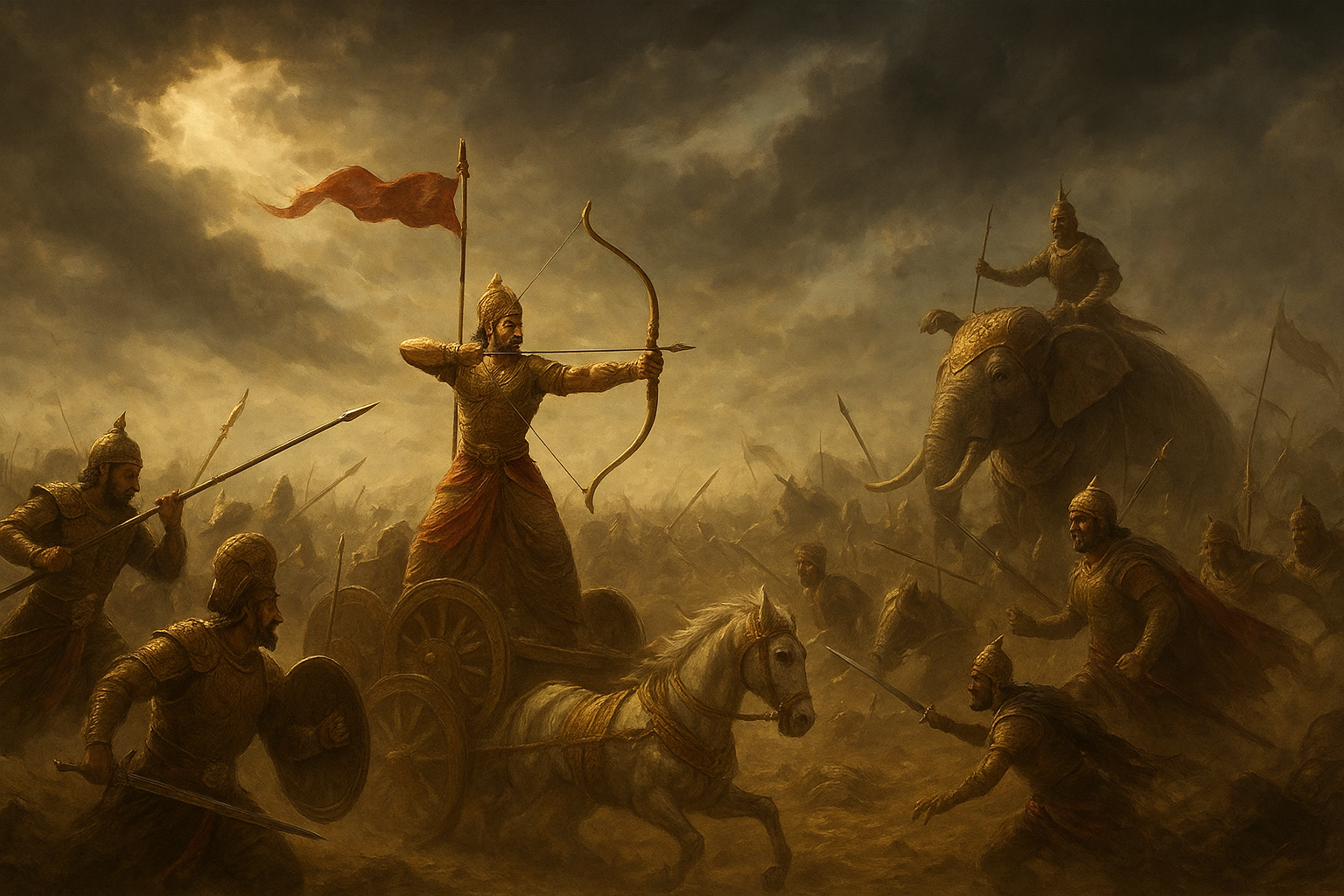
Kurukshetra War: The Epic Battle of Mahabharata, Its 18 Days, Warriors and Untold Lessons
The Kurukshetra War is one of the most significant events described in the Mahabharata, India’s ancient epic. It tells the story of a devastating conflict between two branches of the Kuru dynasty: the Pandavas and the Kauravas. What began as a family dispute over the throne of Hastinapura eventually turned into an enormous battle that changed the lives of countless people.
According to the Mahabharata, the war continued for 18 days on the sacred land of Kurukshetra, now located in Haryana, India. Powerful warriors, legendary archers, kings and military commanders fought on both sides. Yet the story is remembered for much more than its battlefield victories and losses.
Kurukshetra is also the setting of one of the most important spiritual conversations in Indian tradition. Before the fighting began, Lord Krishna explained the principles of duty, action, righteousness and the nature of life to Arjuna. This conversation became the Bhagavad Gita, a text that continues to influence millions of people.
From the reasons behind the conflict to the important warriors, major events and spiritual teachings, here is a detailed look at the Kurukshetra War and its lasting place in Indian culture.
Table of Contents
ToggleWhat Was the Kurukshetra War in Mahabharata?
The Kurukshetra War was the great conflict between the Pandavas and Kauravas, two related branches of the royal Kuru family. The central issue was the right to rule the kingdom of Hastinapura.
The Pandavas were the five sons associated with King Pandu, while the Kauravas were the hundred sons of Dhritarashtra, the elder brother of Pandu.
Although both families belonged to the same dynasty, disagreements over succession, property and political power gradually destroyed their relationship.
Duryodhana, the eldest Kaurava, refused to accept the Pandavas’ rightful share of the kingdom. Attempts to resolve the dispute through discussion and negotiation failed.
Eventually, both sides gathered their allies and armies at Kurukshetra.
In the Mahabharata, the battlefield is described as Dharmakshetra, meaning the field of righteousness. This description gives the war a deeper meaning because the conflict was not presented merely as a struggle for political power. It also explored questions of justice, responsibility, loyalty and moral choices.
Why Did the Kurukshetra War Happen?
The roots of the Mahabharata war can be traced to a long history of rivalry between the Pandavas and Kauravas.
Several events contributed to the final breakdown of their relationship.
1. Rivalry Between the Pandavas and Kauravas
From an early age, the two groups of cousins were involved in competition and disagreements.
The Pandavas became respected for their abilities, discipline and popularity. Arjuna developed a reputation as an exceptional archer, while Bhima was known for his extraordinary physical strength.
Duryodhana increasingly viewed their success as a threat to his own position.
His jealousy became one of the major reasons behind the growing hostility within the Kuru family.
2. The Game of Dice
One of the most important turning points occurred when Yudhishthira was invited to a game of dice.
Shakuni, Duryodhana’s maternal uncle, played on behalf of the Kauravas and used his skills to defeat Yudhishthira.
During the game, Yudhishthira lost his wealth, kingdom and possessions. The situation eventually led to the humiliation of Draupadi in the royal court.
The incident became a defining moment in the Mahabharata because it exposed the injustice and dishonour taking place within the royal family.
3. The Pandavas’ Exile
Following the dice game, the Pandavas were forced to spend 13 years away from their kingdom.
The arrangement included 12 years of exile in the forest and one year of living in disguise.
They completed the conditions of their exile and returned expecting their share of the kingdom.
However, Duryodhana refused to return their land.
4. Lord Krishna’s Peace Mission
Before the war began, several attempts were made to avoid bloodshed.
Lord Krishna personally visited the Kaurava court as a messenger of peace.
He sought a settlement that would allow the Pandavas to receive a small portion of land and avoid a major conflict.
Duryodhana rejected the proposal and refused to make any meaningful compromise.
With diplomacy exhausted, war became unavoidable in the epic narrative.
Who Were the Main Warriors in the Kurukshetra War?
The Mahabharata features numerous powerful warriors, each with a different personality, responsibility and understanding of dharma.
Some fought for family loyalty, others for friendship, and many believed they were defending what they considered right.
1. Lord Krishna
Lord Krishna played one of the most important roles in the Kurukshetra War.
Although he did not take up weapons in the battle, he supported the Pandavas and became Arjuna’s charioteer.
His guidance helped Arjuna overcome his confusion before the battle.
The teachings Krishna shared during this moment became the Bhagavad Gita, one of Hinduism’s most respected spiritual texts.
2. Arjuna
Arjuna was one of the five Pandava brothers and among the greatest archers described in the Mahabharata.
He was trained by Guru Dronacharya and possessed extraordinary skill with the bow and arrow.
His most important weapon was the Gandiva bow.
Arjuna played a major role in several important battles, including the final confrontation with Karna.
3. Bhima
Bhima was the second Pandava brother and was famous for his tremendous strength.
He was particularly skilled in fighting with the mace.
Bhima had a deep personal rivalry with Duryodhana and played a major role in defeating the Kaurava warriors.
His final mace battle with Duryodhana became one of the defining moments of the 18th day.
4. Yudhishthira
Yudhishthira was the eldest of the five Pandavas.
He was widely associated with truth, patience and dharma.
As the eldest brother, he carried significant responsibility for his family and the kingdom.
His leadership was important throughout the war, although his decisions were sometimes challenged by the difficult circumstances of battle.
5. Duryodhana
Duryodhana was the eldest son of Dhritarashtra and the principal leader of the Kauravas.
His ambition to become king of Hastinapura and his refusal to share power with the Pandavas contributed directly to the war.
He was also a skilled mace fighter and received training from Balarama.
His conflict with Bhima reached its conclusion during the final day of the battle.
6. Karna
Karna was one of the most complex characters in the Mahabharata.
He was the eldest son of Kunti, born before her marriage, but grew up in the household of a charioteer.
Despite his extraordinary talent as a warrior, Karna faced repeated rejection because of his social background.
Duryodhana supported him and gave him the kingdom of Anga, creating a lifelong bond of friendship.
Karna remained loyal to Duryodhana and fought on the Kaurava side, even after learning about his birth and relationship with the Pandavas.
His confrontation with Arjuna on the 17th day became one of the most memorable episodes of the war.
7. Bhishma
Bhishma was the respected elder of the Kuru dynasty and a highly experienced military commander.
He had taken a lifelong vow that shaped the future of the royal family.
Despite his affection for the Pandavas, Bhishma fought for the Kauravas because of his commitment to the throne of Hastinapura.
His knowledge, discipline and battlefield experience made him one of the strongest warriors in the conflict.
8. Dronacharya
Dronacharya was the royal teacher who trained both the Pandavas and Kauravas in warfare.
He was particularly skilled in archery and military strategy.
During the war, he served as a commander of the Kaurava army after Bhishma was no longer able to lead.
His relationship with his students made his participation in the conflict especially complicated.
9. Abhimanyu
Abhimanyu was the son of Arjuna and Subhadra.
Although young, he was an exceptionally talented warrior.
His bravery became legendary during the 13th day of the war when he entered the Chakravyuha formation.
He managed to break into the military formation but became trapped inside when the other Pandava warriors could not follow him.
He fought against several powerful opponents before being killed.
10. Shakuni
Shakuni was the maternal uncle of Duryodhana and one of the central figures behind the political rivalry between the two families.
His role in the dice game contributed to the humiliation of Draupadi and the Pandavas’ exile.
He was known for his political manipulation and strategic thinking.
His actions played an important role in turning family disagreements into a major war.
How Long Did the Kurukshetra War Last?
According to the Mahabharata, the Kurukshetra War lasted for 18 days.
Each day brought new military strategies, powerful confrontations and significant losses.
The epic describes two enormous armies gathering for the conflict.
The Pandava side had seven Akshauhinis, while the Kaurava side had eleven Akshauhinis.
An Akshauhini was a traditional military formation made up of chariots, elephants, cavalry and infantry in a specified ratio.
The difference in the size of the two armies made the Pandavas’ eventual victory particularly significant in the epic narrative.
However, the victory came at an enormous human cost. Many of the leading warriors from both families lost their lives.
The 18 Days of the Kurukshetra War: Major Events Explained
The 18-day battle is the central military narrative of the Mahabharata. Each stage introduced new commanders, strategies and turning points.
Day 1 to Day 9: Bhishma Leads the Kaurava Army
The opening days of the war were dominated by Bhishma, who commanded the Kaurava forces.
His battlefield experience and fighting ability created serious challenges for the Pandavas.
Despite being on opposite sides, Bhishma cared deeply for the Pandavas. This made his position particularly difficult.
The Pandavas struggled to defeat him because of his extraordinary skill and the protection he received on the battlefield.
Day 10: The Fall of Bhishma
The tenth day brought one of the biggest turning points.
The Pandavas used Shikhandi as part of their strategy against Bhishma.
Bhishma had vowed not to fight Shikhandi because of Shikhandi’s past identity as Amba.
Arjuna then attacked Bhishma with a series of arrows.
Bhishma fell from his chariot and lay upon a bed of arrows. However, he did not immediately die because of the boon that allowed him to choose the time of his death.
His fall marked the end of his command over the Kaurava army.
Days 11 to 12: Dronacharya Takes Command
After Bhishma fell, Dronacharya became the commander of the Kaurava forces.
He introduced new military strategies and formations to challenge the Pandavas.
His objective was to capture Yudhishthira, which could have changed the course of the war.
The fighting became increasingly intense as both armies tried to gain an advantage.
Day 13: The Tragic Death of Abhimanyu
The 13th day is remembered for the bravery and tragic death of Abhimanyu.
Dronacharya organised the Kaurava army into the Chakravyuha formation.
Abhimanyu knew how to enter the formation but did not know the complete method of escaping from it.
Despite knowing the risks, he entered the formation to help the Pandava army.
He fought courageously against several experienced warriors but eventually became surrounded and was killed.
His death deeply affected Arjuna and became one of the most emotional episodes of the Mahabharata.
Day 14: Arjuna’s Vow and Jayadratha’s Death
After learning about Abhimanyu’s death, Arjuna became determined to kill Jayadratha, whom he blamed for preventing the other Pandava warriors from entering the Chakravyuha.
Arjuna took a vow to kill Jayadratha before sunset the following day or enter the fire.
The Kaurava army made extensive efforts to protect Jayadratha.
With Krishna’s guidance, Arjuna eventually reached him and fulfilled his vow.
The day’s fighting was particularly fierce and continued late into the night.
Day 15: The Death of Dronacharya
The 15th day brought the end of Dronacharya’s command.
The Pandava side developed a strategy to make him believe that his son Ashwatthama had died.
When Dronacharya heard the news, he became deeply distressed.
He laid down his weapons, and Dhrishtadyumna attacked and killed him.
His death was another major turning point in the conflict.
Day 16: Karna Becomes Commander
After Dronacharya’s death, Karna took command of the Kaurava army.
He had long wanted an opportunity to demonstrate his abilities against Arjuna.
The fighting continued with great intensity, and Karna proved to be a formidable military leader.
His participation brought the conflict closer to the final confrontation between the two great archers.
Day 17: Karna and Arjuna Face Each Other
The 17th day witnessed the long-awaited confrontation between Karna and Arjuna.
Both warriors were highly skilled and possessed extraordinary weapons.
During their battle, Karna’s chariot wheel became stuck in the ground.
He asked Arjuna to pause while he attempted to free it.
Krishna reminded Arjuna of Karna’s earlier actions and the events of the war.
Arjuna eventually released the fatal arrow that killed Karna.
His death was one of the most significant moments in the Mahabharata.
Day 18: The Final Battle and Duryodhana’s Defeat
The final day began with the Kaurava forces facing defeat.
Shalya, who had taken command after Karna, was killed by Yudhishthira.
The remaining Kaurava warriors continued fighting, but their position became increasingly weak.
Duryodhana eventually left the battlefield and hid in a lake.
When he was discovered, Bhima challenged him to a mace fight.
Both warriors were powerful fighters, but Bhima eventually struck Duryodhana on the thigh, defeating him.
The blow violated the conventional rules of mace combat, making the final victory morally complicated.
Although the main battle ended, the story did not stop there. Ashwatthama later attacked the Pandava camp at night, killing the sons of the Pandavas and other sleeping warriors.
This final act showed that even after victory, the war continued to bring suffering.
What Is the Bhagavad Gita’s Connection With the Kurukshetra War?
One of the most important reasons the Kurukshetra War remains significant is its connection with the Bhagavad Gita.
Before the battle began, Arjuna looked across the battlefield and saw his relatives, teachers, friends and respected elders standing on the opposing side.
He became overwhelmed by grief and moral confusion.
Arjuna questioned whether fighting a war against his own family could ever be the right decision.
He lowered his bow and expressed his unwillingness to fight.
Lord Krishna, who was serving as his charioteer, responded by explaining the deeper meaning of duty, the soul, action and spiritual wisdom.
This conversation forms the Bhagavad Gita.
Some of its central teachings include:
- Dharma: A person should understand and fulfil their responsibilities with honesty and integrity.
- Karma Yoga: Perform your duties sincerely without becoming attached to the results.
- Atma: The soul is eternal and is not destroyed when the physical body dies.
- Self-control: Wisdom requires control over emotions, desires and attachment.
- Devotion: Faith and devotion can guide a person towards spiritual understanding.
The Bhagavad Gita is not simply a discussion about warfare. It explores the difficult choices people face when their responsibilities, relationships and personal beliefs come into conflict.
Why Is Kurukshetra Called Dharmakshetra?
Kurukshetra is often called Dharmakshetra, which translates to the land of righteousness.
The name appears in the opening verse of the Bhagavad Gita:
“Dharmakshetre Kurukshetre…”
The description connects the battlefield with the larger philosophical themes of justice, duty and moral responsibility.
According to Hindu traditions, Kurukshetra was a sacred region long before the Mahabharata War.
It is associated with King Kuru, ancient sages and several important religious events.
Today, the region is one of India’s most important pilgrimage destinations and attracts visitors interested in the Mahabharata, Hindu traditions and the Bhagavad Gita.
Kurukshetra War: Mythology, Tradition and Historical Questions
The Kurukshetra War occupies an important position in Indian religious and cultural traditions.
For millions of Hindus, the events described in the Mahabharata are part of a sacred epic that carries spiritual and moral significance.
At the same time, scholars continue to examine the historical background of the Mahabharata, its composition and the possible relationship between its narrative and ancient events.
There is no universally accepted historical date for the war.
Different traditional chronologies and modern academic interpretations propose different time periods. Archaeological discoveries in Haryana and surrounding regions provide evidence of ancient settlements and cultures, but they do not independently establish every event or character described in the epic.
It is therefore useful to distinguish between the religious tradition, the literary account and what archaeology can establish.
This distinction does not reduce the cultural importance of the Mahabharata. Its influence on Indian philosophy, literature, art and social thought remains enormous.
What Happened to the Pandavas After the Kurukshetra War?
Although the Pandavas won the war, their victory came with tremendous loss.
Most of the major warriors on both sides had died, including many relatives and friends.
Yudhishthira was eventually crowned king of Hastinapura.
He initially struggled with the consequences of the war and the destruction it had caused.
The Mahabharata describes how the Pandavas attempted to restore order and fulfil their responsibilities as rulers.
Later, after ruling for many years, they gave up their kingdom and began their final journey towards the Himalayas.
This journey, known as the Mahaprasthanika Parva, forms part of the final section of the Mahabharata.
Their story concludes with a spiritual journey that reflects the epic’s larger themes of duty, detachment and the temporary nature of worldly power.
Important Places in Kurukshetra Associated With the Mahabharata
Modern Kurukshetra in Haryana is closely connected with the religious traditions and stories of the Mahabharata.
Visitors can explore several locations associated with Lord Krishna, the Pandavas and the Bhagavad Gita.
1. Jyotisar
Jyotisar is traditionally regarded as the place where Lord Krishna delivered the teachings of the Bhagavad Gita to Arjuna.
It is one of the most important pilgrimage sites in Kurukshetra.
The sacred banyan tree and the Gita-related installations make it a popular destination for devotees.
2. Brahma Sarovar
Brahma Sarovar is a large and sacred water body in Kurukshetra.
It holds great religious importance and attracts pilgrims throughout the year.
The site becomes particularly vibrant during religious festivals and Gita Jayanti celebrations.
3. Sannihit Sarovar
Sannihit Sarovar is another important pilgrimage destination.
According to religious belief, it is associated with the meeting of sacred rivers and is considered an auspicious place for rituals and prayers.
4. Bhishma Kund
Bhishma Kund at Narkatari is traditionally associated with the story of Bhishma lying on a bed of arrows.
The location attracts visitors interested in the Mahabharata and its important characters.
5. Mahabharata Anubhav Kendra
The Mahabharata Anubhav Kendra at Jyotisar offers visitors an opportunity to explore the epic through modern museum technology and storytelling.
Its galleries present different aspects of the Mahabharata using visual displays and interactive experiences.
These attractions help visitors understand why Kurukshetra remains an important centre of Indian religious and cultural heritage.
What Can We Learn From the Kurukshetra War?
The Mahabharata is not only an epic about kings, warriors and kingdoms. It also examines human behaviour and the consequences of personal decisions.
The Kurukshetra War offers several lessons that remain relevant today.
1. Greed Can Destroy Relationships
The conflict between the Pandavas and Kauravas demonstrates how jealousy and an uncontrolled desire for power can destroy even the closest family relationships.
2. Wrong Decisions Have Long-Term Consequences
The dice game and the humiliation of Draupadi show how injustice can create consequences that continue for generations.
3. Duty Is Not Always Easy
Arjuna’s dilemma reminds readers that fulfilling responsibilities can sometimes involve painful choices.
The Bhagavad Gita encourages people to approach their duties with wisdom and a clear understanding of their responsibilities.
4. Friendship and Loyalty Carry Responsibility
Karna’s loyalty towards Duryodhana is one of the most complex relationships in the epic.
His story encourages readers to think about the difference between friendship and supporting every action of a friend.
5. Victory Does Not Always Bring Happiness
The Pandavas won the war, but they lost many loved ones.
Their experience highlights the emotional and human cost of conflict.
6. Wisdom Is More Powerful Than Anger
Krishna’s guidance to Arjuna shows the importance of patience, understanding and thoughtful action during difficult circumstances.
Why Does the Kurukshetra War Still Matter Today?
Thousands of years after the period traditionally associated with the Mahabharata, the Kurukshetra War continues to attract readers, researchers, spiritual seekers and storytellers.
Its characters represent different human qualities, including courage, ambition, loyalty, jealousy, sacrifice and moral confusion.
The Bhagavad Gita continues to be studied in educational institutions, religious centres and philosophical discussions across the world.
The epic has also inspired countless television serials, films, theatre productions, books and artistic interpretations.
For Haryana, Kurukshetra represents an important part of the state’s cultural identity.
The city connects ancient traditions with modern pilgrimage and tourism. Its temples, sacred water bodies and museums continue to introduce new generations to the Mahabharata.
The International Gita Mahotsav further highlights this connection by bringing together spiritual activities, cultural programmes and visitors from different parts of India and abroad.
Frequently Asked Questions About the Kurukshetra War
1. Where Was the Kurukshetra War Fought?
According to the Mahabharata, the war was fought at Kurukshetra, a sacred region in present-day Haryana, India. The area is closely associated with the Pandavas, Kauravas and the teachings of the Bhagavad Gita.
2. How Many Days Did the Kurukshetra War Last?
According to the Mahabharata, the battle continued for 18 days. Each day featured major military confrontations and the deaths of important warriors.
3. Who Won the Kurukshetra War?
The Pandavas won the Kurukshetra War. Their victory came after Duryodhana was defeated by Bhima on the 18th day.
4. Who Was the Main Commander of the Kaurava Army?
Bhishma, Dronacharya, Karna and Shalya served as major commanders of the Kaurava army at different stages of the war.
5. Who Was Arjuna’s Charioteer?
Lord Krishna served as Arjuna’s charioteer during the Kurukshetra War. He also delivered the teachings of the Bhagavad Gita before the battle began.
6. Why Did Arjuna Refuse to Fight Initially?
Arjuna became emotionally overwhelmed when he saw his relatives, teachers and friends standing against him. He questioned the morality of fighting and killing people he loved and respected.
7. Who Killed Karna?
Arjuna killed Karna on the 17th day of the Kurukshetra War, with Lord Krishna guiding him during the confrontation.
8. Who Killed Duryodhana?
Bhima defeated Duryodhana in a mace fight on the 18th day by striking his thigh.
9. What Is an Akshauhini in the Mahabharata?
An Akshauhini was a traditional military formation consisting of chariots, elephants, cavalry and infantry in a specified numerical ratio. The Mahabharata describes seven Akshauhinis on the Pandava side and eleven on the Kaurava side.
10. Where Did Lord Krishna Deliver the Bhagavad Gita?
According to Hindu tradition, Lord Krishna delivered the Bhagavad Gita to Arjuna at Kurukshetra. Jyotisar in Haryana is traditionally identified as the sacred location of this conversation.
11. Is the Kurukshetra War Historically Proven?
The Mahabharata is an ancient epic with enormous religious and cultural importance. However, the exact historical date of the war and the identification of its events with archaeological evidence remain subjects of scholarly discussion. There is no universally accepted archaeological proof of the complete epic narrative.
12. Why Is Kurukshetra Important in Hinduism?
Kurukshetra is considered sacred because of its association with the Mahabharata War and the Bhagavad Gita. It is an important pilgrimage destination with sites such as Jyotisar, Brahma Sarovar and Sannihit Sarovar.
Final Thoughts: The Lasting Legacy of the Kurukshetra War
The Kurukshetra War remains one of the most powerful stories in Indian literature and spiritual tradition.
Its narrative explores the consequences of greed, the importance of justice, the complexity of relationships and the responsibilities that come with power.
The 18-day battle brought the conflict between the Pandavas and Kauravas to an end, but its deeper message continued through the Bhagavad Gita.
For generations, the teachings of Lord Krishna have encouraged people to act responsibly, understand their duties and approach life’s challenges with wisdom.
Today, Kurukshetra in Haryana continues to preserve this legacy through its sacred sites, cultural traditions and spiritual celebrations.
The story of the Kurukshetra War is ultimately a reminder that the greatest battles are not always fought with weapons. Many of life’s most difficult struggles take place within the human mind, where the choices between right and wrong must be made.