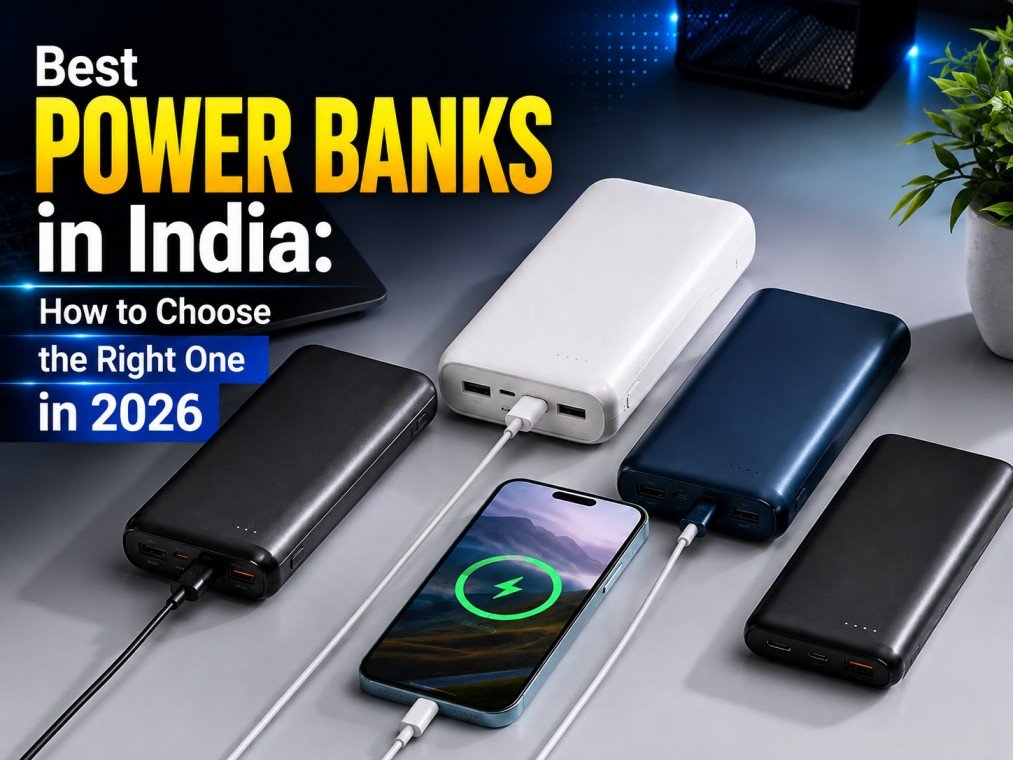
A power bank has become one of the most useful smartphone accessories.
Whether you travel frequently, spend long hours away from a charging socket, work outdoors or simply want a backup battery for your phone, a power bank can provide extra charging when you need it.
But choosing one is not as simple as looking at the largest mAh number.
A good power bank should match your phone, charging requirements, travel habits and budget.
Capacity, charging speed, USB-C support, size, weight and safety features can all make a difference.
This guide explains what to look for before buying a power bank in India in 2026.
Table of Contents
ToggleWhat Is a Power Bank?
A power bank is a portable battery designed to store electrical energy and use it later to charge devices.
Depending on the model, a power bank can charge:
- Smartphones
- Tablets
- Wireless earbuds
- Smartwatches
- Cameras
- Portable gaming devices
- Some laptops
The devices supported depend on the power bank’s capacity, output and charging standards.
How Does a Power Bank Work?
A power bank contains rechargeable battery cells along with electronic circuitry that controls charging and power output.
You first charge the power bank itself.
Later, when your phone or another compatible device needs power, you connect it to the power bank using a suitable cable.
The power bank transfers stored energy to the connected device.
10000mAh vs 20000mAh Power Bank
One of the first decisions buyers usually face is capacity.
10000mAh Power Bank
A 10000mAh model is generally more compact and easier to carry.
It can be suitable for:
- Daily commuting
- Short trips
- Emergency charging
- Smartphone users who want a lightweight option
20000mAh Power Bank
A 20000mAh model stores more energy but is generally larger and heavier.
It may be more suitable for:
- Long journeys
- Frequent travellers
- Multiple devices
- Camping
- Heavy smartphone users
The actual amount of charge delivered to a device will be lower than the advertised battery capacity because of conversion losses and other factors.
Is a Higher mAh Power Bank Always Better?
No.
A larger capacity can provide more stored energy, but it also usually means greater size and weight.
If you mostly need emergency charging during the day, a smaller power bank may be more convenient.
If you travel frequently and need several charges, a larger model may make more sense.
The right capacity depends on your usage.
What Is Fast Charging in a Power Bank?
Fast charging allows compatible devices to charge at higher power than basic charging.
However, fast charging depends on multiple components:
- Power bank
- Smartphone
- Charging protocol
- Cable
- Charger or input source
Buying a power bank with a high wattage rating does not automatically mean every device will charge at that speed.
Your phone must support the relevant charging technology.
Why USB-C Matters
USB-C has become increasingly important in modern electronics.
A power bank with USB-C can offer convenient charging and, depending on the model, may support both input and output through the same port.
Before buying, check whether the USB-C port supports:
- Input
- Output
- Fast charging
- Higher power delivery
These capabilities can vary between models.
Power Delivery and Charging Standards
Some power banks support charging standards such as USB Power Delivery.
These technologies can allow compatible devices to negotiate an appropriate charging level.
This can be particularly useful for modern smartphones, tablets and certain laptops.
Always check compatibility between the power bank and your device.
How Many Times Can a Power Bank Charge a Phone?
There is no universal answer.
It depends on:
- Power bank capacity
- Phone battery size
- Conversion efficiency
- Charging losses
- Power management
For example, a 20000mAh power bank does not necessarily provide exactly two full charges to a phone with a 10000mAh battery.
The advertised capacity and usable output are not the same thing.
Best Power Bank for Travel
For travel, balance capacity against portability.
Short Trips
A compact 10000mAh power bank can be convenient.
Long Trips
A 20000mAh model may provide more backup.
Air Travel
Airline rules can apply to power banks because they contain lithium batteries.
Always check the latest rules of your airline and departure/arrival authorities before travelling.
Keep the power bank accessible according to the airline’s requirements rather than assuming every model is permitted in every situation.
Best Power Bank for iPhone
iPhone users should check compatibility with the power bank’s charging output and cable.
Important considerations include:
- USB-C support
- Power Delivery support where applicable
- Charging speed
- Cable compatibility
- Size
A power bank designed around modern USB-C charging can be particularly convenient for compatible iPhone models.
Best Power Bank for Android Phones
Android smartphones vary considerably in their charging technologies.
Before purchasing, check your phone manufacturer’s specifications.
A power bank should ideally support the charging standard and power level your smartphone can actually use.
A higher-rated power bank can still work, but the phone will generally determine how much power it accepts.
Power Bank for Tablets
Tablets typically have larger batteries than smartphones.
For regular tablet users, a higher-capacity power bank may be more practical.
Check the tablet’s charging requirements before purchasing.
Can a Power Bank Charge a Laptop?
Some high-output power banks can charge compatible laptops through USB-C Power Delivery.
But not every power bank supports laptop charging.
Check:
- Output wattage
- USB-C Power Delivery support
- Laptop charging requirements
- Manufacturer compatibility information
A smartphone-focused power bank may not provide enough power for a laptop.
Power Bank Safety Features
Safety should be more important than simply finding the cheapest option.
Look for products from reputable manufacturers with appropriate protection features.
Common protections may include:
- Overcharge protection
- Over-discharge protection
- Over-current protection
- Short-circuit protection
- Temperature protection
Never use a visibly damaged, swollen or leaking power bank.
Why Cheap Power Banks Can Be Risky
Extremely cheap products may use lower-quality components or provide misleading capacity and output claims.
A bargain is not worthwhile if the product:
- Heats excessively
- Has unreliable charging
- Uses poor-quality cells
- Provides inaccurate specifications
- Lacks basic protection
Buy from a reputable seller and verify the specifications.
How to Check Power Bank Quality
Before buying, check:
Brand Reputation
Look for manufacturers with established products and customer support.
Specifications
Check the actual capacity, output and charging standards.
Reviews
Look for recent reviews rather than relying only on the overall rating.
Warranty
A clear warranty can provide additional confidence.
Seller
Buy from an established and trustworthy retailer.
Lightweight Power Banks
If portability is your main concern, consider a smaller capacity.
A compact power bank can easily fit inside:
- Backpack
- Handbag
- Laptop bag
- Travel pouch
For daily emergency charging, portability may matter more than maximum capacity.
Power Bank With Built-In Cable
Some models include an integrated cable.
This can be convenient because you do not need to carry a separate cable.
However, check whether the built-in cable supports the charging standard and power requirements of your device.
Power Bank With Multiple Ports
Multiple ports can be useful if you need to charge several devices.
For example:
- Smartphone
- Earbuds
- Tablet
But remember that some power banks reduce the available output when multiple devices are connected simultaneously.
Check the manufacturer’s specifications.
How to Maintain a Power Bank
Proper storage can help extend the useful life of a power bank.
Avoid:
- Extreme heat
- Water exposure
- Physical damage
- Using damaged cables
- Leaving the device in direct sunlight for long periods
If you notice swelling, unusual heat or physical damage, stop using the power bank.
How Long Does a Power Bank Last?
The lifespan depends on:
- Battery chemistry
- Charging cycles
- Usage
- Storage conditions
- Temperature
- Product quality
Rechargeable batteries gradually lose capacity over time.
A power bank that once provided several charges may eventually provide fewer.
Power Bank Buying Checklist
Before purchasing, check these points:
- Capacity
- Output wattage
- USB-C support
- Fast charging compatibility
- Number of ports
- Size
- Weight
- Safety features
- Warranty
- Seller reputation
- Airline requirements if travelling
This checklist can help prevent buying a product that does not match your needs.
Common Power Bank Buying Mistakes
Choosing Only by mAh
Capacity is important, but it is not the only specification.
Ignoring Charging Standards
A high-wattage product may not provide its maximum speed to your phone.
Buying the Cheapest Model
Very low prices can sometimes indicate compromises in components or specifications.
Ignoring Weight
A huge power bank may be inconvenient for everyday carrying.
Not Checking Compatibility
Always check your device’s charging requirements before buying.
Which Power Bank Should You Buy?
There is no single best power bank for everyone.
For Daily Use
A compact 10000mAh model can be practical.
For Frequent Travel
A 20000mAh model may provide more backup.
For Fast Charging
Look for a model supporting the appropriate charging protocol and output for your phone.
For Multiple Devices
Choose a model with enough capacity and suitable ports.
For Laptop Charging
Look for high-output USB-C Power Delivery support and verify compatibility with your laptop.
Final Verdict
The best power bank is not necessarily the one with the highest capacity or the highest wattage.
The right choice depends on how you use your devices.
For everyday emergency charging, a compact power bank can be convenient.
For long trips and multiple devices, a higher-capacity model may be more useful.
Fast charging and USB-C support are also important considerations for modern smartphones.
Most importantly, choose a reputable product with clear specifications and appropriate safety protections.
Before buying, compare capacity, charging speed, compatibility, size, weight and warranty instead of focusing on one specification.
Frequently Asked Questions
Which is better, a 10000mAh or 20000mAh power bank?
A 10000mAh model is generally more portable, while a 20000mAh model provides more stored energy. Choose based on your travel and charging needs.
What is the best power bank for smartphones?
The best model depends on your smartphone’s charging requirements, desired capacity, charging speed and portability.
Is 20000mAh power bank allowed on flights?
Airline and aviation rules apply to lithium-battery power banks and can vary. Check the current rules of your airline before travelling.
Is USB-C important in a power bank?
Yes. USB-C can provide convenient charging and, on compatible models, fast charging and Power Delivery.
Can a power bank charge a laptop?
Some high-output USB-C power banks can charge compatible laptops. Check the required wattage and Power Delivery support before buying.
Does a 20000mAh power bank give two full charges?
Not necessarily. Conversion and charging losses mean usable output is lower than the advertised battery capacity.
How long does a power bank last?
Battery lifespan varies based on usage, charging cycles, temperature, storage and product quality.
Is a cheap power bank safe?
Price alone does not determine safety, but extremely cheap products with unclear specifications or poor quality control can carry greater risks. Choose reputable products with appropriate safety protections.