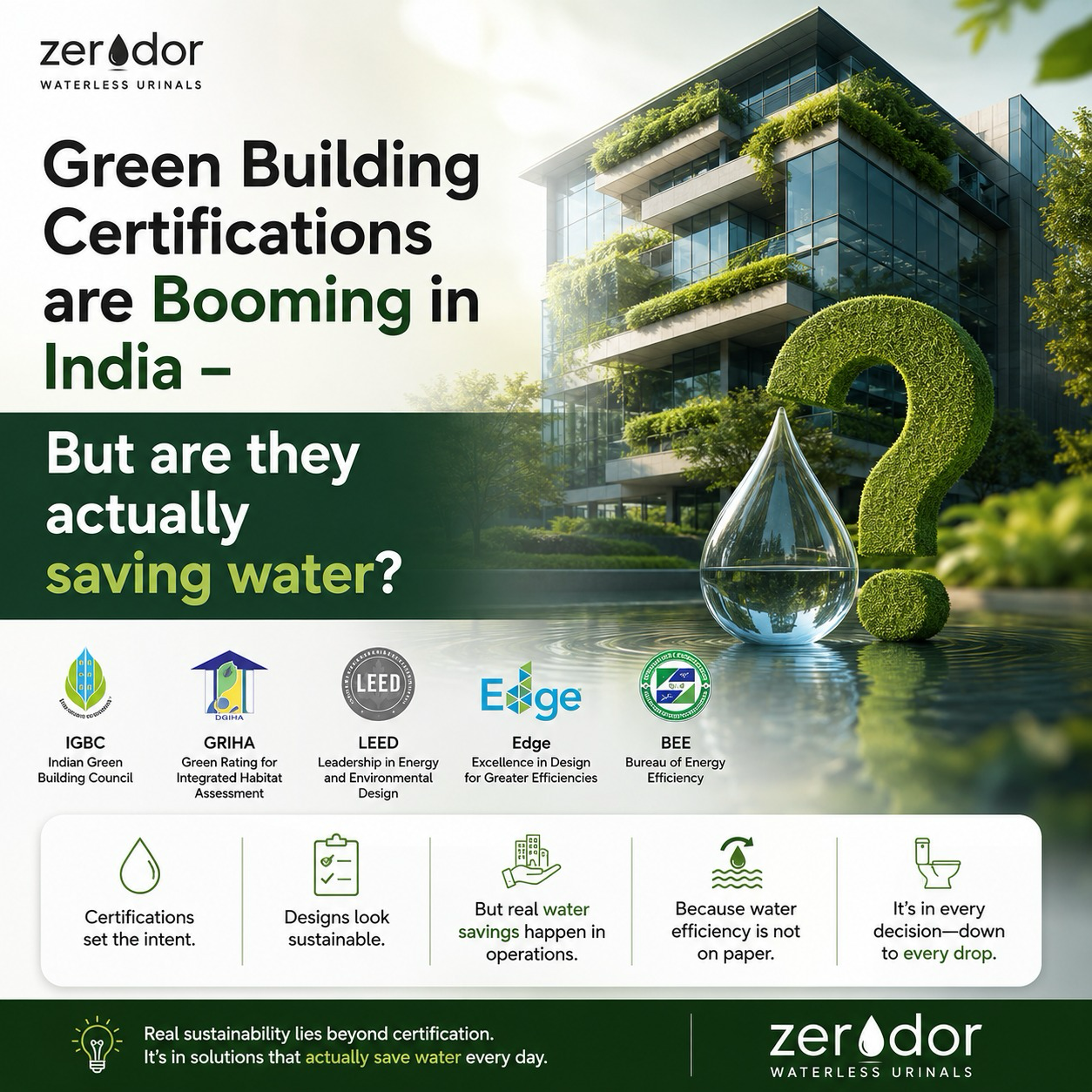
India’s green building movement has reached a point where the question is no longer how many buildings are certified? It is: what happens after the certificate is framed and the building is occupied?
India’s green building ecosystem has expanded dramatically, with more than 19,000 projects registered under the Indian Green Building Council (IGBC) ecosystem. LEED-certified buildings, GRIHA-rated projects and other sustainability frameworks have helped push water efficiency, energy conservation and responsible resource use into mainstream construction conversations.
That is a significant achievement. But it also creates a more uncomfortable question: Are we measuring green buildings by what they were designed to achieve, or by what they achieve once people start using them? Water is where this performance gap becomes particularly important.
A building can be designed with low-flow fixtures, rainwater harvesting, wastewater treatment, and water-efficient landscaping. It can earn points for these interventions and eventually receive a green building certification. Yet, years later, how many building owners can confidently show exactly how many liters of potable water their interventions have saved? This is the gap India needs to start talking about: the difference between sustainability by design and sustainability by performance.
Table of Contents
ToggleThe certification is not the finish line
Green building certifications play an important role. They establish benchmarks, encourage better design decisions, and give developers, architects and facility managers a framework for incorporating sustainability into buildings. But certification should ideally be the beginning of a building’s sustainability journey and towards its final destination.
Consider water efficiency. A project may specify efficient plumbing fixtures during design and construction. But once the building is operational, actual water consumption depends on occupancy, user behavior, maintenance, leakage, fixture performance, cleaning practices and operational decisions.
A water-efficient fixture that is poorly maintained may not deliver the expected performance. A rainwater harvesting system may exist but remains underutilized. An STP may be installed but operates below its intended efficiency. And water-saving technology may be present without anyone continuously measuring its real-world impact.
In other words, a green building can have all the right technologies and still miss the opportunity to deliver their full potential.
The missing metric: liters saved
India’s water conversation has traditionally focused heavily on infrastructure: build the STP, install the rainwater harvesting system, specify efficient fixtures and obtain certification. The next stage needs to focus on something much simpler: Show us the numbers.
How much water was consumed before the intervention?
How much is it being consumed now?
How many liters of potable water are being avoided every month?
How much wastewater is being generated?
How much water is actually reused?
And perhaps most importantly: can those numbers be independently tracked and verified? This shift from installation to measurement could fundamentally change how sustainability is evaluated in India’s built environment.
For facility managers, this is not merely a sustainability question. It is also an operational one. Every liter of water avoided can translate into lower procurement costs, reduced wastewater loads, lower tanker dependency, and potentially lower pressure on treatment infrastructure.
The Restroom is a good place to start
One of the clearest examples of this performance gap exists in an area that rarely receives enough attention in green building conversations: the restroom.
Take urinals in commercial buildings. Traditional flushing urinals can consume significant quantities of potable water every day, particularly in high-footfall buildings. Yet the consumption can easily disappear into the building’s overall water bill.
This is where waterless urinal technology offers measurable intervention. Ekam Eco Solutions’ Zerodor, for example, is designed to eliminate the need for flushing water in urinals. Its impact can therefore be translated into a relatively straightforward metric: the amount of potable water that would otherwise have been used for flushing.
With more than 85,000 Zerodor installations, the company says its systems have helped save more than 3.5 billion liters of water. The significance of such a figure is not simply its scale. It demonstrates a broader principle: sustainability becomes more powerful when a technology output can be expressed in measurable units.
From Green Credentials to green evidence
This is where product certification and performance data become important. A technology labelled “green” is not enough. Building owners increasingly need evidence that a product performs as claimed, fits into their operational environment, and can contribute to measurable sustainability outcomes.
Green Pro certification, for instance, provides a recognized framework for evaluating environmentally preferable products. When such certified technologies are combined with actual building-level data, the conversation moves beyond marketing claims.
The objective should not be to replace green building certification. It should be strengthened with post-occupancy evidence. Imagine two buildings with identical water-efficiency credits.
Building A can show that it installed efficient fixtures but has no consistent record of actual water savings. Building B can show its baseline consumption, intervention date, monthly water data, and cumulative savings. Both may be certified green. But only one can clearly demonstrate its operational impact. The distinction will become increasingly important as sustainability reporting becomes more data driven.
India’s next green building challenge is already here
India has spent years establishing the foundations of green construction. The next challenge is to make those buildings demonstrably high performing.
That means moving beyond questions such as: “Did we install it?” towards: “Is it working? “And then: “How much impact did it create? “For developers, this means thinking about measurable outcomes from the design stage itself. For architects and consultants, it means specifying technologies whose performance can be monitored. For facility managers, it means establishing baselines and tracking water consumption after occupancy. And for technology providers, it means being willing to put measurable performance behind sustainability claims.
The opportunity is enormous because water is one of the few sustainability metrics that can be translated so directly into operational impact. A liter of potable water that is not consumed is measurable. A liter of wastewater reused is measurable. A tanker avoided is measurable. And over time, these measurements tell a much more meaningful story than a certificate hanging on a wall.
The Future of green buildings will be measured after handover
India does not need fewer green buildings. It needs more green buildings that can prove they are delivering what they promised. The 19,000-plus IGBC project milestone is a reason to celebrate. But it should also mark the beginning of the next conversation.
Certification tells us that a building was designed or assessed against a sustainability framework. Performance data tells us what that building actually did. That distinction may define the next decade of India’s green building movement. Because the most sustainable building isn’t the one with the most impressive certificate. It is the one that can show, in numbers, how much water it saved.