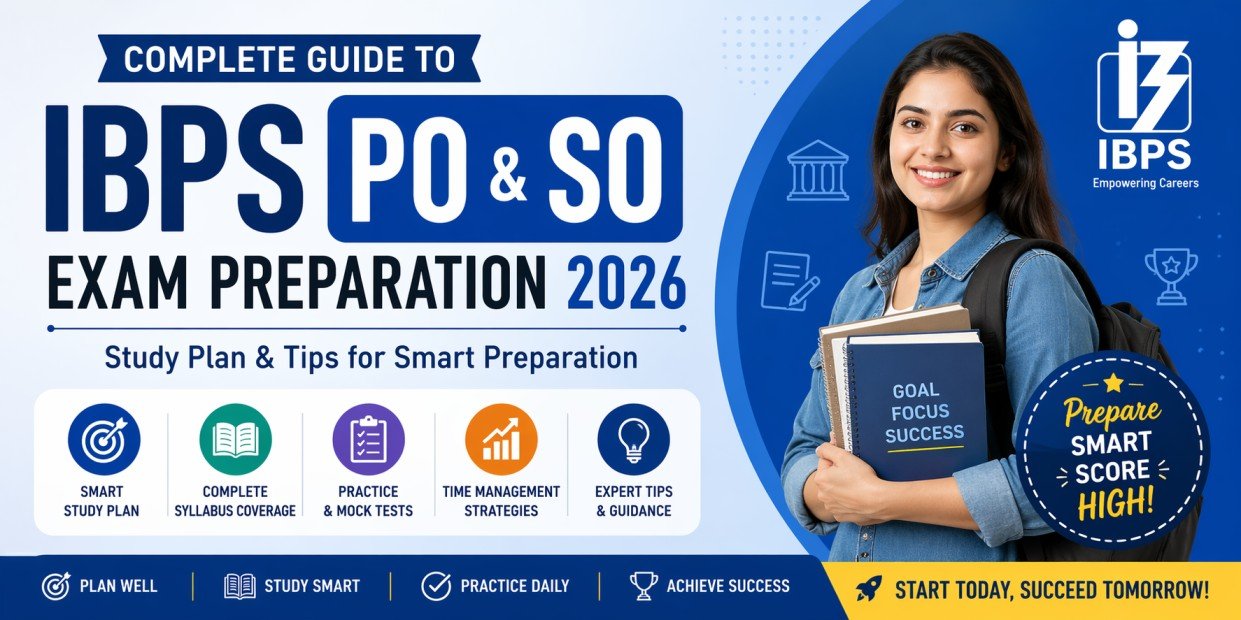
Preparing for banking exams like IBPS PO and IBPS SO is not just about studying harder—it’s about studying smarter with the right plan and consistency. Every year, lakhs of aspirants compete for limited vacancies, which makes having a clear strategy essential. Many aspirants often wonder, “Which is better, IBPS PO or IBPS SO?” The answer depends on your career goals—IBPS PO is ideal for those seeking a general banking role with growth opportunities, while IBPS SO suits candidates who want to work in their specialised field. With the right subject-wise approach and regular practice, cracking these exams becomes much more achievable. In this article, you’ll find a simple study plan, preparation tips, and key topics to focus on. Follow it consistently, and you can confidently move closer to securing your place in the banking sector.
Table of Contents
ToggleIBPS PO vs IBPS SO – Key Differences in Preparation
Before choosing your path in banking, it is important to understand what is the difference between IBPS PO and IBPS SO.
- IBPS PO mainly focuses on Quant, Reasoning and English
- IBPS SO includes Professional Knowledge along with basic sections
Pro Tip:
Try studying the common subjects together, and make sure to spend some extra time on the Professional Knowledge section for IBPS SO.
Smart Study Plan for IBPS PO and SO Preparation
A smart study plan with consistent preparation can help you improve your efficiency and save time.
- Follow separate preparation for both Prelims and Mains
- First, focus on concept building
- Practice questions regularly
- Revise topics frequently
Section-Wise Strategy (Reasoning, Quant, English & Professional Knowledge)
Follow a section-wise strategy to score high in each subject to improve your overall performance.
Reasoning Ability
Focus on puzzles, seating arrangement, and logical reasoning questions to improve accuracy. Practice different types of puzzles daily (linear, circular, floor-based) to build speed and confidence. Work on easy topics like syllogism and inequality to secure quick marks. Analyse mistakes regularly and learn shortcut approaches to solve questions faster in the exam.
Quantitative Aptitude
Strengthen basic concepts like percentages, ratios, and arithmetic. Practice Data Interpretation (DI) regularly, as it carries high weightage in both prelims and mains. Focus on speed and accuracy in simplification and number series. Learn short tricks and approximation techniques to save time. Revise formulas frequently and attempt sectional mocks to improve performance.
English Language
Improve reading habits and focus on comprehension, grammar, and vocabulary. Read newspapers like The Hindu daily to enhance understanding and vocabulary. Practice reading comprehension, cloze tests, and error spotting regularly. Work on grammar rules and sentence structure to avoid mistakes. Maintain a vocabulary notebook for revision and practice para jumbles to improve logical flow understanding.
Professional Knowledge (For IBPS SO)
Study subject-specific topics based on your specialisation and practice previous year questions. Focus more on core subjects, as most questions are concept-based and direct. Revise important definitions, formulas, and case-based concepts regularly. Take mock tests to understand the exam pattern and improve accuracy. Keep updating yourself with recent developments related to your field.
General Awareness / Banking Awareness
Stay updated with current affairs, especially banking and financial news. Focus on RBI updates, monetary policies, banking terms, and financial institutions. Read monthly current affairs PDFs and revise them weekly. Give importance to static GK along with current updates. Practice quizzes daily to improve retention and recall speed.
How to Prepare for IBPS SO Professional Knowledge Section
The professional section is the most important for IBPS SO:
- Core subject concepts are essential for IBPS SO
- Choose standard books to gain knowledge on subjects
- Practice with previous year papers
- Revise regularly for a better understanding
Daily Routine for IBPS PO and SO Preparation
A simple and effective daily study routine can improve consistency and help you clear the IBPS PO and IBPS SO exams.
- Spend 2 hours on Quant to improve your analytical, problem-solving skills, speed, accuracy, logical reasoning and decision making.
- Spend 2 hours on Reasoning to improve subject analysis, identify connections and evaluate options.
- Spend 1 hour on English to evaluate your language skills
- Speed 1 hour on Professional Knowledge / Mock
Time Management Strategy for IBPS Exams
Time management is an important key to success in these IBPS exams:
- Attempt easy questions first to utilise your time
- Avoid taking more time for unsure questions
- Maintain your accuracy
- Practice mock tests with a limited time
Most Important Topics for IBPS PO & SO 2026
Focus on high-weightage topics to boost your overall score and to master them.
- Reasoning: Seating Arrangement, Puzzle, Syllogism, Inequality, Coding Decoding
- Quant: Simplification, Approximation, Number Series, Data Interpretation (DI), Quadratic Equation, Data Sufficiency (Quants), Quantity Based Questions
- English: Reading Comprehension, Cloze Test, Error Spotting, Sentence Improvement, Sentence Correction, Fillers (Single & Double Fillers), Para Jumbles / Sentence Rearrangement, Sentence Connector, Word Swap
- Professional Knowledge: Core subjects
Common Mistakes to Avoid in IBPS Preparation
Avoid these most common mistakes made by aspirants to crack the IBPS exam with confidence.
- Studying without a proper plan
- Fewer mock tests
- Not enough revision
- Focusing only on strong areas
- Ineffective time management
Last 30 Days Strategy for IBPS PO and SO
The final month is important for aspirants, and a very crucial time for revision:
- Revise important topics to score well
- Take daily mock tests to improve accuracy and speed
- Analyse mistakes to be better
- Focus on weak areas and spend more time on those subjects
- Avoid new topics in the last days
Mock Test Strategy for IBPS Exams
Mock tests help you understand the real exam and increase your confidence and discipline in time management.
- Take 3–4 mocks per week
- Analyse each test to improve your overall performance
- Improve weak areas to score well
- Track your progress for a better understanding
Final Thoughts
Achieving success in the IBPS PO and SO exams in 2026 is attainable with a focused strategy and consistent effort. Prioritise building strong concepts, practice regularly, and manage your time effectively. Success depends on studying smart and maintaining consistency, not simply increasing study hours.
FAQs – IBPS PO & SO Preparation
- Can I prepare for IBPS PO and SO together?
Yes, both exams have similar syllabuses, so that preparation can be done together. - How many months are required for IBPS preparation?
Around 3–6 months of consistent preparation is enough. - How to prepare for IBPS SO professional knowledge?
Focus on core concepts and practice previous year questions. - Is IBPS SO easier than IBPS PO?
The difficulty level varies, but IBPS SO requires subject knowledge. - What is the best strategy for IBPS exams?
Follow a structured plan, practice mock tests, and revise regularly.