Brand visibility is becoming increasingly important in modern search. Businesses are no longer competing only for traditional Google rankings. They also need to understand how their brand appears across search engines, AI-powered search experiences, answer engines, knowledge systems, and other digital platforms.
This is where platforms and frameworks focused on brand intelligence can become useful. One concept that often appears in data-driven brand analysis is normalization transformation. For marketers, understanding BrandRank.ai normalization transformation rules can help explain how different types of brand and search data may be standardized before being analyzed or compared.
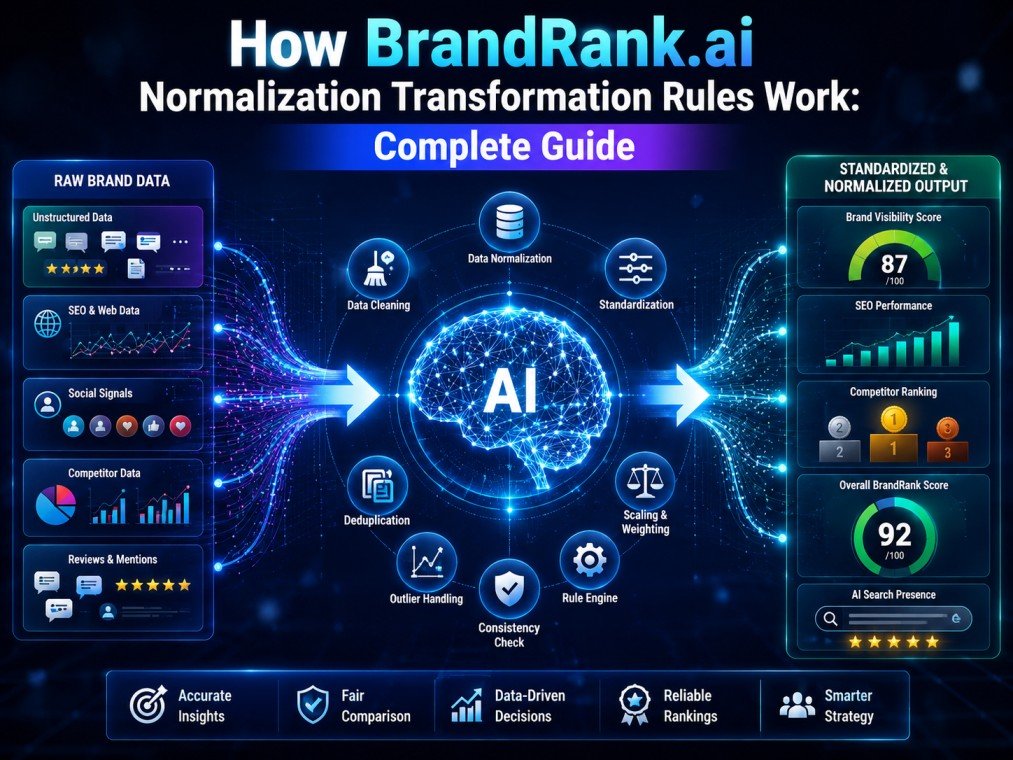
In simple terms, normalization is about making different data points more comparable. If one metric is measured on a scale of 0–100, another is measured in percentages, and another uses raw numerical values, directly comparing them may produce misleading conclusions. Transformation rules help convert those values into a consistent format.
This guide explains what normalization transformation rules mean, why they matter, how they can work in brand intelligence systems, and what marketers should consider when interpreting normalized scores.
Table of Contents
ToggleWhat Is BrandRank.ai?
BrandRank.ai is associated with AI-focused brand visibility and search intelligence. The broader idea behind such platforms is to help businesses understand how brands are represented, discovered, and evaluated across modern search and AI environments.
Traditional SEO primarily focuses on rankings, keywords, backlinks, organic traffic, and technical optimization. AI-era brand visibility introduces additional questions:
- Is the brand mentioned in AI-generated answers?
- How frequently does an AI system associate the brand with a particular topic?
- Which competitors are appearing alongside the brand?
- How consistent is the brand’s digital presence?
- What entities and concepts are associated with the brand?
- How does brand visibility change across different queries?
These questions often require data from multiple sources.
Because those sources can produce data in different formats, normalization becomes an important part of analysis.
What Are Normalization Transformation Rules?
Normalization transformation rules are mathematical or logical rules used to convert data into a standardized representation.
Imagine that a brand analysis system collects three metrics:
- Brand mentions: 850
- Visibility percentage: 62%
- Authority score: 0.78
These values cannot be compared directly because they represent different scales and measurements.
A normalization process could transform them into standardized scores.
For example:
| Original Metric | Original Value | Normalized Representation |
|---|---|---|
| Brand mentions | 850 | Standardized score |
| Visibility | 62% | Standardized score |
| Authority | 0.78 | Standardized score |
The exact transformation depends on the methodology being used.
The key objective is to make different measurements easier to compare, combine, rank, or visualize.
Why Normalization Matters in AI Search
AI search is fundamentally different from traditional keyword ranking.
A traditional search report might say:
Keyword: Best digital marketing agency
Position: 4
An AI visibility report could involve several dimensions:
- Mention frequency
- Citation frequency
- Brand prominence
- Query coverage
- Competitor visibility
- Sentiment
- Contextual relevance
Combining these dimensions requires careful data handling.
Without normalization, a metric with naturally larger numerical values could dominate the final score even if it is not more important.
Normalization helps reduce this problem.
How BrandRank.ai Normalization Transformation Rules Can Work
The exact implementation of a proprietary platform’s internal rules may not be publicly documented in full. Therefore, marketers should distinguish between general normalization principles and any officially documented BrandRank.ai methodology.
A typical normalization workflow can involve several stages.
Step 1: Collect Raw Data
The first stage involves collecting raw observations.
Depending on the platform, these could include brand mentions, search visibility, AI responses, rankings, citations, competitor information, or other brand-related signals.
At this stage, values may exist in completely different formats.
For example:
- Metric A = 125
- Metric B = 0.42
- Metric C = 78%
- Metric D = 12 mentions
These numbers should not automatically be interpreted as being on the same scale.
Step 2: Clean the Data
Before transformation, data generally needs to be cleaned.
Data cleaning can include:
- Removing duplicate records
- Handling missing values
- Correcting inconsistent formats
- Identifying outliers
- Standardizing names
- Resolving duplicate entities
- Checking invalid observations
This step is particularly important in brand analysis because the same company can appear under multiple names.
For example, a company could appear as:
- Example Company
- Example Co.
- Example Inc.
- example.com
If these references are not properly associated, the resulting brand analysis may be fragmented.
Step 3: Select the Transformation Method
Different metrics may require different normalization methods.
Common approaches include:
- Min-max normalization
- Z-score standardization
- Percentage normalization
- Log transformation
- Rank-based transformation
- Weighted scoring
The appropriate approach depends on the purpose of the metric.
Step 4: Apply the Transformation
A normalization formula converts the raw value into a standardized score.
For example, min-max normalization is commonly represented as:
Normalized Value = (X − Minimum) / (Maximum − Minimum)
This converts values into a range between 0 and 1.
A platform could then multiply the result by 100 to create a 0–100 score.
However, this is a general mathematical example and should not be assumed to be the exact proprietary formula used by BrandRank.ai.
Step 5: Apply Weights
Not every signal necessarily has equal importance.
A brand visibility system might conceptually assign different weights to different metrics.
For example:
- Brand mentions = 30%
- AI citation visibility = 30%
- Search visibility = 25%
- Contextual relevance = 15%
A weighted score could then be calculated from the normalized values.
Again, these numbers are illustrative rather than an assertion about BrandRank.ai’s actual proprietary weighting system.
Normalization vs Transformation
Normalization and transformation are related but not identical concepts.
Normalization generally refers to putting data onto a comparable scale.
Transformation is a broader concept that can involve changing the mathematical representation of data.
For example, a logarithmic transformation can reduce the impact of extremely large values.
Suppose two brands receive:
- Brand A: 100 mentions
- Brand B: 10,000 mentions
The difference is enormous.
A logarithmic transformation can reduce the influence of that difference, depending on the analytical objective.
This can be useful when data has a highly skewed distribution.
Why Raw Brand Data Can Be Misleading
Raw numbers often look objective, but they can hide important differences.
Suppose Brand A has 1,000 mentions and Brand B has 500 mentions.
At first glance, Brand A appears twice as visible.
But what if Brand A operates across 50 categories while Brand B focuses on only one?
Or what if Brand A receives many low-value mentions while Brand B receives fewer but highly authoritative mentions?
This demonstrates why a single raw number does not necessarily represent brand strength.
Normalization can provide a more structured way to compare different observations.
The Importance of Context
A normalized score should never be interpreted without understanding the underlying data.
For example, a score of 80 may sound impressive.
But what does 80 mean?
It could represent:
- 80 out of 100
- A percentile
- A weighted index
- A relative competitor score
- A transformed visibility metric
The meaning depends on the methodology.
This is why marketers should always look at the definition of the metric rather than assuming that all 0–100 scores are equivalent.
BrandRank.ai Normalization Transformation Rules and Competitive Analysis
One major application of normalization is competitive analysis.
Businesses often want to compare their brand with competitors.
For example:
| Brand | Raw Visibility | Normalized Score |
|---|---|---|
| Brand A | 840 | 82 |
| Brand B | 690 | 71 |
| Brand C | 530 | 60 |
The normalized score makes the comparison easier to interpret.
However, the underlying methodology remains important.
If the normalization process changes, the resulting scores can also change.
Therefore, businesses should focus not only on individual scores but also on trends over time.
Tracking Changes Over Time
One of the most useful applications of normalized metrics is trend analysis.
Suppose a company records:
- January: 48
- February: 52
- March: 61
- April: 68
The business can identify a positive trend.
However, marketers should ask what caused the increase.
Possible reasons could include:
- Improved content
- More authoritative backlinks
- Increased brand mentions
- Better entity consistency
- Increased media coverage
- Improved search visibility
- More relevant content
- Changes in AI search behavior
The score itself is a measurement—not necessarily an explanation.
Normalization and AI Overviews
The rise of AI-generated search experiences has changed the way brands think about visibility.
A brand may not rank first in a traditional search result but could still be mentioned prominently in an AI-generated response.
Conversely, a website can rank well for specific keywords while having limited visibility in AI-generated answers.
This creates a broader concept of AI brand visibility.
Normalization can potentially help combine different AI-search signals into more understandable metrics.
Normalization and Generative AI
Generative AI systems can produce different responses to similar prompts.
This creates another challenge for brand measurement.
For example, a brand may appear in responses to:
- “Best SEO agencies”
- “Top digital marketing companies”
- “Best AI marketing tools”
- “SEO agencies for small businesses”
The brand may have different visibility across each query.
A useful brand intelligence system may need to aggregate observations across many prompts.
Normalization can help turn these observations into comparable measurements.
Common Challenges With Normalization
Normalization is powerful, but it is not perfect.
Different Data Sources
Data from different sources may use different definitions.
One platform might define a brand mention differently from another.
Outliers
A small number of extremely large values can distort certain normalization methods.
Changing Benchmarks
If the underlying competitive environment changes, normalized scores may change even when a brand’s absolute performance remains relatively stable.
Methodology Changes
If a platform changes its transformation rules, historical comparisons may become difficult.
Lack of Transparency
When a score is proprietary, marketers may not know exactly how every component contributes to the final result.
For this reason, normalized metrics should be treated as analytical indicators rather than absolute truth.
Best Practices for Using Normalized Brand Metrics
Focus on Trends
Do not obsess over a single score.
Track performance over time and identify consistent changes.
Compare Similar Measurements
When benchmarking competitors, make sure the same methodology and time period are being used.
Examine Underlying Data
Whenever possible, investigate the raw observations behind a normalized score.
Combine Quantitative and Qualitative Analysis
Numbers provide useful signals, but they should be combined with actual search results, AI responses, content quality, customer feedback, and brand reputation.
Avoid Over-Optimization
A higher score is not always the ultimate goal.
The goal should be stronger brand visibility, relevance, authority, and trust.
How Marketers Can Improve Brand Visibility
Understanding normalization is only one part of a broader AI visibility strategy.
Businesses can strengthen their digital presence by focusing on:
Create High-Quality Content
Publish content that answers real user questions and demonstrates expertise.
Build Brand Consistency
Keep company names, descriptions, services, contact information, and other important brand information consistent across trusted platforms.
Develop Topical Authority
Create comprehensive content around the subjects that are closely associated with the brand.
Earn Authoritative Mentions
Digital PR, editorial coverage, industry publications, and legitimate links can contribute to a stronger online presence.
Optimize for Entities
Modern search increasingly relies on entities and relationships rather than only individual keywords.
Brands should clearly communicate:
- Who they are
- What they do
- Where they operate
- Which products or services they offer
- What topics they specialize in
Monitor AI Search
Regularly test important prompts across AI-powered search systems and observe how the brand is represented.
A Practical Example
Imagine a fictional company called ABC Marketing.
The company tracks three signals:
- Search visibility
- AI mentions
- Brand citations
The raw measurements are different:
- Search visibility = 64%
- AI mentions = 38
- Citations = 15
Instead of directly adding these numbers together, the organization could normalize each metric.
After transformation, suppose the illustrative scores are:
- Search visibility = 70
- AI mentions = 55
- Citations = 48
The company could then monitor these standardized metrics over time.
The important point is not the exact numbers. The value comes from having a consistent methodology that allows performance to be compared across reporting periods.
What Businesses Should Ask About a Normalized Score
Whenever you encounter a brand score, ask:
- What does the score measure?
- What is the scoring range?
- What data is included?
- How frequently is the data updated?
- Is the score absolute or relative?
- How are missing values handled?
- How are outliers handled?
- Are different metrics weighted?
- Has the methodology changed?
- Can the underlying data be reviewed?
These questions can prevent marketers from making incorrect conclusions.
The Future of Brand Measurement
Brand measurement is moving beyond traditional rankings.
As AI systems become more important in discovery and decision-making, businesses will increasingly need to understand how their brands are represented in machine-generated answers.
This could make concepts such as:
- AI visibility
- Brand mentions
- Entity authority
- Citation presence
- Contextual relevance
- Competitive visibility
- Sentiment
- Recommendation frequency
more important to digital marketing strategies.
Normalization will remain useful because these measurements can exist on different scales.
The future is therefore likely to involve increasingly sophisticated methods for converting complex brand signals into understandable business intelligence.
Conclusion
Understanding BrandRank.ai normalization transformation rules requires first understanding the broader role of normalization in data-driven brand intelligence.
Normalization helps convert different measurements into comparable representations. Transformation rules determine how raw information can be processed, standardized, and potentially combined into meaningful scores.
For marketers, the most important lesson is that a normalized score should not be viewed in isolation. It is a representation of underlying data produced according to a particular methodology.
Businesses should therefore combine normalized metrics with raw data, competitor research, AI search testing, content analysis, brand mentions, and broader SEO performance.
As AI-powered search continues to evolve, measuring brand visibility will become increasingly complex. Organizations that understand both the numbers and the methodology behind those numbers will be better positioned to make informed decisions.
Ultimately, normalization is not about creating a perfect number. It is about creating a consistent and useful way to understand complex data.
Frequently Asked Questions
What are BrandRank.ai normalization transformation rules?
They refer to the concept of applying normalization and transformation methods to brand-related data so different measurements can potentially be compared or analyzed consistently. The exact proprietary implementation should be verified against BrandRank.ai’s official documentation.
Why is normalization important in brand analytics?
Normalization can make metrics with different scales easier to compare. This can be particularly useful when analyzing multiple brand visibility or AI-search signals.
Does a higher normalized score always mean better performance?
Not necessarily. The meaning of a score depends on the methodology, benchmark, and metrics used to calculate it.
What is the difference between normalization and transformation?
Normalization usually focuses on putting data into a comparable scale, while transformation is a broader process that can change how data is mathematically represented.
Can normalized scores be used for competitor analysis?
Yes. Normalized metrics can make competitor comparisons easier, provided the same methodology, data definitions, and time periods are used.
Should marketers rely only on normalized scores?
No. Normalized scores should be combined with raw data, search results, AI responses, content performance, brand mentions, and other relevant business metrics.
How can businesses improve AI brand visibility?
Businesses can focus on high-quality content, consistent brand information, topical authority, authoritative mentions, entity optimization, and ongoing monitoring of AI-powered search results.
Can normalization rules change?
Yes. Analytical platforms can update methodologies, data sources, benchmarks, or scoring systems. Marketers should monitor methodology changes when comparing historical scores.
Disclaimer: This article is intended for general educational and informational purposes. It describes normalization concepts and possible approaches in AI and brand analytics and does not claim that the illustrative formulas, weights, examples, or scoring methods represent proprietary BrandRank.ai algorithms unless officially documented by the platform. Always refer to the platform’s current official documentation for exact methodology and implementation details.