Artificial intelligence is changing how people interact with software.
For years, businesses have used chatbots to answer questions, provide customer support and guide visitors through websites.
Now a newer concept is receiving significant attention: AI agents.
Although AI agents and chatbots can both communicate with users, they are not necessarily the same thing.
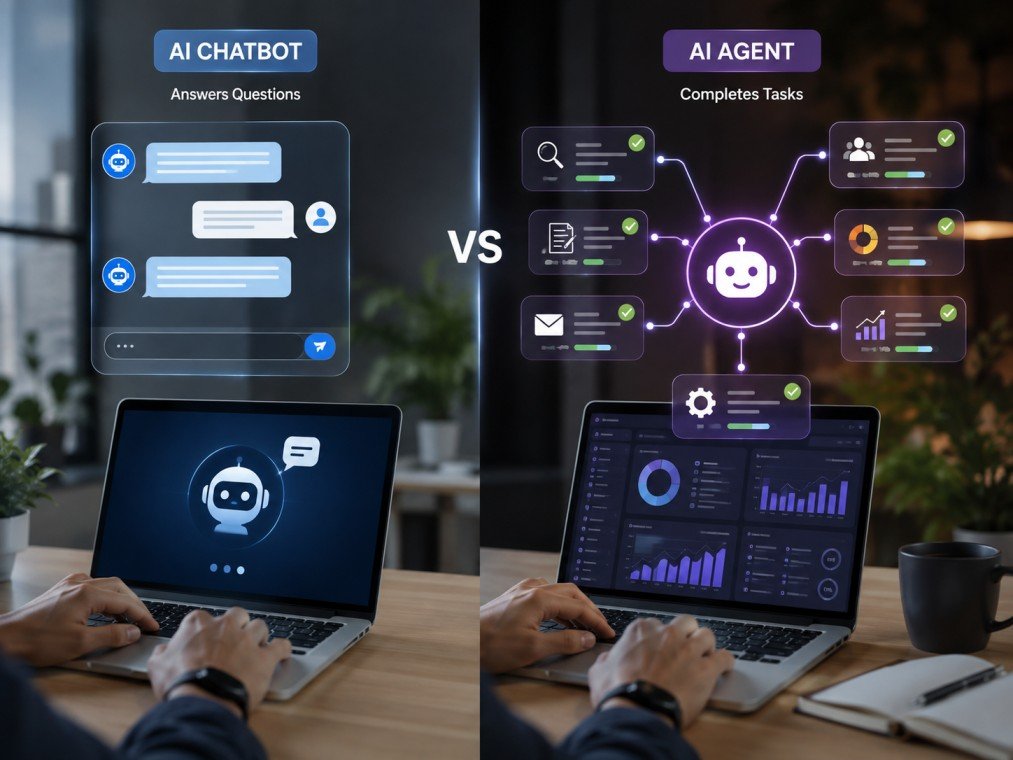
A chatbot may primarily focus on conversation and predefined or AI-generated responses.
An AI agent can be designed to go further by understanding a goal, deciding what steps may be required, using available tools and working through a task.
The distinction becomes particularly important when businesses start exploring AI automation.
So, what is the difference between an AI agent and a chatbot?
Let’s break it down.
Table of Contents
ToggleWhat Is a Chatbot?
A chatbot is software designed to communicate with users through a conversational interface.
Traditional chatbots typically follow predefined rules.
For example, a customer may select:
1 — Order Status
2 — Return Request
3 — Contact Support
The chatbot then provides the relevant response.
Modern AI chatbots can be much more flexible.
They may use large language models to understand natural-language questions and generate responses.
Examples of Chatbot Tasks
A chatbot might:
- Answer frequently asked questions
- Explain products
- Provide basic customer support
- Help users navigate a website
- Collect information
- Schedule simple requests
- Answer common questions
- Assist with basic troubleshooting
The key characteristic is that the chatbot’s primary interaction is conversation.
What Is an AI Agent?
An AI agent is an AI-powered system designed to work toward a goal and potentially perform multiple steps to accomplish it.
Instead of only responding to a question, an agent can potentially:
- Understand the objective.
- Break the task into steps.
- Decide what action to take.
- Use available tools.
- Observe the result.
- Continue or adjust its approach.
- Complete the task.
The exact capabilities depend on how the agent has been designed and what tools or permissions it has.
For example, a business AI agent might receive a request to research potential customers.
It could potentially search available data, organize information, evaluate predefined criteria and prepare a report.
That is considerably different from simply answering:
“What is a customer lead?”
AI Agent vs Chatbot: The Simple Difference
The easiest way to understand the distinction is:
A chatbot is primarily designed to communicate. An AI agent is designed to accomplish a goal, potentially using tools and multiple actions.
However, the boundary is not always perfectly defined.
Some modern chatbots have agent-like capabilities, while some systems described as agents may have relatively limited autonomy.
The technology is evolving quickly.
AI Agents vs Chatbots Comparison
| Feature | Chatbot | AI Agent |
|---|---|---|
| Main purpose | Conversation | Goal/task completion |
| Responds to questions | Yes | Yes |
| Multi-step tasks | Limited or depends on design | Often a core capability |
| Tool usage | Sometimes | Common |
| Planning | Usually limited | Can be part of the system |
| Autonomy | Usually lower | Can be higher |
| Decision-making | Limited | Can make decisions within defined boundaries |
| Automation | Basic to moderate | Moderate to advanced |
| Human supervision | Often required | Depends on task and risk |
| Business workflows | Customer conversations | Task and process automation |
This table is a simplified comparison because AI systems differ significantly in architecture and implementation.
How Does a Chatbot Work?
A typical chatbot workflow looks something like this:
User asks a question
↓
Chatbot interprets the message
↓
System identifies the appropriate response
↓
Chatbot responds
For an AI chatbot, a large language model may be involved in understanding and generating the response.
For a traditional rule-based chatbot, predefined rules may determine what happens next.
Example
A customer asks:
“What time does your store open?”
The chatbot can retrieve or generate the relevant information and answer.
This is a straightforward conversational task.
How Does an AI Agent Work?
An agent-based workflow can involve more stages.
For example:
User gives a goal
↓
AI understands the objective
↓
Creates or selects a plan
↓
Uses available tools
↓
Checks results
↓
Takes additional actions
↓
Completes the task
The actual workflow depends on the agent’s architecture.
Example
Imagine a user says:
“Find three suitable meeting times next week and prepare an email invitation.”
A sufficiently capable agent could potentially:
- Check calendar availability
- Identify suitable time slots
- Prepare an email
- Ask for confirmation
- Send the invitation if authorized
A basic chatbot may simply explain how to create a calendar event.
That difference illustrates the concept of task-oriented AI.
Key Difference: Conversation vs Action
One of the most useful ways to understand the difference is to look at action.
A chatbot can answer:
“How can I reset my password?”
An AI agent could potentially:
- Identify the user’s account
- Start the reset process
- Generate or send a reset link
- Confirm completion
Of course, an actual system would need the necessary integrations, authentication and permissions.
The important point is that the agent is designed around doing something, not only explaining something.
Are All AI Agents Autonomous?
No.
This is an important misconception.
The term “AI agent” does not necessarily mean that the system can independently do anything it wants.
Agents can operate within carefully defined boundaries.
For example, a business might allow an agent to:
- Read certain documents
- Search a database
- Draft emails
- Create reports
But require human approval before:
- Sending external communications
- Making purchases
- Deleting information
- Changing financial records
This is known as keeping humans involved in important decisions.
What Are AI Agents Used For?
AI agents can potentially be used across many industries.
Customer Support
An agent could help investigate customer issues, retrieve account information and follow predefined support procedures.
Sales
AI agents can potentially research prospects, update CRM information and assist sales teams.
Marketing
Agents can assist with:
- Research
- Content planning
- Campaign workflows
- Reporting
- Lead qualification
Software Development
Some AI systems can assist developers with:
- Code generation
- Debugging
- Testing
- Documentation
- Repository tasks
Research
AI agents can potentially perform multi-step research workflows by gathering and organizing information from permitted sources.
Business Operations
Agents can assist with repetitive workflows such as:
- Data processing
- Report preparation
- Document handling
- Task routing
- Internal knowledge retrieval
What Are Chatbots Used For?
Chatbots remain extremely useful.
Common applications include:
Customer Questions
Answering frequently asked questions.
Website Assistance
Helping visitors find information.
Lead Collection
Collecting names, email addresses or requirements.
Support
Providing first-level customer assistance.
Product Information
Explaining features, pricing or specifications.
Appointment Assistance
Helping users understand available services or initiate booking processes.
A chatbot can be the better choice when the primary requirement is communication rather than complex task execution.
AI Chatbot vs AI Agent for Customer Support
This is where the distinction becomes practical.
Suppose an ecommerce customer asks:
“Where is my order?”
A chatbot may answer:
“Your order is currently in transit.”
An agent could potentially go further by:
- Identifying the order
- Checking the shipping system
- Looking up tracking information
- Interpreting the status
- Explaining the expected next step
If the system has appropriate access and permissions, the agent can perform more of the workflow.
But Does Every Business Need an AI Agent?
No.
If your business receives 20 common questions every day, a simple chatbot may be enough.
You don’t need an advanced autonomous workflow to answer:
- What are your opening hours?
- Where are you located?
- What services do you provide?
- How can I contact you?
Using a complex agent for simple questions could add unnecessary cost and complexity.
When Should You Use a Chatbot?
A chatbot may be appropriate when you need:
- FAQ automation
- Website assistance
- Basic customer support
- Lead collection
- Simple conversations
- Guided navigation
- Product information
If the workflow is relatively predictable, a chatbot can be a practical choice.
When Should You Use an AI Agent?
An AI agent may make more sense when the workflow requires:
- Multiple steps
- Tool usage
- Data retrieval
- Decision-making
- Repeated actions
- System integrations
- Goal-oriented workflows
For example, an agent could potentially manage a process that requires information from several systems.
AI Agents and Digital Marketing
AI agents could become particularly useful in digital marketing.
Consider a marketing workflow.
A marketer wants to identify new content opportunities.
An agent could potentially:
- Research a topic.
- Identify related questions.
- Analyze existing content.
- Organize opportunities.
- Create a content brief.
- Prepare a publishing task.
The exact capabilities depend on the tools and integrations available.
AI Agents for SEO
SEO workflows can involve many repetitive activities.
An AI agent could potentially assist with:
- Keyword organization
- Content briefs
- Internal-link suggestions
- Content audits
- Competitor research
- Reporting
- Content refresh workflows
However, SEO decisions should not be completely delegated to AI.
Search behavior changes, business goals vary and content quality requires human judgment.
AI Agents for Small Businesses
Small businesses often have limited staff.
An AI agent could potentially assist with repetitive processes such as:
- Lead qualification
- Customer inquiry handling
- Appointment workflows
- Report generation
- Internal information retrieval
- Email drafting
The biggest consideration is not whether an agent is technically possible.
It is whether the automation creates enough value to justify the implementation and oversight required.
Benefits of AI Agents
Automation
Agents can potentially automate multi-step workflows.
Productivity
Employees can spend less time on repetitive tasks.
Speed
Some workflows can be completed faster.
Scalability
An automated workflow can potentially handle more requests without increasing manual effort proportionally.
Tool Integration
Agents can potentially interact with software systems through APIs and other approved tools.
Limitations of AI Agents
AI agents also introduce challenges.
Errors
An agent can make incorrect decisions or misunderstand a task.
Hallucinations
AI systems can generate information that sounds convincing but is incorrect.
Security
Giving an AI access to business systems requires careful security controls.
Cost
Advanced agent workflows may require multiple services and infrastructure.
Monitoring
Important workflows need monitoring and safeguards.
Unclear Decisions
Complex tasks may require human judgment that an AI system cannot reliably provide.
Benefits of Chatbots
Chatbots also have several advantages.
Simpler Implementation
Basic chatbot workflows can be easier to deploy.
Predictable
Rule-based systems can provide controlled responses.
Customer Availability
Chatbots can operate outside normal business hours.
Lower Complexity
For basic customer questions, a chatbot may be all that is needed.
Limitations of Chatbots
Traditional chatbots can struggle when:
- Questions are unexpected.
- Users don’t follow predefined options.
- Conversations require multiple systems.
- A task requires several actions.
- Context changes during the conversation.
Modern AI chatbots can address some of these limitations, which is why the line between chatbots and agents is becoming less rigid.
AI Agents vs Chatbots: Which Is Better?
There is no universal winner.
The better technology depends on your objective.
Choose a Chatbot When:
You mainly need conversation and information delivery.
Consider an AI Agent When:
You need goal-oriented task execution involving multiple steps and tools.
For many businesses, the ideal solution may actually be a combination.
A chatbot can handle the conversation.
An agent can perform complex tasks behind the scenes.
Can a Chatbot Become an AI Agent?
Potentially, yes.
Modern AI applications can combine conversational interfaces with agent-like capabilities.
For example:
User → Chat Interface → AI System → Tools → Business Systems → Result
In such a setup, the user may still feel like they are talking to a chatbot, while the system underneath performs agentic tasks.
This is one reason why the terminology can sometimes become confusing.
AI Agent vs Chatbot vs AI Assistant
These terms are often used interchangeably, but they can describe different concepts.
Chatbot
Primarily focused on conversational interaction.
AI Assistant
Designed to assist a user with various tasks, often through conversation.
AI Agent
Designed to pursue a goal and potentially perform multi-step actions using tools.
These are not strict universal definitions, and different companies may use the terms differently.
What Is the Future of AI Agents?
AI agents are likely to become increasingly integrated into software and business workflows.
Instead of opening several applications and manually moving information between them, users may increasingly interact with AI systems that coordinate multiple steps.
For example:
“Prepare my weekly marketing report and identify the three campaigns that need attention.”
A future marketing agent could potentially gather approved data, analyze it and prepare a report.
Human review would still be important for many business decisions.
The future is therefore less about AI replacing every employee and more about people working with increasingly capable AI systems.
How Businesses Should Prepare for AI Agents
Businesses interested in AI agents should start with simple workflows.
Step 1: Identify Repetitive Tasks
Find activities employees perform repeatedly.
Step 2: Measure the Cost
Estimate how much time the process consumes.
Step 3: Check Data Access
Determine which systems and information the AI would need.
Step 4: Start With Low-Risk Automation
Avoid giving an AI unrestricted control over sensitive systems.
Step 5: Add Human Approval
Require confirmation for important decisions.
Step 6: Monitor Results
Track errors, savings and user satisfaction.
Step 7: Expand Gradually
Once a workflow is reliable, consider additional automation.
Frequently Asked Questions
What is the main difference between an AI agent and a chatbot?
A chatbot is primarily designed for conversational interaction, while an AI agent is generally designed to accomplish a goal through multiple steps, potentially using external tools and systems.
Is ChatGPT a chatbot or an AI agent?
ChatGPT is a conversational AI system, but depending on the capabilities and tools available in a particular environment, it can also perform tasks that are commonly associated with agentic systems. The exact distinction depends on the functionality being used.
Are AI agents better than chatbots?
Not necessarily. A chatbot may be better for simple customer questions, while an AI agent can be more appropriate for complex multi-step workflows.
Can AI agents replace chatbots?
An agent can potentially perform chatbot-like conversational tasks, but businesses may still use simpler chatbot systems when the primary requirement is customer communication.
Can AI agents work without humans?
Some workflows can operate with limited human intervention, but important or high-risk processes should generally include appropriate human oversight and controls.
Are AI agents expensive?
Costs vary widely depending on the model, infrastructure, integrations, usage and complexity of the workflow. A simple agent can be relatively inexpensive, while enterprise systems can be significantly more complex.
Can small businesses use AI agents?
Yes. Small businesses can potentially use AI agents for repetitive workflows such as lead qualification, customer support, reporting and internal information retrieval.
Are AI agents safe?
AI agents can introduce security and operational risks, especially when they have access to business systems. Proper permissions, authentication, monitoring and human approval are important.
What is the difference between an AI assistant and an AI agent?
An AI assistant generally helps a user with tasks, often through conversation. An AI agent typically emphasizes goal-oriented, multi-step task execution. In practice, the capabilities can overlap.
Final Thoughts
The difference between AI agents and chatbots is becoming increasingly important as businesses adopt artificial intelligence.
A simple chatbot can be an excellent solution for answering customer questions and providing information.
An AI agent goes a step further by potentially planning actions, using tools and completing multi-step workflows.
But more advanced does not always mean better.
If your business needs simple FAQ automation, start with a chatbot.
If you have repetitive multi-step processes involving several tools or systems, an AI agent may provide more value.
The best approach is to begin with the business problem rather than the technology.
Don’t ask, “Do I need an AI agent?”
Ask:
“Which repetitive task can AI reliably help me complete?”
That question will lead to a much more practical AI strategy.
Disclaimer: AI capabilities, terminology, pricing, integrations and available features change rapidly. This article provides general educational information and should not be treated as technical, security, legal or business advice. Always evaluate an AI system’s permissions, privacy, reliability and security before connecting it to business data or critical systems.