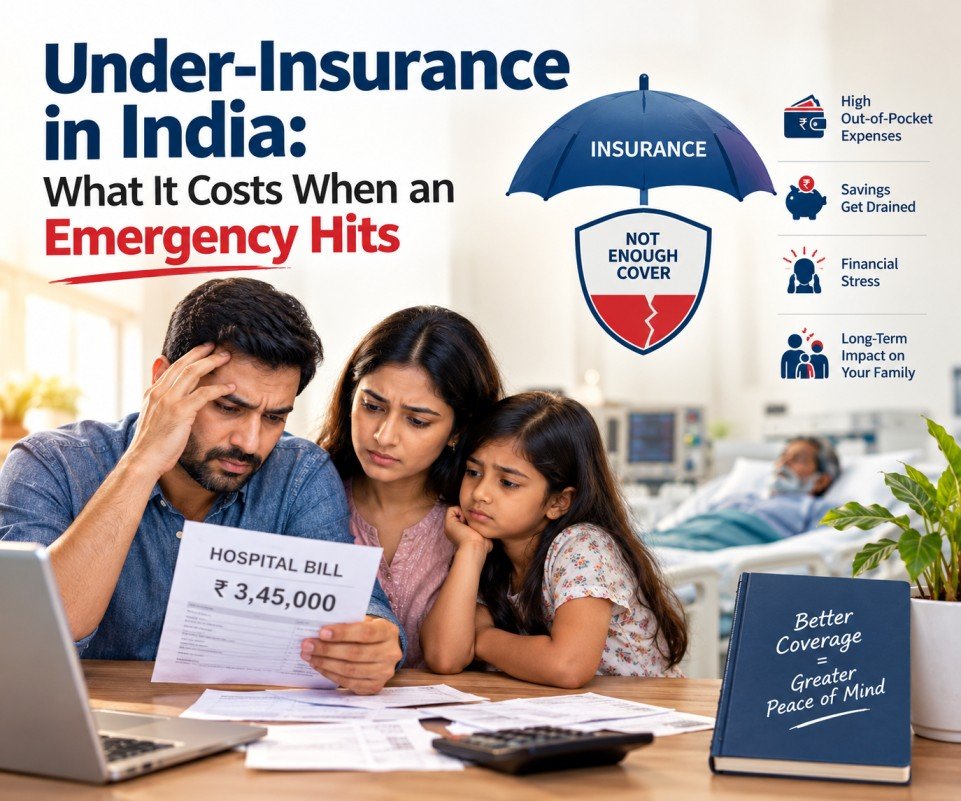
Most conversations about insurance in India are about whether people have it at all. A quieter and more dangerous problem is the people who do have it, but not enough of it. Under-insurance, holding a policy too small for the loss it is meant to cover, is widespread, and it is dangerous precisely because it feels like safety right up until the moment it isn’t.
A family with a small health policy or a modest term plan believes it’s protected, and arranges its finances around that belief. The gap between the belief and the real cost of a serious event only shows itself when the event arrives, the worst possible moment to discover it.
Table of Contents
ToggleBeing covered isn’t the same as being covered enough
Insurance suggests an all-or-nothing state, covered or not, but the reality is a matter of degree. A health policy for a few lakh is real cover, yet it can fall far short of what a major illness in a private hospital costs. A term plan bought years ago may have made sense then and be a fraction of what your family would now need. In each case there is a policy, and a false sense of completeness that comes with holding one.
That gap between what you’re insured for and what you’d actually lose has a name: the protection gap. It’s the part of a loss that insurance won’t pay because the cover was never large enough, and it lands squarely on the household.
Why is India so widely under-insured?
Several habits push people towards buying too little. Cover is often bought as a formality, a small policy taken to tick a box or claim a tax break, sized to the premium someone was willing to pay rather than the loss they’d face. Buying the cheapest adequate-looking option quietly produces cover that isn’t adequate at all.
Time then widens the gap. A sum insured that was reasonable a decade ago is eroded by inflation, and medical costs in particular have risen faster than most people’s health cover. Incomes and responsibilities grow, but the policy often doesn’t, because no one prompts a review. The result is a country full of people technically insured and practically exposed.
What the gap costs when the emergency actually arrives
The cost of under-insurance is invisible until a claim, and then it is brutally concrete. When a hospital bill runs past the sum insured, the insurer pays up to the limit and the rest is yours to find, at exactly the moment you can least afford it. A serious illness bites hardest, since medical bills can dwarf a modest health policy in a single admission.
What happens next is a familiar, costly scramble. The household drains its savings, and when those run out it borrows a personal loan at a steep rate, or pledges gold through a gold loan appto raise cash fast. A shortfall in cover becomes a debt that outlasts the emergency, turning a survivable event into a lasting setback.
Why is under-insurance sometimes worse than none?
There’s a case that being under-insured is more dangerous than being uninsured, and it rests on false confidence. Someone with no cover at least knows they are exposed and may keep a larger emergency fund. Someone with a small policy believes they are protected and plans accordingly, right up to the day the cover proves too thin.
That misplaced security is the trap. You budget and take risks assuming a serious event is handled, only to find in the middle of one that most of the cost still falls on you. Discovering the gap while already dealing with a crisis is part of what makes under-insurance so damaging. Cover you can’t rely on when it matters gives you the comfort of insurance without the protection.
Working out how much cover is actually enough
Fixing this starts with honestly sizing the loss rather than the premium. For health, that means covering what serious treatment costs in your city today, with room for medical inflation, often far more than the small policies people default to, and a top-up plan can raise the ceiling cheaply. For life, it means a sum that could replace your income and clear your debts, not a token amount.
Property follows the same logic, insured at what it would cost to rebuild. Working through these numbers, and comparing what adequate cover would cost through an insurance app or an adviser, usually shows that closing the gap is far cheaper than people assume. Match the cover to the loss, then revisit it as costs and responsibilities rise.
What does it cost to fix versus to ignore?
Set the two costs side by side and the case makes itself. The extra premium to move from inadequate to adequate cover is usually modest, a manageable annual sum. The cost of leaving the gap open is potentially lakhs of out-of-pocket expense and years of debt.
That imbalance is what makes under-insurance such an avoidable mistake, both common and unusually cheap to correct, unlike most financial problems. Checking whether your cover would genuinely carry you through a serious event, and topping it up if it wouldn’t, is among the cheapest protection your money can buy, and among the most valuable when you need it.