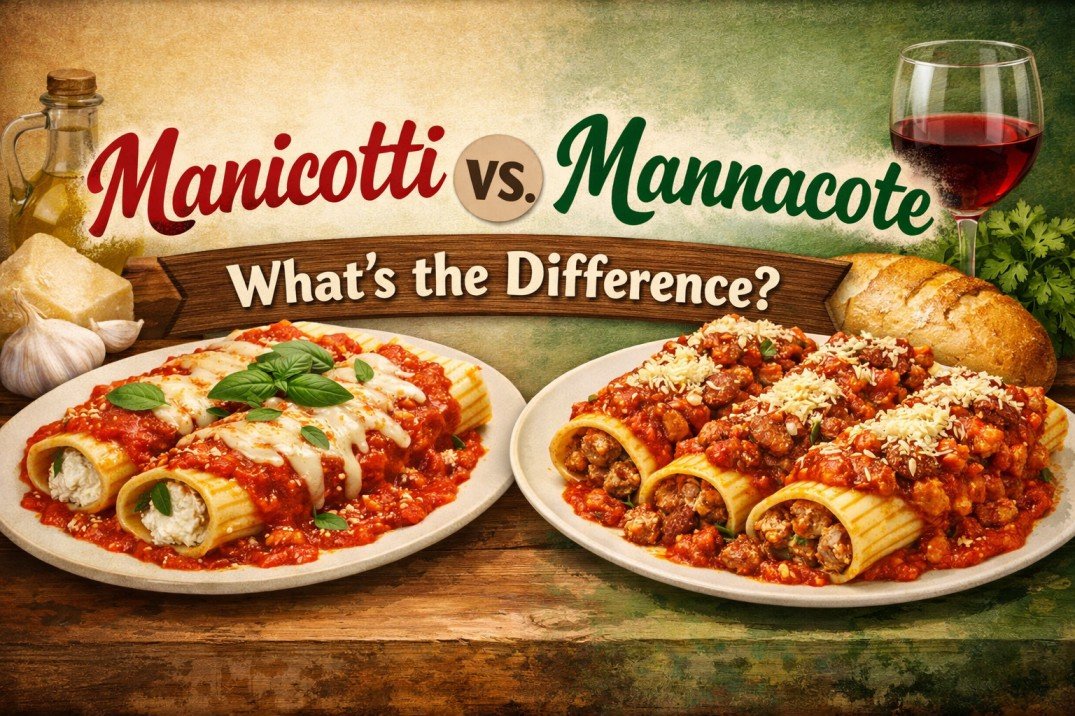
If you’ve ever browsed an Italian restaurant menu or listened to Italian-American conversations, you might have come across two seemingly different words: manicotti and mannacote. At first glance, they may appear to refer to entirely different dishes—but in reality, the distinction is more about language, culture, and pronunciation than food itself.
In this comprehensive guide, we’ll break down everything you need to know about manicotti vs. mannacote—from their origins and meanings to regional dialects, cultural significance, preparation styles, and common misconceptions.
Table of Contents
Toggle1. What Is Manicotti?
Manicotti is a classic Italian pasta dish consisting of large tube-shaped pasta shells stuffed with a rich filling—typically ricotta cheese, mozzarella, herbs, and sometimes meat—then baked in tomato sauce.
Key Characteristics:
- Large cylindrical pasta tubes
- Stuffed with cheese or meat filling
- Covered in marinara or tomato sauce
- Baked until bubbly and golden
The word manicotti comes from Italian and is the plural form of manicotto, which means “little sleeve”—a reference to the pasta’s tubular shape.
2. What Is Mannacote?
Here’s where things get interesting.
“Mannacote” is not an official Italian word. Instead, it’s an Italian-American pronunciation or slang version of “manicotti.”
So technically:
- Manicotti = correct Italian term
- Mannacote = Americanized pronunciation
Despite this, “mannacote” has become culturally significant in certain communities, especially among Italian-Americans in the northeastern United States.
3. The Linguistic Difference
The difference between manicotti and mannacote is primarily phonetic (sound-based) rather than culinary.
Standard Italian Pronunciation:
- Manicotti → mah-nee-KOH-tee
Italian-American Pronunciation:
- Mannacote → mah-nuh-GOAT or man-uh-GOAT
Over time, Italian immigrants adapted their language to fit American speech patterns, resulting in simplified or altered pronunciations.
4. Italian vs. Italian-American Pronunciation
Italian is a phonetic language, meaning words are pronounced exactly as they’re spelled. However, when Italian immigrants arrived in America (late 19th–early 20th century), several factors changed how words were spoken:
- Influence of English phonetics
- Regional dialects from Italy
- Generational language shifts
- Oral tradition over written language
This led to transformations like:
| Italian Word | Italian-American Version |
|---|---|
| Manicotti | Mannacote |
| Mozzarella | Mutzarel / Mootz |
| Capicola | Gabagool |
| Ricotta | Rigot |
So “mannacote” is part of a broader pattern of linguistic evolution.
5. Historical Origins of the Word
The term manicotti originates from standard Italian, but many Italian immigrants who came to the U.S. spoke regional dialects, not standardized Italian.
Italy wasn’t fully unified linguistically until the late 19th century, so immigrants brought with them:
- Neapolitan dialects
- Sicilian dialects
- Southern Italian speech patterns
These dialects often:
- Dropped vowel endings
- Softened consonants
- Altered syllables
Thus, “manicotti” gradually transformed into “mannacote” in spoken Italian-American communities.
6. Cultural Context: Why “Mannacote” Exists
“Mannacote” is deeply rooted in Italian-American identity.
It reflects:
- Family traditions
- Oral storytelling
- Home cooking culture
- Generational heritage
In many households, especially in places like New York, New Jersey, and Philadelphia, “mannacote” isn’t just a word—it’s a symbol of:
- Sunday dinners
- Nonna’s recipes
- Cultural pride
Even though it’s technically “incorrect,” it carries emotional and cultural authenticity.
7. Regional Dialects and Their Influence
Most Italian immigrants to the U.S. came from Southern Italy, where dialects differ significantly from standard Italian.
Key Dialect Features:
- Final vowels often dropped
- “c” sounds softened or changed
- Syllables compressed
For example:
- Manicotti → Manigot → Mannacote
This transformation is consistent with how many Italian words evolved in immigrant communities.
8. Differences in Usage Today
In Italy:
- Only “manicotti” is used
- “Mannacote” would not be understood
In the United States:
- “Manicotti” is used in:
- Restaurants
- Cookbooks
- Formal settings
- “Mannacote” is used in:
- Casual conversation
- Italian-American households
- Pop culture references
9. How Manicotti Is Made
While the linguistic debate is interesting, the real star is the dish itself.
Ingredients:
- Manicotti pasta shells
- Ricotta cheese
- Mozzarella cheese
- Parmesan cheese
- Eggs
- Fresh herbs (parsley, basil)
- Tomato sauce
Preparation Steps:
- Cook pasta shells until al dente
- Prepare cheese filling mixture
- Stuff shells carefully
- Place in baking dish with sauce
- Top with cheese
- Bake until golden and bubbly
10. Traditional vs. Modern Recipes
Traditional Italian Style:
- Uses crepes (crespelle) instead of dried pasta
- Lighter filling
- Simpler seasoning
Italian-American Style:
- Uses dried pasta tubes
- Heavier cheese filling
- More sauce and cheese on top
This distinction further highlights how Italian cuisine evolved in America.
11. Common Misconceptions
❌ Myth 1: Mannacote is a different dish
Truth: It’s the same dish—just pronounced differently.
❌ Myth 2: Mannacote is “wrong”
Truth: Linguistically non-standard, but culturally valid.
❌ Myth 3: Manicotti always uses pasta tubes
Truth: Traditional versions often use crepes.
12. Which Term Should You Use?
It depends on context:
Use “Manicotti” when:
- Writing formally
- Ordering at restaurants
- Cooking from recipes
- Speaking with non-Italian audiences
Use “Mannacote” when:
- Talking with family
- Embracing Italian-American culture
- Keeping traditions alive
There’s no “right” or “wrong”—just different contexts.
13. Why This Difference Matters
At first, this may seem like a trivial pronunciation issue, but it actually reveals something deeper:
- How languages evolve in diaspora communities
- How culture shapes communication
- How food connects generations
“Mannacote” is a linguistic time capsule—a preserved version of how immigrants adapted to a new world while holding onto their roots.
14. Final Thoughts
So, what’s the difference between manicotti and mannacote?
In short:
- Manicotti is the correct Italian term
- Mannacote is an Italian-American pronunciation
But beyond that simple distinction lies a rich story of immigration, adaptation, and cultural identity.
Whether you call it manicotti or mannacote, one thing is certain:
it’s a delicious, comforting dish that continues to bring people together around the table.
FAQ
What is the difference between manicotti and mannacote?
The difference between manicotti and mannacote is mainly in pronunciation and cultural usage. Manicotti is the correct Italian term for a stuffed pasta dish, while mannacote is an Italian-American slang or dialect version of the same word.
Is mannacote a real Italian word?
No, mannacote is not a standard Italian word. It comes from Italian-American pronunciation influenced by Southern Italian dialects. In Italy, people only use manicotti.
Why do Italian-Americans say mannacote?
Italian-Americans say mannacote due to linguistic evolution. Many immigrants spoke regional dialects where vowel endings were softened or dropped, leading to altered pronunciations over generations.
Are manicotti and stuffed shells the same?
No, manicotti and stuffed shells are different dishes. Manicotti uses large tube-shaped pasta, while stuffed shells use shell-shaped pasta. The fillings are often similar but the shape and presentation differ.
What is manicotti traditionally made of?
Traditional manicotti is made with pasta tubes or crepes filled with ricotta cheese, mozzarella, herbs, and sometimes meat, then baked with tomato sauce and cheese on top.
How do you pronounce manicotti correctly?
The correct Italian pronunciation of manicotti is mah-nee-KOH-tee. In Italian-American dialect, it is often pronounced as mannacote.
Is it wrong to say mannacote?
It’s not “wrong,” but it’s non-standard Italian. It’s culturally accepted in Italian-American communities but should be avoided in formal or authentic Italian contexts.
Do Italians understand the word mannacote?
Most Italians will not recognize “mannacote”, as it does not exist in standard Italian. They use manicotti instead.
What does manicotti mean in Italian?
The word manicotti comes from manicotto, meaning “little sleeve”, referring to the pasta’s tube-like shape.
Is manicotti an authentic Italian dish?
Yes, manicotti is based on authentic Italian cuisine, but the Italian-American version (with pasta tubes and heavy cheese filling) differs from traditional Italian recipes, which often use crepes.