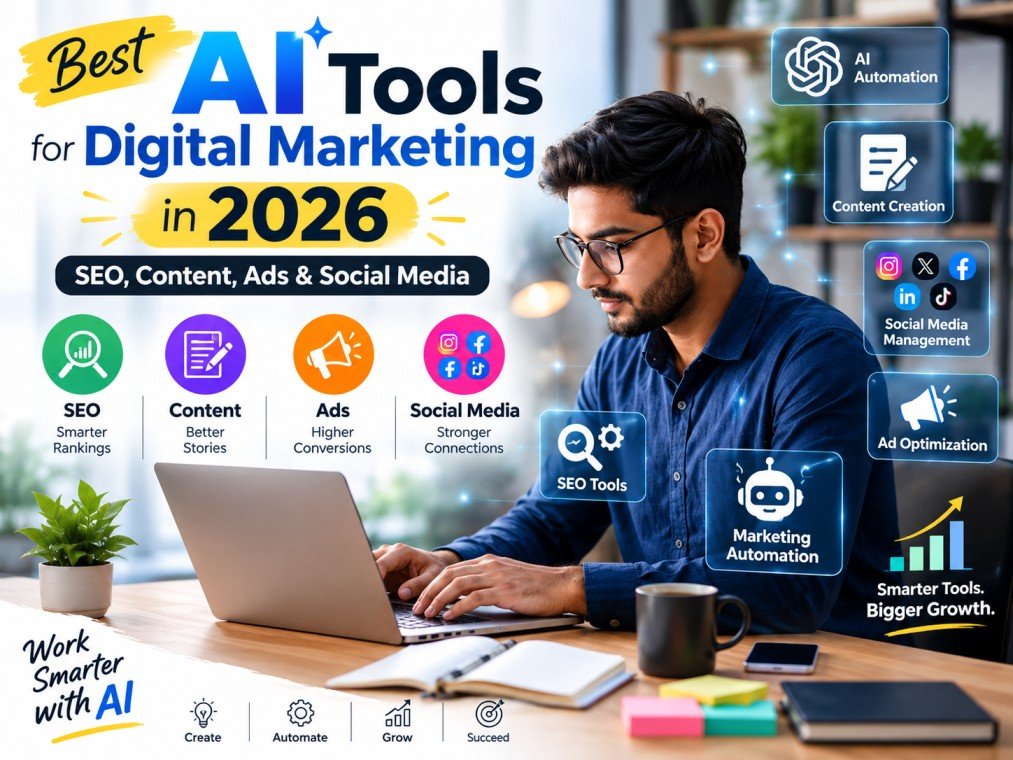
Artificial intelligence has moved from being an experimental technology to becoming a practical part of many digital marketing workflows.
Marketers can now use AI to brainstorm content, analyze information, create visuals, research keywords, prepare campaigns, summarize data and automate repetitive tasks.
However, using more AI tools does not automatically create a better marketing strategy.
The real advantage comes from choosing the right tool for the right task.
A content creator may need an AI writing assistant.
An SEO professional may need research and optimization tools.
A social media manager may need content planning and creative tools.
A performance marketer may need AI assistance for campaign analysis and ad creative.
This guide explains the major categories of AI marketing tools and how marketers can use them effectively.
Table of Contents
ToggleWhat Are AI Marketing Tools?
AI marketing tools are software applications that use artificial intelligence to assist with marketing-related tasks.
Depending on the platform, they can help with:
- Keyword research
- Content creation
- SEO
- Market research
- Social media
- Advertising
- Email marketing
- Image creation
- Video creation
- Customer support
- Data analysis
- Marketing automation
Some tools focus on one specific task, while others combine several capabilities.
Why Are AI Tools Important for Digital Marketing?
Traditional digital marketing can involve many repetitive activities.
For example, an SEO professional may research hundreds of keywords.
A social media manager may create dozens of posts every month.
A content team may need to turn one idea into articles, videos, newsletters and social posts.
AI can assist with parts of these workflows.
Potential Benefits
Faster research
AI can help organize large amounts of information.
Content assistance
It can generate ideas, outlines and drafts.
Better productivity
Repetitive tasks can sometimes be automated.
Content repurposing
One piece of content can be adapted for different platforms.
Data analysis
AI-assisted tools can help identify patterns in marketing data.
But these benefits depend on how the tools are used.
Best AI Tools for Digital Marketing
There is no universal “best” AI marketing tool.
The right choice depends on the marketing task.
1. ChatGPT — Marketing Strategy and Content
ChatGPT can assist with a wide range of digital marketing tasks.
Marketers can use it for:
- Content ideas
- Blog outlines
- SEO briefs
- Social media captions
- Email drafts
- Ad copy variations
- Customer personas
- Marketing brainstorming
- Content repurposing
- FAQ generation
One useful approach is to give the AI detailed context.
For example:
Create a content brief for a local digital marketing company targeting small businesses in India. Include customer pain points, search intent, FAQs and practical examples.
The output should then be reviewed and adapted to the actual business.
Best For
Marketing strategy, brainstorming and content workflows
2. Google Gemini — Research and Marketing Ideas
Google Gemini can assist with research, brainstorming, writing and summarization.
Possible marketing applications include:
- Topic research
- Content planning
- Competitor research assistance
- Brainstorming
- Summarization
- Campaign ideas
When using AI for research, marketers should verify important information against reliable sources.
Best For
Research assistance and marketing brainstorming
3. Perplexity — Marketing Research
Perplexity is useful for research-oriented workflows.
A marketer can use it to explore:
- Market trends
- Industry information
- Competitor topics
- Customer questions
- Research sources
- Topic backgrounds
The important step is to inspect the underlying sources rather than accepting every AI-generated statement automatically.
Best For
Research and source discovery
4. Semrush — SEO and Competitive Research
Semrush provides a large set of digital marketing and SEO tools.
Depending on the current plan and features, marketers can use it for:
- Keyword research
- Competitor analysis
- Backlink research
- SEO analysis
- Content research
- Rank tracking
- Site audits
Its AI-related features can also assist with parts of content and marketing workflows.
Best For
SEO research and competitive analysis
5. Ahrefs — SEO Research
Ahrefs is another widely used SEO platform.
It can help marketers research:
- Keywords
- Backlinks
- Competitors
- Organic search opportunities
- Content performance
AI can help with some content-related tasks, but the underlying SEO data remains important for making informed decisions.
Best For
SEO and competitor research
6. Canva — Marketing Creatives
Canva can help marketers create visual assets without requiring advanced graphic-design skills.
Common uses include:
- Instagram posts
- Social media banners
- Advertisements
- Presentations
- Infographics
- YouTube thumbnails
- Pinterest graphics
- Marketing presentations
AI-assisted design features can speed up some creative tasks.
Best For
Social media and marketing design
7. Adobe Express — Marketing Content
Adobe Express offers tools for creating marketing graphics, videos and social media content.
It can be useful for:
- Promotional graphics
- Social media content
- Short videos
- Marketing materials
- Content resizing
Best For
Quick marketing creatives
8. CapCut — Short-Form Marketing Videos
CapCut can help marketers create and edit short videos.
Depending on the current feature set and availability, creators can use AI-assisted features for:
- Captions
- Video editing
- Background removal
- Effects
- Short-form content
This can be useful for Instagram Reels, YouTube Shorts and other vertical video formats.
Best For
Short-form video marketing
9. Grammarly — Marketing Copy Editing
Grammarly can help improve written marketing material.
It can assist with:
- Grammar
- Clarity
- Tone
- Conciseness
- Rewriting
Marketing copy still needs a human review because brand voice and persuasive messaging require context.
Best For
Copy editing and writing improvement
10. HubSpot — Marketing and CRM Workflows
HubSpot provides marketing, sales and customer relationship tools with AI capabilities.
Depending on the product and plan, businesses can use it for workflows involving:
- CRM
- Marketing
- Customer data
- Sales
- Content
Best For
Marketing + CRM workflows
Best AI Tools for SEO
AI can assist SEO professionals at multiple stages.
Keyword Research
AI can generate related topics and question variations.
Search Intent
It can help classify queries into informational, commercial, navigational and transactional intents.
Content Briefs
AI can help organize subtopics and questions.
Content Optimization
AI can identify areas that may need clearer explanations.
Content Refreshing
AI can help identify sections that require review.
However, AI should not replace actual keyword data, search-result analysis or expert judgment.
AI Tools for Keyword Research
For serious keyword research, dedicated SEO platforms such as Semrush and Ahrefs can provide valuable data.
AI assistants can then help turn that data into:
- Topic clusters
- Content briefs
- FAQs
- Long-tail variations
- Article structures
A strong workflow is therefore:
SEO data → AI analysis → human strategy → content
rather than:
AI → random keywords → hundreds of articles
Best AI Tools for Content Marketing
Content marketing requires more than writing articles.
You may need:
- Topic research
- Content planning
- Writing
- Editing
- Images
- Social promotion
- Repurposing
A practical toolkit could combine an AI writing assistant with a design platform and an SEO research tool.
How AI Can Help Bloggers
A blogger can use AI to:
- Find topic ideas.
- Group related keywords.
- Create an outline.
- Generate questions.
- Draft sections.
- Rewrite unclear passages.
- Create social media versions.
- Develop image concepts.
- Build content updates.
But the final article should contain information that is genuinely useful to the reader.
AI Tools for Social Media Marketing
Social media marketing involves both creativity and consistency.
AI can help generate:
- Caption ideas
- Content calendars
- Video scripts
- Hook ideas
- Post variations
- Hashtag suggestions
- Creative concepts
A marketer can take one blog article and turn it into:
Blog → Instagram carousel → Reel script → X post → LinkedIn post → Pinterest description
This is one of the most practical applications of AI.
AI Tools for Google Ads and Paid Marketing
AI is increasingly used within advertising platforms to assist with campaign creation, targeting, creative development and optimization.
Marketers can also use AI assistants to brainstorm:
- Ad headlines
- Descriptions
- Audience ideas
- Landing-page copy
- Campaign concepts
- A/B testing ideas
However, advertising decisions should be based on actual campaign data.
AI-generated ad copy should not be published without checking:
- Claims
- Pricing
- Offers
- Brand information
- Policy compliance
AI Tools for Email Marketing
AI can help with:
- Subject-line ideas
- Email drafts
- Personalization ideas
- Follow-up sequences
- Newsletter outlines
- Content repurposing
For example, a long blog article can be converted into a short newsletter.
The marketer should still ensure that emails are accurate, relevant and consistent with the brand voice.
AI for Local SEO
Local businesses can use AI to assist with:
- Local content ideas
- FAQ generation
- Review-response drafts
- Service descriptions
- Location-page planning
- Social content
However, AI should never be used to generate fake customer reviews.
Reviews should represent genuine customer experiences.
AI for Digital Marketing Agencies
Agencies can potentially save significant time by using AI for repetitive workflows.
For example:
Client Research
Create an initial research framework.
Content Planning
Build monthly topic calendars.
Social Media
Generate first drafts of captions.
Reporting
Summarize large amounts of campaign data.
Client Communication
Prepare draft emails and reports.
Creative Production
Generate initial concepts for campaigns.
The agency should still apply human strategy and quality control.
AI Tools for Small Businesses
Small businesses often have limited marketing resources.
AI can help them handle some tasks internally.
For example:
- Create social media ideas
- Draft website copy
- Research content topics
- Prepare email campaigns
- Create simple graphics
- Analyze customer questions
This doesn’t mean a business needs dozens of subscriptions.
Start with the tools that solve the most important problems.
AI Marketing Tools: Free vs Paid
Many marketing platforms offer free trials, limited free plans or free features.
Before paying for a tool, consider:
- Usage limits
- Data access
- Export options
- Integrations
- Team features
- Commercial usage
- Accuracy
- Customer support
A free tool is useful only if its limitations do not prevent you from completing your work.
How to Choose the Right AI Marketing Tool
Ask these questions before adding another AI tool to your marketing stack.
What Problem Does It Solve?
Don’t buy a tool simply because it is trending.
Does It Save Time?
Measure whether the tool actually reduces manual work.
Is the Output Reliable?
Test the results before using them in important campaigns.
Does It Integrate With Your Workflow?
A powerful tool that requires constant manual copying may not be efficient.
Is the Cost Justified?
Compare the subscription price with the time or revenue benefit it provides.
A Simple AI Digital Marketing Workflow
A practical workflow can look like this:
Step 1: Research the market.
Step 2: Identify customer problems.
Step 3: Research keywords.
Step 4: Build a content cluster.
Step 5: Use AI to create a content brief.
Step 6: Write and edit the article.
Step 7: Create supporting visuals.
Step 8: Publish and internally link related content.
Step 9: Repurpose the article for social media.
Step 10: Monitor performance.
Step 11: Update content when information changes.
This creates a complete marketing cycle rather than treating AI as only a writing tool.
AI Does Not Replace Digital Marketing Strategy
This is an important distinction.
AI can help execute tasks.
It does not automatically know:
- Your ideal customer
- Your competitive advantage
- Your business economics
- Your brand positioning
- Your customer relationships
- Your local market
A marketer still needs to make strategic decisions.
The strongest model is:
Human strategy + AI assistance + data + experimentation
How to Use AI Without Hurting SEO
Using AI is not a shortcut to search rankings.
Avoid:
- Publishing large numbers of generic articles
- Copying competitor content
- Adding keywords unnaturally
- Creating pages with little original value
- Publishing unverified claims
- Generating fake reviews
- Creating content solely to manipulate search rankings
Instead:
- Research the audience
- Answer specific questions
- Add original examples
- Verify facts
- Improve existing information
- Use first-hand expertise
- Keep content updated
This approach is much more sustainable.
AI, SEO and Google AI Search
Search is increasingly becoming more conversational.
People may ask complete questions rather than typing only short keywords.
For example:
Instead of:
“local SEO”
a user may ask:
“How can a small restaurant get more customers from Google without spending heavily on ads?”
This means marketers should understand the underlying question behind a keyword.
Create content that answers the actual problem.
How to Optimize Content for AI Search
There is no guaranteed formula for appearing in AI-generated search results.
However, useful practices include:
- Answer the main question clearly.
- Use descriptive headings.
- Explain concepts with examples.
- Include relevant supporting questions.
- Cite reliable information where appropriate.
- Keep important information current.
- Demonstrate genuine expertise.
- Avoid unnecessary filler.
Most importantly, write for people first.
Best AI Marketing Stack for Beginners
A beginner doesn’t need a huge collection of tools.
A simple stack could include:
AI assistant: Research, ideas and content drafting.
SEO platform: Keyword and competitor research.
Design platform: Social graphics and presentations.
Video editor: Reels and short videos.
Analytics: Measure actual results.
Add specialized tools only when a genuine need appears.
Final Thoughts
AI has changed the digital marketing workflow, but it has not eliminated the need for marketers.
The best AI tools can help you research faster, generate ideas, create content, analyze information and automate repetitive work.
But the tool itself is not the strategy.
A successful digital marketing workflow still depends on understanding the audience, choosing the right search intent, creating useful content, measuring results and continuously improving.
For most marketers, the best approach is not to collect dozens of AI subscriptions.
Start with a small toolkit.
Learn how each tool fits into your workflow.
Then build a system around research → strategy → content → distribution → measurement → optimization.
That is where AI can create the biggest practical advantage.
Frequently Asked Questions
What are the best AI tools for digital marketing?
Useful options include ChatGPT, Gemini, Perplexity, Semrush, Ahrefs, Canva, Adobe Express, CapCut, Grammarly and HubSpot, depending on the specific marketing task.
Which AI tool is best for SEO?
There is no single best tool. Dedicated SEO platforms are useful for keyword and competitor data, while AI assistants can help turn research into content strategies and briefs.
Can AI tools replace digital marketers?
AI can automate or assist with many repetitive tasks, but strategy, creativity, customer understanding and decision-making still require human involvement.
Can AI help with Google Ads?
Yes. AI can assist with campaign ideas, copy variations and analysis, while advertising platforms themselves increasingly include AI-powered features. Campaign decisions should still be monitored using actual performance data.
Which AI tool is best for social media?
The best choice depends on the task. AI assistants can help with captions and ideas, while platforms such as Canva and CapCut can assist with visual and video production.
Are AI marketing tools free?
Some offer free plans or limited free features. Pricing, usage limits and available features change, so check the current official plan before choosing a tool.
Can AI-generated content rank on Google?
AI assistance itself does not guarantee rankings. Content should provide genuine value, be accurate and useful, and meet the needs of the audience.
How can small businesses use AI for marketing?
Small businesses can use AI for content ideas, social media, customer FAQs, email drafts, research, creative concepts and other repetitive marketing tasks.
Is AI useful for local SEO?
Yes. AI can assist with content planning, FAQs, service descriptions and other local marketing workflows. However, local information should be accurate and reviews should always represent genuine customer experiences.
Disclaimer: AI tools, features, pricing, usage limits and commercial-use policies can change frequently. Verify current information on the respective official websites before making purchasing or business decisions. This article is for general educational and informational purposes and does not constitute professional marketing, legal or financial advice.