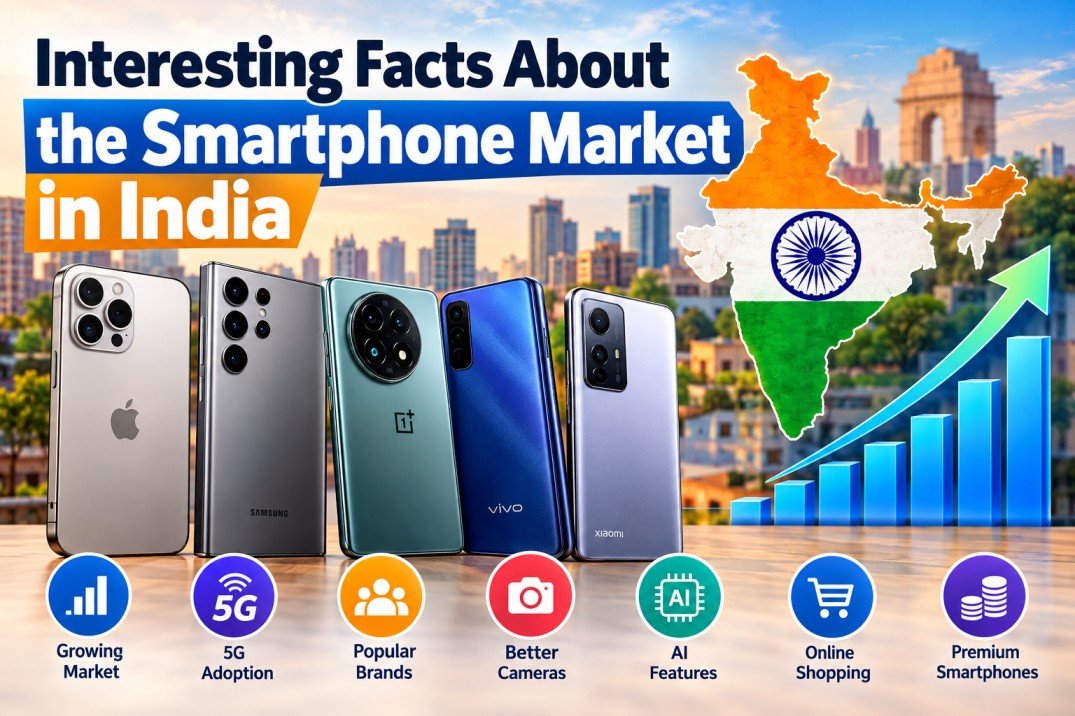
Interesting Facts About the Smartphone Market in India: Trends, Brands and Consumer Habits
India has become one of the world’s most important smartphone markets, with millions of consumers relying on mobile devices for communication, online shopping, digital payments, entertainment and work. From affordable Android phones to premium iPhones, smartphones have changed how people live, shop and access information.
However, the smartphone market in India is evolving. Consumers are looking for better cameras, faster processors, longer battery life, 5G connectivity and artificial intelligence (AI) features. At the same time, rising device prices are influencing buying decisions.
According to Counterpoint Research, India’s smartphone market grew 1% by shipment volume and 8% by market value in 2025. This difference highlights an important trend: consumers are increasingly spending more on smartphones even when unit sales grow slowly.
In this article, we explore interesting facts about the Indian smartphone market, popular brands, emerging technologies, consumer preferences and the trends likely to influence future smartphone purchases.
Table of Contents
Toggle1. India Is One of the World’s Largest Smartphone Markets
India is a major market for smartphone manufacturers because of its large population, growing digital economy and widespread use of mobile internet.
Smartphones are no longer used only for calling and messaging. People depend on them for online education, banking, shopping, navigation, entertainment and professional communication.
The market includes several price segments, from entry-level devices for budget-conscious buyers to premium smartphones designed for photography, gaming and productivity.
This diversity makes India an important market for manufacturers seeking to reach different consumer groups.
2. Vivo, Samsung and OPPO Are Important Players in India
The Indian smartphone market features strong competition among domestic and international brands. Vivo, Samsung, OPPO, Xiaomi, Apple, Motorola and realme compete through different product categories, pricing strategies and retail networks.
According to Counterpoint Research, vivo led India’s smartphone market by shipment volume in 2025, with a 20% share. Apple led by market value, with a 28% share.
These figures demonstrate that the brand selling the most devices is not necessarily the brand generating the highest overall smartphone revenue.
Consumers can compare brands based on price, software support, camera performance, battery life, service availability and long-term reliability.
3. Premium Smartphones Are Becoming More Important
One of the most interesting facts about the smartphone market in India is the growing importance of premium devices.
Some consumers are willing to spend more for advanced cameras, powerful processors, premium designs, better displays and longer software support.
Counterpoint Research reported that smartphones priced above ₹30,000 recorded 29% year-over-year shipment growth in the third quarter of 2025. The overall market’s value also increased by 18% during that quarter.
Apple and Samsung are important players in the premium segment, while other manufacturers are introducing feature-rich devices at competitive prices.
However, premiumisation does not mean every consumer prefers expensive phones. Budget and mid-range smartphones continue to serve a large section of the Indian market.
4. 5G Smartphones Have Changed Consumer Expectations
5G connectivity has become an important consideration for people purchasing a new smartphone.
Compared with 4G, 5G networks can provide higher data speeds and lower latency under suitable network conditions. These capabilities can improve experiences such as high-definition video streaming, online gaming and large file downloads.
Smartphone manufacturers now offer 5G devices across multiple price categories.
Before purchasing a 5G smartphone, buyers should check supported network bands, local network availability, battery performance and whether their mobile plan supports 5G services.
Although 5G is an important growth driver, affordable 4G smartphones remain relevant for consumers who prioritise price over connectivity upgrades.
5. Camera Quality Is a Major Buying Factor
Smartphone cameras have become essential for everyday photography, social media content and video communication.
Consumers increasingly compare features such as optical image stabilisation, night photography, portrait mode, video recording and front-camera quality.
Manufacturers also use computational photography and AI-based image processing to improve photos in different lighting conditions.
However, a higher megapixel count does not automatically guarantee better photographs. Sensor quality, image processing, lens design and stabilisation also influence results.
Buyers should review real-world camera samples rather than choosing a phone based only on its advertised specifications.
6. Artificial Intelligence Is Influencing Smartphone Development
Artificial intelligence is becoming an important part of the smartphone experience.
Depending on the device, AI-powered features may include photo editing, image enhancement, voice assistance, live translation, transcription, writing assistance and intelligent search.
Some premium smartphones also offer on-device AI processing, which can perform certain tasks locally without sending every request to a remote server.
These capabilities are creating new differences between smartphone models and price categories.
Consumers should check which AI features are actually available on a particular device, whether an internet connection is required and how long the manufacturer plans to provide software updates.
7. Battery Life and Fast Charging Remain Essential
Battery performance is another major consideration for Indian smartphone buyers.
People use smartphones throughout the day for navigation, messaging, video streaming, digital payments, online meetings and entertainment. A phone with reliable battery life can be more useful than one with impressive specifications but poor power efficiency.
Fast charging can reduce the time needed to recharge a device, although charging speeds depend on the phone, charger, battery temperature and charging conditions.
When comparing smartphones, consumers should consider battery capacity, real-world endurance, charging support and battery replacement options.
8. Online Shopping Has Changed Smartphone Buying Habits
E-commerce platforms have made smartphone comparisons easier by providing product specifications, customer reviews, price comparisons and promotional offers.
Consumers can research multiple models before visiting a physical store or ordering online.
Major shopping events, bank discounts, exchange offers and no-cost EMI promotions can influence purchasing decisions. However, buyers should compare the final payable price rather than relying only on the advertised discount.
It is also important to check seller ratings, warranty coverage, return policies and whether the product is an authorised Indian-market variant.
9. Affordable Smartphones Face Increasing Price Pressure
Price remains one of the most important factors in the Indian smartphone market.
Entry-level and mid-range buyers often look for a balance between affordability, performance, storage, battery life and software support.
Rising component costs can make it difficult for manufacturers to offer advanced features at low prices. As a result, consumers may need to choose between a newer entry-level phone and an older model with better hardware.
Counterpoint Research reported that Indian smartphone shipments fell 10% year over year in the second quarter of 2026, with rising device prices contributing to weaker demand.
This shows that even a large market can experience periods of slowdown when consumers become more cautious about spending.
10. Apple Is Expanding Its Position in India
Apple has strengthened its position in India’s smartphone market, particularly in the premium category.
According to Counterpoint Research, the iPhone 16 was India’s highest-shipped smartphone model in 2025. Apple also recorded a 28% share of the smartphone market by value that year.
Its position reflects demand for premium devices, trade-in offers, financing options and wider retail availability.
Nevertheless, Android smartphones continue to serve a broad range of budgets and preferences. The best choice depends on the buyer’s requirements, available budget and preferred operating system.
11. Smartphone Financing Can Make Expensive Devices More Accessible
Monthly instalments, bank offers and exchange programmes can help consumers purchase smartphones without paying the entire amount upfront.
These options are particularly relevant in the premium segment, where device prices can be considerably higher than those of entry-level models.
However, buyers should examine the total cost, applicable interest, processing fees, eligibility requirements and repayment terms before choosing a financing plan.
A smartphone should fit comfortably within a person’s budget rather than creating unnecessary financial pressure.
12. Software Updates and Security Are Becoming More Important
Modern smartphones are used to access banking applications, email accounts, personal photographs and sensitive information.
Consequently, software updates and security support should be considered alongside hardware specifications.
Regular updates can deliver security fixes, improve system stability and introduce new features. The length of support varies by manufacturer and model.
Before purchasing a phone, buyers should check the manufacturer’s official update policy, the expected support period and the availability of authorised service centres.
A phone that receives longer software support may offer better long-term value, even if its initial purchase price is slightly higher.
13. Refurbished Smartphones Offer an Alternative to New Devices
Refurbished and pre-owned smartphones can appeal to consumers who want better hardware at a lower price.
A refurbished device may provide access to a higher-end processor, improved camera system or premium display without the cost of a new flagship phone.
However, the condition and reliability of refurbished devices vary considerably.
Buyers should check battery health, repair history, warranty coverage, return eligibility, network compatibility and the seller’s reputation. They should also confirm that the device has been properly reset and is not locked to another account.
For budget-conscious consumers, a reliable refurbished phone can be worth considering when the savings justify the risks.
14. Smartphone Buyers Are Looking for Better Long-Term Value
Consumers increasingly have reasons to keep their smartphones for longer rather than upgrading every year.
A device with sufficient storage, good battery performance, reliable software support and durable construction may remain useful for several years.
Longer replacement cycles can help buyers reduce expenses, although battery degradation and changing software requirements may eventually make an upgrade necessary.
Before purchasing a new phone, consumers should ask whether the upgrade solves a real problem or simply offers a few additional features.
15. What Is the Future of the Smartphone Market in India?
The future of India’s smartphone market will depend on affordability, technological innovation, consumer confidence and manufacturers’ ability to deliver useful features at competitive prices.
Several trends are likely to remain important:
- AI-powered features: More devices may offer AI tools for photography, communication, productivity and search.
- 5G connectivity: Network availability and device affordability will continue to influence adoption.
- Premiumisation: Some consumers will continue to prioritise advanced features and premium designs.
- Value-focused devices: Budget and mid-range smartphones will remain important for price-sensitive buyers.
- Longer software support: Security, reliability and device longevity will influence purchasing decisions.
- Online and offline retail: E-commerce, physical stores, financing and exchange programmes will continue to shape the buying experience.
The market will not necessarily grow at the same rate every year. Changes in component costs, product prices and consumer demand can influence shipment volumes and revenue.
Frequently Asked Questions
What is the smartphone market in India?
The smartphone market in India includes the sale and distribution of smartphones across entry-level, mid-range and premium categories. It covers manufacturers, retailers, online marketplaces, service providers and related businesses.
Which smartphone brand led the Indian market in 2025?
According to Counterpoint Research, vivo led India’s smartphone market by shipment volume in 2025 with a 20% share. Apple led by market value with a 28% share.
Are premium smartphones becoming more popular in India?
Yes, premium smartphones have become more important to the market. Counterpoint Research reported 29% year-over-year shipment growth for smartphones priced above ₹30,000 in Q3 2025. However, affordable smartphones remain essential for many buyers.
Is 5G necessary when buying a smartphone in India?
A 5G smartphone can be a sensible choice for someone who wants access to compatible 5G networks and plans to keep the device for several years. Buyers should also consider their location, budget and actual connectivity needs.
What should I check before buying a smartphone?
Compare the processor, RAM, storage, battery life, camera quality, display, software-update policy, warranty, service availability and final price. Choose a device based on your usage rather than specifications alone.
Why are smartphone prices important in India?
India has consumers across a wide range of income levels. Higher device prices can delay upgrades or push buyers towards lower-priced and refurbished alternatives. Affordability therefore plays an important role in market demand.
What are the biggest smartphone trends in India?
Important trends include 5G adoption, AI-powered features, premium smartphones, improved cameras, fast charging, online shopping and growing attention to software support and device longevity.
Conclusion
The smartphone market in India continues to evolve as technology, consumer expectations and purchasing habits change. While premium devices and AI-powered features are attracting attention, affordability, battery life, camera quality and reliable software support remain important buying considerations.
For consumers, the smartest approach is to compare devices based on actual needs and long-term value. For manufacturers, the challenge is to deliver meaningful innovation while keeping products accessible to different budgets.
Understanding these smartphone market trends can help readers make informed buying decisions and follow the changes shaping India’s mobile technology industry.