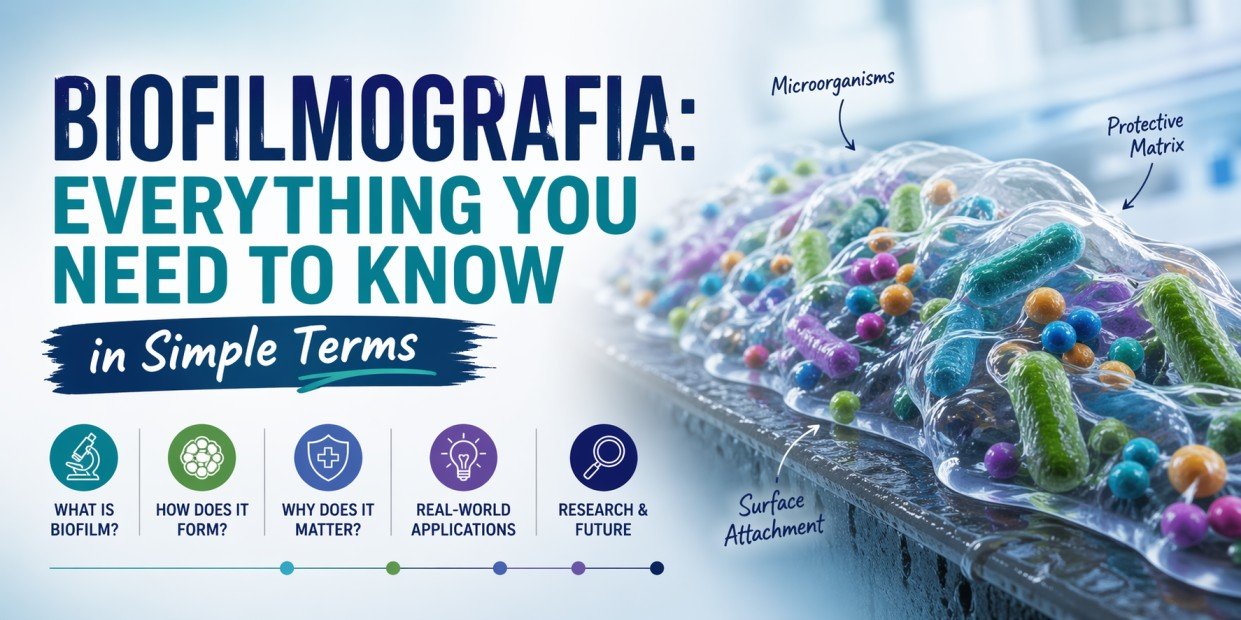
Biofilmografia is the scientific study of how microorganisms—like bacteria and fungi—stop swimming alone and start building organized, resilient “cities” on surfaces. In simple terms, it is the biography and structural map of a biofilm.
While traditional microbiology often studies germs as lonely individuals, biofilmografia looks at the “society” they build. These communities are not random clusters; they are highly engineered structures that help microbes survive everything from bleach to antibiotics.
Table of Contents
Toggle1. What Exactly is Biofilmografia?
The term is a blend of Biofilm (microbial communities) and Grafia (structured writing or study).
-
The Focus: It’s not just about what the bacteria are, but how they are arranged.
-
The “Glue”: Microbes in a biofilm produce a slimy, protective “shield” called an Extracellular Polymeric Substance (EPS). Biofilmografia studies how this shield is built and maintained.
-
The Perspective: It treats microbes as a collective system rather than isolated cells.
2. How These “Micro-Cities” Form
Biofilmografia tracks the lifecycle of these communities in four main stages:
| Stage | What Happens |
| Settling | Free-floating microbes land on a surface (like a tooth, a pipe, or a medical implant). |
| Construction | They begin producing “slime” (the matrix) to anchor themselves permanently. |
| Maturation | The city grows! They build “water channels” to circulate nutrients and move waste out. |
| Expansion | Once the city is full, chunks break off to float away and start new colonies elsewhere. |
3. Why Biofilmografia Matters Today
Understanding these structures is a game-changer for several fields:
Medicine & Health
Most chronic infections are caused by biofilms, not loose bacteria. Because the “city walls” (the matrix) are so thick, antibiotics often can’t get inside. Biofilmografia helps doctors find ways to “break the walls” to treat persistent illnesses.
Industry & Engineering
In factories, biofilms can clog pipes, corrode metal, and contaminate food production lines (known as biofouling). Engineers use biofilmografia to design surfaces that microbes can’t stick to.
Environmental Science
Not all biofilms are “bad guys.” In nature, they help purify water and cycle nutrients in the soil. We use them intentionally in wastewater treatment plants to eat up pollutants.
4. Modern Tools of the Trade
We no longer just look through basic microscopes. Modern biofilmografia uses:
-
3D Imaging: To see the “architecture” of the microbial city.
-
Genetic Sequencing: To hear the “conversations” (chemical signals) microbes use to coordinate.
-
Computational Modeling: Using AI to predict how a biofilm will grow or react to cleaners.
Summary FAQ
What is Biofilmografia?
Biofilmografia is the specialized study of how microorganisms (like bacteria, fungi, and algae) organize themselves into structured, surface-attached communities called biofilms. It focuses on their “biography”—how they grow, build protective shields, and interact as a collective society.
How is a biofilm different from regular bacteria?
Most people think of bacteria as single cells swimming alone (planktonic). A biofilm is different; it is a “micro-city” where thousands of microbes live together under a protective, glue-like layer called the Extracellular Polymeric Substance (EPS). This structure makes them significantly more resilient than individual cells.
Where can I find biofilms in daily life?
They are everywhere! Common examples include:
-
Dental Plaque: The film that forms on your teeth.
-
Slippery Rocks: The “slime” on rocks in a river or pond.
-
Household Grime: The pink or black film in your shower drain or on a kitchen sponge.
-
Medical Devices: Growth on catheters or heart valves.
Why is Biofilmografia important for medicine?
Biofilms are a leading cause of antibiotic resistance. Because the microbial city is protected by a thick “wall” of slime, antibiotics often cannot reach the bacteria inside. Biofilmografia helps scientists understand how to “break into” these structures to treat chronic infections.
What are the stages of biofilm development?
-
Attachment: Microbes land on a surface.
-
Colonization: They start producing the “glue” to stay there.
-
Maturation: They build a complex 3D structure with channels for nutrients.
-
Dispersal: Parts of the biofilm break off to start new colonies elsewhere.
Are all biofilms harmful?
No! While many cause infections or industrial damage (like clogging pipes), many are beneficial. They are used in wastewater treatment to break down pollutants and in agriculture to help plant roots absorb nutrients and stay healthy.
How do scientists study Biofilmografia?
Researchers use advanced tools like Confocal Laser Scanning Microscopy (CLSM) to see 3D structures, genetic sequencing to understand how the microbes communicate, and computer modeling to predict how a biofilm will grow or react to chemicals.
Can we get rid of biofilms?
They are very difficult to remove once fully formed. Ongoing research in Biofilmografia is focused on developing anti-adhesive surfaces (making it too slippery for them to land) and quorum-sensing inhibitors (drugs that stop the microbes from “talking” to each other to build the city).
The Bottom Line
Biofilmografia is the key to managing the microbial world. By understanding how these tiny communities organize, we can better fight infections, protect our environment, and improve industrial efficiency. It is the study of microbial strength through unity.