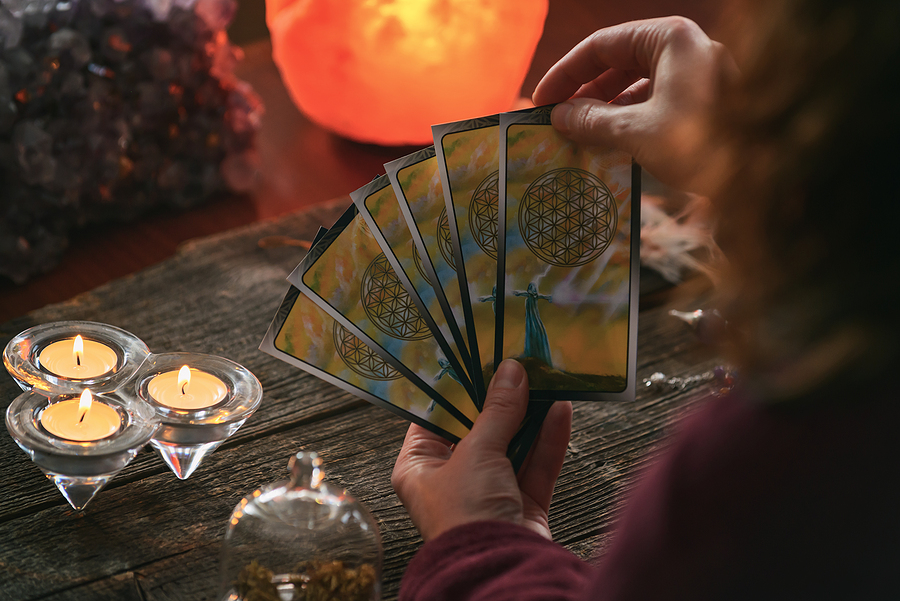
There are moments in life when everything shifts — a job lost, a relationship ended, a move to an unknown city, a decision that rewrites the next decade. These are the moments when people instinctively reach for something deeper than logic. They light a candle, shuffle a deck, and lay the cards out on the table. Not because they believe a piece of painted cardboard holds the future, but because the act of asking forces them to sit still with the question.
Tarot has been used for centuries as a mirror — not a crystal ball. The cards don’t predict the future so much as they illuminate the terrain within. And when life is changing, or when you are on the cusp of a change you can feel but not yet name, certain cards emerge again and again. They carry the weight of transition in their imagery, their symbols, and the traditions built around them.
Here are the six tarot cards most associated with life changes — what they mean, why they appear, and what they are asking you to understand.
Table of Contents
Toggle1. The Tower (Major Arcana XVI)
If there is one card that represents sudden, unavoidable, life-altering change, it is The Tower. The image is vivid and unsettling: a tall stone tower struck by lightning, flames erupting from the windows, two figures falling headlong into the air below. It is not a comfortable card to pull. But discomfort is often where the most honest conversations with ourselves begin.
The Tower appears when a structure in your life — a belief, a relationship, a career, an identity — has been built on an unstable foundation. It doesn’t matter how long you’ve lived in it or how much you’ve invested in its walls. When the lightning comes, it comes fast, and it is rarely polite about timing.
What The Tower is really telling you is that the collapse was already in progress. The lightning doesn’t create the problem — it reveals it. Many people who receive this card in readings recall that they already knew something was wrong. They had felt the cracks for months. The Tower simply names the moment when pretending is no longer an option.
The life change associated with The Tower is almost always one that happens to you rather than one you choose. A sudden breakup. An unexpected termination. A diagnosis that changes everything. The card asks one central question: now that it has fallen, what will you build next — and will you build it better?
There is liberation inside The Tower if you can bear to look. Whatever crumbles was never truly serving you.
2. The Wheel of Fortune (Major Arcana X)
The Wheel of Fortune is a card of cycles, and cycles are perhaps the most honest framework we have for understanding life. The image is rich with symbolism: a great wheel turning in the sky, figures ascending and descending, the letters T-A-R-O arranged on the spokes, four winged creatures representing the fixed signs of the zodiac hovering at each corner — Aquarius, Scorpio, Leo, Taurus. The wheel never stops. It has never stopped.
When this card appears in a reading, it signals that a turning point is either approaching or already underway. Unlike The Tower, which is sharp and sudden, The Wheel of Fortune is about the slow inevitability of change. Seasons turn. Chapters close. What was at the bottom rises. What was at the top descends.
This card is a reminder that no situation — good or bad — is permanent. If you are suffering, the wheel will turn. If you are coasting comfortably, do not become complacent. The Wheel of Fortune asks you to stop fighting the current and instead learn to read it.
In terms of life changes, this card often shows up at the end of long seasons — years of struggle finally giving way to opportunity, or years of stability shifting unexpectedly into uncertainty. It also carries a note of fate: some changes are not fully in your control, and The Wheel invites you to make peace with that. You can adjust your sails. You cannot command the wind.
The deeper spiritual message here is one of trust. The universe operates in patterns larger than any individual life. Surrendering to that — not in defeat but in wisdom — is one of the most powerful things a person can do during a major transition.
3. Death (Major Arcana XIII)
No card is more misunderstood, and perhaps none is more important. Death almost never predicts physical death. What it represents is the death of something — an era, an identity, a way of living that has run its full course.
The imagery of the card is solemn: a skeletal figure in black armor rides a white horse across a landscape. A king lies fallen. A bishop pleads. A young woman has fainted. A child holds flowers and looks on with curiosity rather than fear. In that child is the card’s deepest truth — transformation is only terrifying when we refuse to look at it clearly.
Death is one of the most powerful life-change cards in the entire deck precisely because it does not deal in half measures. It is the end of one thing and, inherently, the beginning of another. You cannot have a sunrise without the night completing itself first.
This card appears when you are being asked — or compelled — to leave something behind entirely. Not to put it on pause. Not to revisit it later. To let it die. The relationship that has become a habit rather than a love. The career that pays the bills but hollows you out. The version of yourself you built to please other people.
Death in tarot is mercy, not cruelty. It arrives when holding on would cost you more than letting go. The life change it announces is final, but it is also clarifying. Once you know something is over, you are free to begin.
4. The Star (Major Arcana XVII)
After rupture comes hope. The Star is one of the most quietly powerful cards in the major arcana, and it tends to appear after periods of great difficulty. A figure kneels at the edge of water, pouring from two vessels — one into the water, one onto the land. Above her, eight stars shine in a clear sky. The largest star is gold. The others are white. There is nothing threatening here. There is only openness.
The Star represents renewal, faith, and the slow return of purpose. In the context of life changes, it is the card that appears once the storm has passed — or just as it is beginning to pass — to remind you that recovery is not only possible, it is already happening.
What makes The Star significant as a change card is its quality of direction. It is the star that sailors navigate by. It doesn’t drag you toward the future; it gives you a fixed point to orient yourself against in the dark. This is the card of people rebuilding after loss, starting over after a life chapter ends, or simply finding their way back to who they were before the world got complicated.
The life change The Star heralds is an inner one as much as an outer one. It is the moment you start to believe again — in yourself, in possibility, in the idea that what comes next might actually be good.
5. The Hanged Man (Major Arcana XII)
Few cards provoke as much discomfort as The Hanged Man, and yet few are as quietly instructive for anyone in the middle of a life transition. A figure hangs by one foot from a living tree, suspended, still, with an expression of perfect peace. His hands are bound behind his back or simply at rest. He is not struggling. He is waiting with complete surrender.
The Hanged Man is the card of the pause — the necessary, often maddening suspension between one chapter of life and the next. It is the period after you’ve left the old thing but before the new thing has revealed itself. The job has been resigned but the new path isn’t clear. The relationship has ended but healing is still underway. The decision has been made but the results are not yet visible.
We live in a culture that pathologizes stillness. Waiting feels like failure. Uncertainty feels like error. But The Hanged Man insists that some transformations cannot be rushed, and that the attempt to force them often delays them further.
What this card asks of you is a specific kind of courage: the courage to do nothing, to trust the process, to allow the in-between to exist without trying to resolve it prematurely. The shift in perspective that the Hanged Man experiences — being literally upside down, seeing the world from a new angle — only becomes possible because he has stopped fighting his position.
In terms of life changes, this card often appears at the exact moment a person needs to hear: you are not stuck. You are gestating.
6. Judgement (Major Arcana XX)
Judgement is the card of the great reckoning — not in a punishing sense, but in the sense of a final accounting that leads to resurrection. The imagery is drawn from Christian eschatology: an angel sounds a trumpet from the clouds, and figures rise from coffins below, their arms outstretched, their faces lifted. It is an image of awakening, of being called.
In a tarot reading, Judgement appears when a person is on the threshold of a profound and permanent shift in identity. Not just a change in circumstances, but a change in who they understand themselves to be. This card announces that something is calling you — a vocation, a truth, a version of yourself you have been too afraid to claim.
The life change associated with Judgement is one of evaluation and commitment. It asks you to look honestly at the life you have been living and decide whether it aligns with who you truly are. It is the card of people who have arrived at a crossroads not by accident but by years of internal work, and who are finally ready to answer the call they’ve been hearing for a long time.
Judgement does not promise an easy path. But it does promise that the path is the right one, and that you have, at long last, the clarity to walk it.
A Final Word on Cards and Change
Tarot does not create change. Life does. But the cards have a way of making the invisible visible — of taking the blur of emotion and uncertainty and shaping it into an image you can look at directly. The six cards explored here — The Tower, The Wheel of Fortune, Death, The Star, The Hanged Man, and Judgement — each map a different quality of transformation.
Some changes are chosen. Some arrive without warning. Some require surrender, and others demand action. What all of them require is presence — the willingness to sit with what is actually happening, rather than what you wish were happening.
The next time one of these cards appears on your table, don’t flinch. Lean in. The card is not the change. But it might be the conversation you needed to have with yourself before you were ready to move through it.