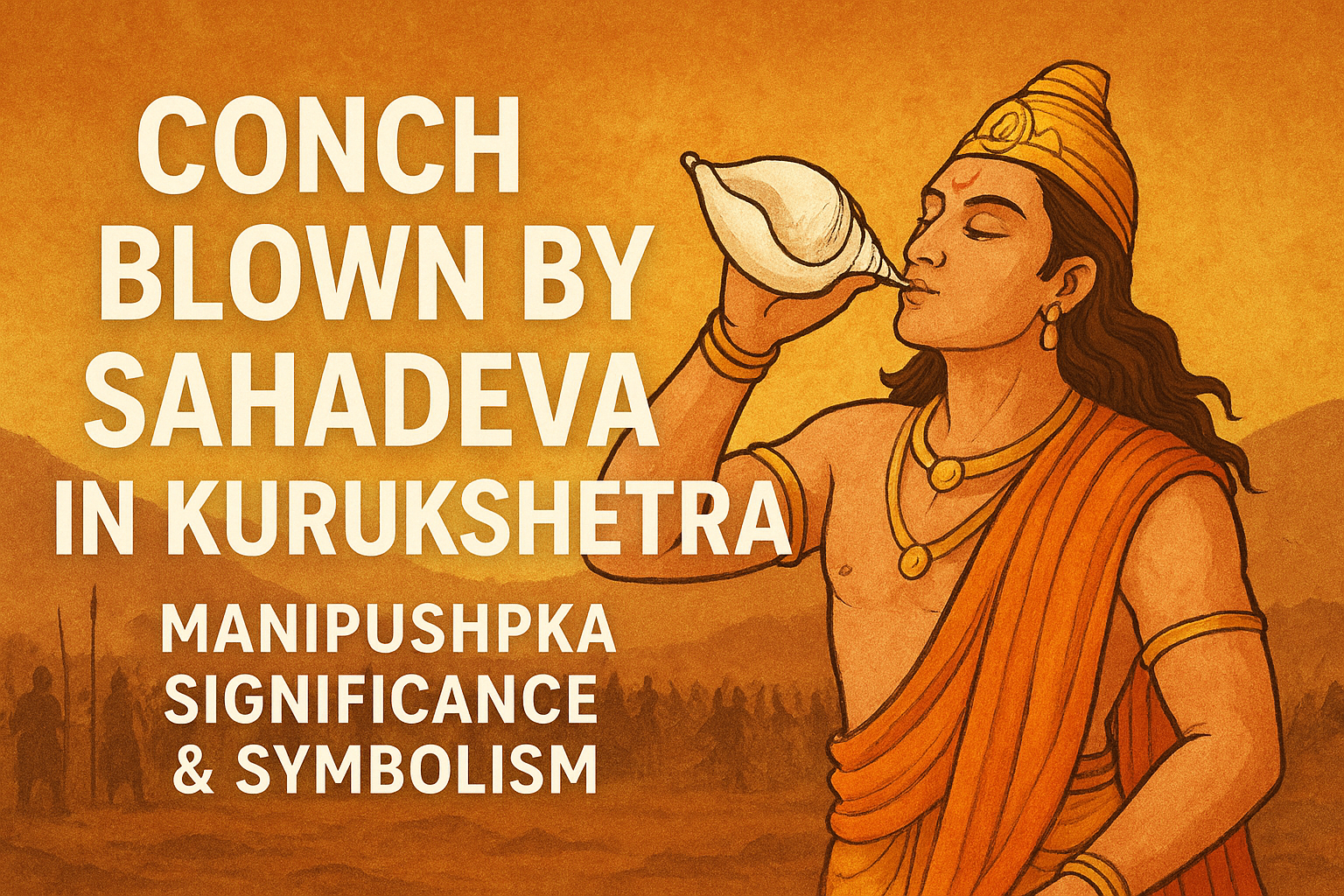
The Kurukshetra battlefield, where the great Mahabharata war took place, is an important part of India’s cultural, religious, and philosophical history. Each warrior entered the combat with his individual weapons, chariots, and most significantly, with conches (shankhas). These conches were more than simply weapons; they stood for strength, divinity, righteousness, and identity.
Sahadeva, the youngest of the five Pandava brothers, also carried a conch that he blew at the opening of the war. This act, although seems simple, had deep meaning and is now a vital part of Mahabharata traditions. In this essay, we will go into great length on the importance of Sahadeva’s conch, its part in the Kurukshetra war, its spiritual meaning, and how it has inspired people for millennia.
Table of Contents
ToggleAn Introduction to Sahadeva
Sahadeva, the youngest of the Pandava brothers, was born to Madri (the second wife of King Pandu) by the blessings of the Ashwini Kumaras (the twin celestial physicians). Sahadeva and his twin brother Nakula were noted for their great intelligence, knowledge of astrology, and loyalty.
People adored Nakula for being the best at sword fighting and taking care of horses, but they respected Sahadeva for being an expert in astrology, sword fighting, and spiritual understanding. Not only was he a strong warrior, but he also had a good sense of how the battle would go in the grand scheme of things.
An Overview of the Conches in the Mahabharata
Bhagavad Gita (Chapter 1) talks about how warriors blew conches before the conflict in Kurukshetra to show that they were ready and to call on divine powers through the sounds of their conches.
Some well-known conches were:
Panchajanya: Krishna’s conch
Devadatta: Arjuna’s conch
Paundra is Bhima’s conch.
The conch of Yudhishthira is called Anantavijaya.
Sughosha is Nakula’s conch.
Manipushpaka is Sahadeva’s conch.
Each conch symbolises the spiritual aura, destiny, and dharmic function of the warrior.
Sahadeva’s Conch: Manipushpaka
Manipushpaka was the name of the conch that Sahadeva blew. The name comes from two Sanskrit words:
Mani (gem) stands for brilliance, clarity, and divine force.
Pushpaka (flower-like) — representing purity, expansion, and blossoming truth.
So, Manipushpaka stood for Sahadeva’s growing insight and heavenly clarity.
When Sahadeva blew his conch at the start of the conflict, it wasn’t just a sound of war; it was a statement of truth, justice, and his willingness to defend dharma (righteousness) against adharma (unrighteousness).
Sahadeva’s conch in Kurukshetra is a symbol of Dharma
Sahadeva’s conch was a sign of his promise to keep dharma. As the youngest Pandava, his dedication and wisdom showed how close the Pandava brothers were.
2. Energy for the spirit
People said that the vibrations of Manipushpaka called on celestial forces that got rid of negativity and gave the Pandava army strength and trust.
3. Astrological Meaning
Sahadeva was a great astrologer who knew how the stars were lined up for the fight. People thought that the time of his conch blow had astrological meaning since it brought celestial powers together in favour of dharma.
4. A sign of strength in silence
Sahadeva was not as violent as Bhima and Arjuna, who were known for their bravery. He was more calm and placid. His conch showed that wisdom, silence, and inner clarity may also be strong.
The Role of Conches in War
The Mahabharata says that as the Pandavas and their friends blew their conches, the sound echoed over Kurukshetra and made the Kaurava army’s hearts shake.
The sound affected both the body and the mind. It made the Pandavas feel better and scared their adversaries.
Sahadeva’s Manipushpaka, while not as well known as Krishna’s or Arjuna’s, added to this great chorus of dharma.
The Philosophical Side
The conch (shankha) is not just a war trumpet in Indian philosophy; it is also linked to creation and the cosmic sound (Om).
The sound of the conch is like the sacred phrase Om, which is thought to be the sound of the universe.
Spiritual enlightenment: Sahadeva was calling for both courage and spiritual enlightenment in the soldiers when he blew his Manipushpaka.
Sahadeva, the astrologer, knew about time (Kala). His conch meant that the time had come for justice to win.
The Story of Sahadeva’s Conch
Sahadeva doesn’t get as much attention in popular retellings as Arjuna or Bhima, yet his part was quite important. People remember his conch as a sign of:
Being humble and wise
Strength and silence together
The mixing of dharma with knowledge of the universe
Today, people who study and follow the Mahabharata see the blowing of Manipushpaka as a reminder that even the smallest voice in the search for truth has eternal power.
Relevance Today
Leadership: Sahadeva shows us that real leaders are wise and humble at the same time.
As the youngest Pandava, he illustrates that even the youngest people can stand up for what is right.
Faith & Devotion: When he blows his conch, it urges his followers to be strong in their faith even when things go tough.
Questions that are often asked (FAQ)
1. What did Sahadeva call his conch?
The name of Sahadeva’s conch was Manipushpaka, which means “like a gem flower.”
2. What was the conch’s role in the Mahabharata war?
The conches represented the proclamation of dharma, summoned divine powers, and exerted psychological influence on the adversarial forces.
3. What did Manipushpaka stand for?
It stood for Sahadeva’s function as a quiet but formidable force in the Pandava army, as well as purity, knowledge, and humility.
4. Was Sahadeva’s conch as strong as Krishna’s Panchajanya?
Each conch had its own special meaning. Panchajanya stood for divine might, whereas Manipushpaka stood for clarity and wisdom.
5. Did Sahadeva’s astrological knowledge influence the war?
Yes, Sahadeva was a skilled astrologer, and it is thought that his expertise helped the Pandavas make smart choices during the war.
6. Why do people talk about Sahadeva less than the other Pandavas?
Sahadeva’s humble attitude, silence, and job as a supporter frequently made him less important in stories, yet his efforts were just as important.
Conclusion
The blowing of Sahadeva’s conch Manipushpaka in Kurukshetra was not a small thing; it was a very important gesture. It stood for the coming together of dharma, knowledge, humility, and spiritual strength. Sahadeva wasn’t as well-known as his brothers, yet he played a strong but quiet role. His conch blast is still heard today as a reminder that truth, no matter how softly uttered, will always be louder than lies.