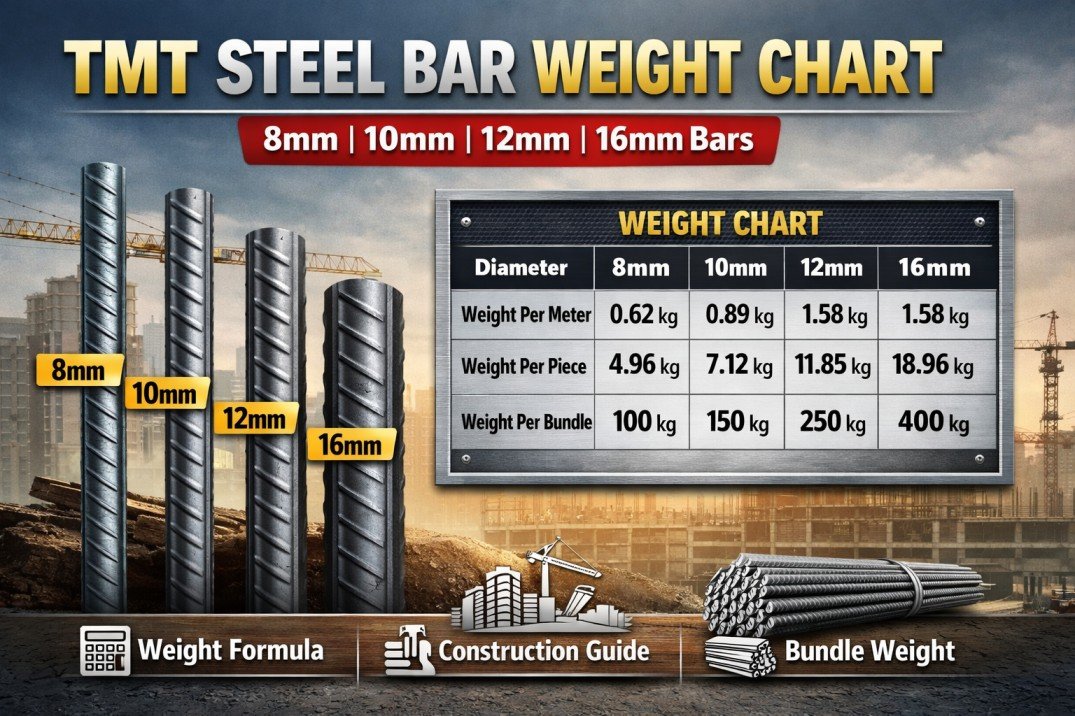
TMT Steel Bar Weight Chart: 8mm, 10mm, 12mm & 16mm Bars
Thermo Mechanically Treated (TMT) bars have become the backbone of modern construction, renowned for their exceptional strength, ductility, and resistance to corrosion. Whether you are a civil engineer, contractor, architect, or a homeowner overseeing a construction project, understanding the weight of TMT bars is crucial for material estimation, structural calculations, and procurement decisions. The steel bar weight chart for popular sizes like 8mm, 10mm, 12mm, and 16mm provides essential insights into these aspects.
This article delivers a comprehensive guide on TMT bar weight calculation, elaborates on the standard weights of various sizes (8mm, 10mm, 12mm, 16mm), explains their importance in construction, and addresses frequently asked questions to help you make informed choices.
What is a TMT Steel Bar?
TMT bars are high-strength reinforcement bars manufactured using a specialized thermo-mechanical process, which makes them highly durable, ductile, and suitable for withstanding high loads and shock. Their ribbed profile ensures a powerful grip with concrete, making them indispensable in modern reinforced concrete structures.
Importance of Bar Weight in Construction
Knowing the weight of TMT bars is vital for:
– Accurate Cost Estimation: Steel is sold per kilogram or metric ton, so knowing the weight helps estimate the total steel required and, therefore, the cost.
– Structural Calculations: Engineers need exact weights for structural integrity analysis, as the steel must support specific loads.
– Transportation & Handling: Knowledge of bar weights facilitates planning for storage, handling, and logistics.
– Quality Assurance: Ensuring the delivered bars match the ordered weight and specification maintains construction quality.
How is TMT Bar Weight Calculated?
The weight of TMT bars is calculated based on their standard density and dimensions. The most commonly used formula for finding the weight of a round steel bar is:
Weight (kg/m) = (D² × 0.006165)
Where D is the diameter of the bar in millimeters.
Explanation of the formula:
– The formula is derived using the density of steel (approximately 7,850 kg/m³) and the cross-sectional area of the bar, considering π/4 × D².
– This calculation gives you the weight of TMT steel bar per meter.
Standard TMT Bar Sizes in India
TMT bars are available in various diameters, commonly ranging from 6mm to 40mm. However, for most residential, commercial, and small-to-medium infrastructure projects, the most widely used sizes are 8mm, 10mm, 12mm, and 16mm.
TMT Steel Bar Weight Chart: 8mm, 10mm, 12mm, and 16mm
Below is a detailed chart showing the standard weight of common TMT bar sizes:
| TMT Bar Diameter | Weight per Meter (kg) | Weight for 1 Length (12 m) (kg) |
|---|---|---|
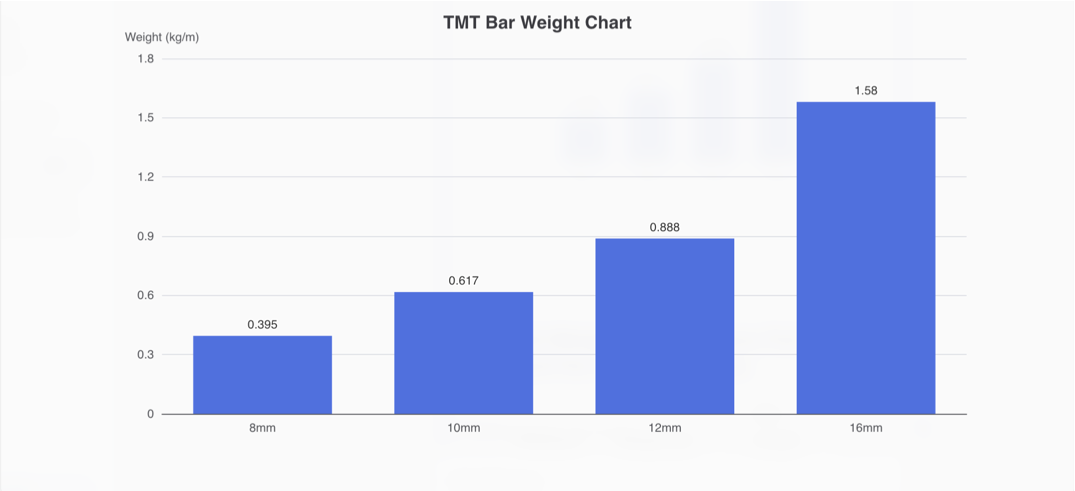
| 8 mm | 0.395 | 4.74 |
| 10 mm | 0.617 | 7.40 |
| 12 mm | 0.888 | 10.65 |
| 16 mm | 1.58 | 18.96 |
Note: The standard commercial length of a TMT bar is 12 meters.
Breakdown of Weight Calculations
– 8mm TMT Bar
– Weight/meter = (8 × 8 × 0.006165) ≈ 0.395 kg
– 10mm TMT Bar
– Weight/meter = (10 × 10 × 0.006165) ≈ 0.617 kg
– 12mm TMT Bar
– Weight/meter = (12 × 12 × 0.006165) ≈ 0.888 kg
– 16mm TMT Bar
– Weight/meter = (16 × 16 × 0.006165) ≈ 1.58 kg
Visual Reference: TMT Bar Weight Chart
Here’s a simple line comparison of weights per meter for these standard sizes:
Unit Weight of Steel Bars: Full Chart for Common Sizes
| Diameter (mm) | Weight per meter (kg) | 12m Length (kg) |
|---|---|---|
| 6 | 0.222 | 2.664 |
| 8 | 0.395 | 4.74 |
| 10 | 0.617 | 7.404 |
| 12 | 0.888 | 10.656 |
| 16 | 1.58 | 18.96 |
| 20 | 2.47 | 29.64 |
| 25 | 3.85 | 46.20 |
| 32 | 6.32 | 75.84 |
| 40 | 9.87 | 118.44 |
Practical Application in Construction
1. Estimation and Billing
For any construction project, one of the first steps is the BOQ (Bill of Quantity)—it specifies how much TMT steel is required. Using the bar weight chart, you can quickly convert running meter measurements into kilograms or metric tons for procurement and cost calculation.
Example:
A slab requires 400 meters of 12mm TMT steel.
Total weight = 400 × 0.888 = 355.2 kg.
2. Structural Safety
The structural engineer’s design is based on load and stress calculations. Choosing the correct diameter and ensuring quality by cross-checking weight against the weight chart maintains safety and integrity.
3. Quality Assurance & Control
If the weight of delivered bars deviates from the standard chart, it may indicate substandard material or a manufacturing defect. Such discrepancies should be addressed immediately to avoid compromised structures.
How to Cross-Verify the Weight of TMT Bars Onsite
Step 1: Measure the length of the bar.
Step 2: Measure the diameter using calipers.
Step 3: Weigh the bar using an accurate scale.
Step 4: Compare the measured weight per meter with the theoretical values from the chart.
Benefits of Using Standard TMT Bar Sizes
1. Uniformity in Structure: Adherence to standard bar sizes ensures the structure’s stability and the proper bonding of steel with concrete.
2. Easier Procurement: Market availability is higher for standard sizes, reducing lead times and costs.
3. Simplifies Engineering Calculations: Standard weights make estimation and design work straightforward.
Grades of TMT Bars
TMT bars are available in grades like Fe-415, Fe-500, Fe-550, Fe-600, etc. The “Fe” stands for iron, and the number indicates the minimum yield strength in N/mm². The grade does not affect the unit weight—only the chemical and mechanical properties.
FAQs
Q1: Why is it important to know the TMT bar’s unit weight?
Knowing the unit weight ensures structural safety, correct billing, cost estimation, and quality control. Weight deviations often point to substandard or counterfeit material.
Q2: Are the weights same for all TMT bars of a given diameter?
Theoretically, yes. In reality, minor deviations happen due to manufacturing tolerances, but IS (Indian Standards) specifications set limits to ensure minimal variation.
Q3: How to calculate the total number of bars required for a specific weight?
First, calculate the weight of one bar (length × weight per meter). Then divide the total required weight by the weight of one bar.
Q4: Does the bar weight chart apply to both twisted (TOR) and TMT bars?
The calculation is based on geometrical dimensions and density; it applies to both. However, TMT is preferred for superior quality and performance.
Q5: What if the procurement length is not 12 meters?
Adjust the weight proportionally. For example, a 10-meter bar of 16mm diameter will weigh:
10 × 1.58 = 15.8 kg.
Q6: What are the main standards governing steel bars in India?
BIS 1786 sets specifications for TMT bar requirements.
Conclusion
The TMT Steel Bar Weight Chart is not just a tabulation; it’s an essential tool for engineers, buyers, and project managers. It enables correct estimation, ensures quality, and facilitates safe, cost-effective, and robust construction. Always cross-check the delivered steel against the standard chart, and only source TMT bars from reputed brands complying with BIS standards.
By mastering the interpretation and application of steel bar weight charts for sizes like 8mm, 10mm, 12mm, and 16mm, you take a significant step towards building structures that stand the test of time—safe, strong, and reliable.
References:
– IS 1786: High Strength Deformed Steel Bars and Wires for Concrete Reinforcement – Specification.
– Indian Standards for Reinforcement Steel.
– Manufacturer catalogs (Tata Tiscon, JSW, SAIL, etc.).